• The move to the new server is done. There are some software and database maintenance updates in process. This has us passing the hat around to help out. We appreciate any donations. Seriously, even a dollar helps. The payment page may be found here - https://www.audiokarma.org/support.html

Sansui SP 2000X mids question

quentello

New Member
Sorry, Header is wrong,, should be SP 2500X
So I have a set of Sansui SP 2500X speakers and wondered if the two 130mm mids are different as is one a squawker and the other a mid range ?
The reason I am asking is one in each box doesnt put out much sound.
I looked at used replacement ones online and they have two different part numbers,, Mids are listed as s-136 and the s-155 as Squawkers but not from the 2500x,,

I know most dislike these speakers but they are not in my main system and I do kinda like them.
My main system I use my Normans , Chapmans and AR`s,, plus I have JBLs, Mac ML-1Cs and others
 
Last edited:
Register to hide this ad
Which speakers are you asking about the SP 2000X in your thread title? if so I can't find any info on that model.

Or are you asking about the Sansui SP 2500X in your post?
 
Awh crap,, fat fingers,,
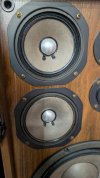
Yes SP 2500X speakers,, I know that some people refer to Midrange as squakers but in both boxes there are two mids but they look different around the foam area,, I have heard mentioned right or wrong that squawkers were higher freq then mids and never looked into if that was true
 
"squawker" and "midrange" are essentially synonymous. Squawker was supposed to be in the same vein as woofer and tweeter, but cooler heads prevailed and midrange is now the preferred descriptor. Squawker does appear to have held on longer on Japanese-made loudspeakers, though.

To answer your initial question, they are (or should be) the same. You can confirm this by unscrewing them from the cabinet; they should both have the same model numbers stamped on the magnets. If not, it's possible that they've been modified. You can also look at the wiring; in most speakers, identical drivers are wired in a series or parallel arrangement directly from the crossover (that is, there are two wires for the two speakers), but there are some exceptions where each driver has its own set of two wires coming from the crossover (so in this hypothetical case with two mids, there would be a total of four wires).
 
"squawker" and "midrange" are essentially synonymous. Squawker was supposed to be in the same vein as woofer and tweeter, but cooler heads prevailed and midrange is now the preferred descriptor. Squawker does appear to have held on longer on Japanese-made loudspeakers, though.

To answer your initial question, they are (or should be) the same. You can confirm this by unscrewing them from the cabinet; they should both have the same model numbers stamped on the magnets. If not, it's possible that they've been modified. You can also look at the wiring; in most speakers, identical drivers are wired in a series or parallel arrangement directly from the crossover (that is, there are two wires for the two speakers), but there are some exceptions where each driver has its own set of two wires coming from the crossover (so in this hypothetical case with two mids, there would be a total of four wires).
Yeah thanks,, I was wondering about that. Haven`t heard that squawker term for a long time,, threw me off,, I will be re-capping these shortly and will check. It`s weird that both the top mids are not putting out any sound,, and the surrounds look different than the lower ones,, that where I thought after seeing the term squawker it might be a low-tweeter or hi-mid ,, Now I am curious as to the part numbers and the difference in surrounds. So I went and pulled them,, top one is Pt # S-134 13.5 ohm, range 1k-4khz, bottom one is pt# S-136 12 ohm range 1K to 10khz
Interesting,,
 

Attachments

  • P 2500X Squawker.jpg
    P 2500X Squawker.jpg
    94.1 KB · Views: 6
Looks like I was wrong; I took a brief look at some other 2500Xs on line and they all looked like they had the same mids (I didn't look closely enough), plus the brochure calls it a 3-way with twin mids. But what you have is completely normal, and that's a bizarre way to build them. I guess that makes them a 3.5 way or a 4 way system (depending on the crossover design). Maybe what's in the brochure was the preproduction model and they changed the design afterwards. The woofer in the brochure is different from the other photos I found online as well.
 
Looks like I was wrong; I took a brief look at some other 2500Xs on line and they all looked like they had the same mids (I didn't look closely enough), plus the brochure calls it a 3-way with twin mids. But what you have is completely normal, and that's a bizarre way to build them. I guess that makes them a 3.5 way or a 4 way system (depending on the crossover design). Maybe what's in the brochure was the preproduction model and they changed the design afterwards. The woofer in the brochure is different from the other photos I found online as well.

Differing driver resonances ...
But it complicates and muddles the output instead of improving it ...
Same as designs with ridiculously complicated crossovers with too many elements ..

Exact opposite of Burhoe design's with only a cap to protect the tweeters and two drivers which were designed to roll off naturally with each other ..
Clear articulate output even at low volumes is the result ..
 
Last edited:
All speaker designs are trade-offs, between simplicity of design, and not using drivers outside their most linear frequency bandwidth.

All drivers have rolloffs, breakup modes, excursion limits, and dispersion characteristics due to diameter. A larger driver will generally have a lower rolloff point on the bottom, but also a lower rolloff point on the highs. Larger drivers will also start to have cone breakup at lower frequencies compared to smaller drivers. Same goes for excursion- a larger driver can move more air at the same excursion, and therefore can play lower frequencies with less distortion.

In addition, a larger driver will start to have directivity issues (beaming, where the sound field starts to shrink from omnidirectional to a "beam", due to cancellation of sound from one side of the driver reaching the other side at a later time, and therefore being out of phase).

Simple as possible is good. It is easy to go simpler than optimal, though. The aforementioned Burhoe modules do a good job, but they're not ideal in all ways- they do have dispersion pattern anomalies near crossover, and problems with driver rolloff and breakup modes as well. I have owned EPI 150s for many years, and though I am a big fan of them- I do hear the anomalies...

Regards,
Gordon.
 
Back
Top Bottom