• Please note that Audiokarma will be offline briefly for updates early on Monday morning, September 28th.

Sansui XL-500

zingzing123

New Member
Picked up a pair of Sansui XL-500s and I’m pretty to new to this vintage speaker stuff so I need some advice.

First off the speakers are missing the mid-tweeters, one completely missing and the other is blown (tested with multimeter). The model of the mid-tweeter is T-192c and there isn’t a remote chance I’m going to find those. How do I pick a proper tweeter replacement? I’m not expecting like a one to one miracle or anything but based on the attached specs there’s so many different tweeters at different prices so how would I go about picking something that would be a good faithful replacement?

Also the speakers are very loud and a lot of bass (as expected) but the sound sounds kinda muddy (maybe proper terminology?). I think this might be because there are no terminals but the midrange sounds kinda weird. I’m thinking this is due to the crossover being old. Tips on caps and stuff for the xl-500?

Also just any information, spec sheets, information on the crossover, and model numbers on all the drivers would be greatly appreciated. I was barely able to find anything.
 

Attachments

  • IMG_5894.jpeg
    IMG_5894.jpeg
    76.1 KB · Views: 11
Register to hide this ad
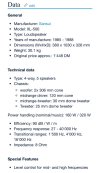
I'm going to assume the reason it sounds muddy is that the mid-tweeter covers most of the sound above 4khz. I think this Dayton tweeter might do the job. The only questionable spec is the sensitivity, which is listed as 89dB for the Dayton, but we don't know what it is for the entire system. If you want to search for something else, you want something with flat frequency response out to at least 16khz (which basically means the supertweeter is going to be all but inaudible) and a resonant frequency (Fs) of ≤2khz. And of course an impedance of 8Ω. If you're going to purchase from Parts Express, they have reasonable prices on electrolytic caps (a lot of members here use Daytons).

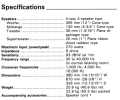
ETA: sensitivity of the speakers is 93dB, so those tweeters I linked above aren't the best solution. But it shouldn't be difficult to find a more sensitive tweeter with appropriate specs. and BTW, the specs from manual of the lower model XL-300 (below), which appears to use the same components, list the tweeter and supertweeter as planars, not domes. Finding a planar tweeter at an appropriate price (I wouldn't put too much money into these) with the required specs may be difficult, though.
1710970881711.png
 
Last edited:
I'm going to assume the reason it sounds muddy is that the mid-tweeter covers most of the sound above 4khz. I think this Dayton tweeter might do the job. The only questionable spec is the sensitivity, which is listed as 89dB for the Dayton, but we don't know what it is for the entire system. If you want to search for something else, you want something with flat frequency response out to at least 16khz (which basically means the supertweeter is going to be all but inaudible) and a resonant frequency (Fs) of ≤2khz. And of course an impedance of 8Ω. If you're going to purchase from Parts Express, they have reasonable prices on electrolytic caps (a lot of members here use Daytons).

ETA: sensitivity of the speakers is 93dB, so those tweeters I linked above aren't the best solution. But it shouldn't be difficult to find a more sensitive tweeter with appropriate specs. and BTW, the specs from manual of the lower model XL-300 (below), which appears to use the same components, list the tweeter and supertweeter as planars, not domes. Finding a planar tweeter at an appropriate price (I wouldn't put too much money into these) with the required specs may be difficult, though.
View attachment 3153636
Thanks a lot I really appreciate it.

Another question I have is the power handling of the replacement tweeter. How would I choose a correct tweeter so I don’t have to worry about burning the driver cause I want to hit the full 300w of the speaker occasionally. Would something like this work? Obviously it would be better if I knew the exact specs on the t-192c driver but they basically don’t exist online.

I’ll probably end up going with those tweeters, I don’t really care too much about faithful reproduction cause I never heard them properly in the first place so titanium domes will do.

Also for crossover points, the tweeter is between 4000-16000. So my tweeter just needs to cover that range? Is that how that works technically?
 
Another question I have is the power handling of the replacement tweeter.
Power handling really doesn't matter. A tweeter actually uses very little power; most of the power is in the low frequencies. Any modern tweeter should be able to the power you're going to give it in this speaker.
Also for crossover points, the tweeter is between 4000-16000. So my tweeter just needs to cover that range? Is that how that works technically?
No. A crossover is not like a wall, it's like a slope. So it doesn't mean that below 4000 hz this driver won't produce any sound; it's a gradual transition from the tweeter from the midrange. The simplest crossover (1st order) transitions at 6dB/Octave (each time you halve the frequency you go down an octave), but it's not unusual to see 12dB/octave or higher. These are decisions made by the engineer that designed the speaker, based on the specs of the driver and the desired performance. That's why I mentioned the resonant frequency; general rule of thumb is that you want a tweeter that has an Fs of at least half the crossover frequency.
 
Power handling really doesn't matter. A tweeter actually uses very little power; most of the power is in the low frequencies. Any modern tweeter should be able to the power you're going to give it in this speaker.

No. A crossover is not like a wall, it's like a slope. So it doesn't mean that below 4000 hz this driver won't produce any sound; it's a gradual transition from the tweeter from the midrange. The simplest crossover (1st order) transitions at 6dB/Octave (each time you halve the frequency you go down an octave), but it's not unusual to see 12dB/octave or higher. These are decisions made by the engineer that designed the speaker, based on the specs of the driver and the desired performance. That's why I mentioned the resonant frequency; general rule of thumb is that you want a tweeter that has an Fs of at least half the crossover frequency.
One more question for ya boss man. How important is it to match the voltage of capacitors. Obviously the capacitance should be the same, but the crossover of the XL-500s use all 50v caps of which there are none on parts express. I checked other forums and they say the voltage just needs to be larger and that it doesn’t really have too much difference if the voltage is different. Thoughts?
 
I checked other forums and they say the voltage just needs to be larger and that it doesn’t really have too much difference if the voltage is different. Thoughts?
That's correct. The voltage rating on capacitors is just a high limit of what it can handle, it doesn't otherwise affect its functionality. You can always go higher, just not lower.
 
Back
Top Bottom