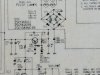
I'm pretty familiar with electronic schematics and recently bought a $10 practice amp to re cap and re transistor. Looking at the schematic I came across a transistor spec I'm not sure how to interpret. I'm attaching it as a pic but it reads with three different Transistors specified as part Q13. Anyone know how to read this? Also, in the same pic you'll notice a cap with a spec of '.' (part C92 and C89 in the schematic) how to interpret that as well as I see it other places in the schematic so I imagine it's not just a mistake.


You are using an out of date browser. It may not display this or other websites correctly.
You should upgrade or use an alternative browser.
You should upgrade or use an alternative browser.
Register to hide this ad

Oilmaster
Sonycus Peritum
For Q13, they (conveniently) specify 3 options and/or they could have used any of those during the fabrication span for this unit.
As for C92/89, I guess it's an asterisk symbol, meaning that they have specifed the actual values elsewhere on the schematic or in the service manual, often as a function to which region it was exported to.
As for C92/89, I guess it's an asterisk symbol, meaning that they have specifed the actual values elsewhere on the schematic or in the service manual, often as a function to which region it was exported to.
Thank you!For Q13, they (conveniently) specify 3 options and/or they could have used any of those during the fabrication span for this unit.
As for C92/89, I guess it's an asterisk symbol, meaning that they have specifed the actual values elsewhere on the schematic or in the service manual, often as a function to which region it was exported to.

ironcoder
Active Member
It looks like the transistor is being used for a voltage regulator. It has an FT of 180mhz. That number is of no consequence for voltage regulation. Looks like about anything with enough current capacity will work. The simplest thing is a TIP42. It has much higher rating for current etc except frequency response. No frequency response necessary for a regulator. You can even get TIP42s at Amazon. If you are a prime member, free shipping. https://www.amazon.com/Pieces-MCIGI...eywords=tip42&qid=1567184374&s=gateway&sr=8-2
8 bucks for a pack of 15. These and the TIP 41C are always good to have around.
8 bucks for a pack of 15. These and the TIP 41C are always good to have around.
It looks like the transistor is being used for a voltage regulator. It has an FT of 180mhz. That number is of no consequence for voltage regulation. Looks like about anything with enough current capacity will work. The simplest thing is a TIP42. It has much higher rating for current etc except frequency response. No frequency response necessary for a regulator. You can even get TIP42s at Amazon. If you are a prime member, free shipping. https://www.amazon.com/Pieces-MCIGI...eywords=tip42&qid=1567184374&s=gateway&sr=8-2
8 bucks for a pack of 15. These and the TIP 41C are always good to have around.
True with the TIP42, but I wouldn't buy those Chinese fakes.


Before people go down the rabbit hole - TIP42 is PNP while the regulator is NPN. So TIP41 is okay here, not TIP42.
Also, often * means there is something specific about that part, which is usually in the parts list (like flame proof resistors, or certain capacitor types.). Or could be a note in the schematic ....
Also, often * means there is something specific about that part, which is usually in the parts list (like flame proof resistors, or certain capacitor types.). Or could be a note in the schematic ....
Before people go down the rabbit hole - TIP42 is PNP while the regulator is NPN. So TIP41 is okay here, not TIP42.
Also, often * means there is something specific about that part, which is usually in the parts list (like flame proof resistors, or certain capacitor types.). Or could be a note in the schematic ....
Good catch!
ironcoder
Active Member
Yes, the fake transistors have become a nightmare for those of us who try to use them. How do you differentiate? I saw a youtube on fake 2N3055s. You have to take a dremel or something like it to cut off the metal cap. You can then look inside and tell if it is fake. I just bought 20 of them and cut a top off and luckily found that they were real 2N3055s. Sacrificing one of 20 to insure they are real is well worth it.True with the TIP42, but I wouldn't buy those Chinese fakes.
Yes, the fake transistors have become a nightmare for those of us who try to use them. How do you differentiate? I saw a youtube on fake 2N3055s. You have to take a dremel or something like it to cut off the metal cap. You can then look inside and tell if it is fake. I just bought 20 of them and cut a top off and luckily found that they were real 2N3055s. Sacrificing one of 20 to insure they are real is well worth it.
I buy transistors from reputable sources. Amazon is not one of them.
 At least on FleaBay, you can easily check a seller's feedback to see if anyone got fakes from them. The TO-3 transistor cap doesn't really have a function other than to protect the die. If you didn't damage it, the transistor can still be used, and even bond the cap back on. I would use it in my own equipment and not think twice. The fake TO-3 caps are easily knocked off without needing to cut it. I'm sure the Chinese are reading the feedback and coming up with ways to make things look more "authentic".
 One "key" is if a transistor is long obsolete and out of production, and the photo is of a brand new "shiny" transistor, you can bet it's a fake.
ironcoder
Active Member
Before people go down the rabbit hole - TIP42 is PNP while the regulator is NPN. So TIP41 is okay here, not TIP42.
Also, often * means there is something specific about that part, which is usually in the parts list (like flame proof resistors, or certain capacitor types.). Or could be a note in the schematic ....
Sorry about missing the direction of the arrow. I keep a large stock of TIP41Cs and TIP42Cs around to fix a lot of things. I am old and am missing some details a bit more often. sigh......
I buy transistors from reputable sources. Amazon is not one of them.
One "key" is if a transistor is long obsolete and out of production, and the photo is of a brand new "shiny" transistor, you can bet it's a fake.
I think you are right about this Skywatcher. The cap I took off did not come off easily. I would not have wanted to use it because of the small fragile wires showing on the top. As you know some TO3s are mounted on the rear panel. You just could not have trusted this not to get bumped. I just threw it away. I think you gave good advice there about sourcing your transistors. Amazon is a likely spot for fakes. They are already being sued for selling pirated copies of movies. Ebay does often have a lot of feedback to study. I don't buy anything from them if the feedback quality is poor or there is very little feedback. I will buy the rest of my transistors from them. Good call. I have used the TIP series for a lot of audio applications. I have even put them in TO3 sockets when I had nothing else. I have replaced TO92 transistors that had a little extra need for power and dissipation that a 2N2222 would not easily handle as the TIP's. They work fine. They are of course overkill but I have needed 1/2 watt of dissipation and put in a 2N2222. It just ran too warm for my liking. The circuit worked fine with a TIP substitute. Overkill does not seem to matter. This overkill is easily done considering the price of 25 TIP41Cs or 42s. I have an old transistor checker I built from Heathkit. I still really like this tester. I can check the HFE of transistors at different current levels. The TIPs HFE falls off above 2 amps. If you use this transistor to replace a simple audio signal transistor in a circuit, you still have a very high HFE at say 100 ma. I do repair work in a small town on stereos, VHF and HF transceivers and specialty equipment for some businesses in town. I do stereo repair at cost of parts. We are a pretty economically depressed area and I love to be able to restore a couple's sound equipment for them when they are living on social security. If they are really poor, I pay for the parts myself. I have someone driving from out of town next week to have me fix their beloved old stereo equipment. They will stay overnight with a relative and I get to chat with the owner while I work on it. It is a hobby. I have enough retirement income to do this and people who need it really love a price of free. I have even worked on old table radios that had sentimental value to the owners.