


m80116
New Member
Hello, I've recently restored a Scott 670D. I had this one in my inventory for a while and I finally decided to give it a go since I felt it wasn't a unit I wanted to keep... also another thread where somebody was asking about the idler sizes gave me some motivation to address this beast. I have other hefty machines from the 70s like a Technics RS-676US, a SONY TC-206SD, a BIC T-2 dual speed, a Technics RS-630U, an AIWA AD-6500 with slanted auto loading mechanism... you can see where I am going.
So H.H. Scott 670D I believe this is a unit that deserves to live. Manual activated all-metal transport, big flywheel solidly build like most decks from the 70s, none of the electrolytic capacitors have leaked and it gives you the tingly eyes when you lean over it. If proof is in the pudding no components have shifted in value significantly as it sounded almost spot on from the get go, well... 45+ years after it was made but first I had to fight with it for way too many hours as it is a rascal... pointy solder joints, sharp edges, labyrinth accessible screws and 3D puzzle parts that put your brain through its paces, also the cables going to the transport are of the exact length to reach it, it's unbelievable how they managed to assemble this thing because you can't solder the wires in place from the top but you cannot also swing the deck out significantly with them on... it's like if somebody held the deck a few centimeters above its final resting place and soldered the wires both ends, what a joy...
New extended wires soldered in - Greased rear mechanism

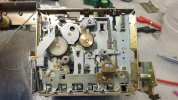
Did I mention the sticky goo idlers? Probably some artificially produced rubber that has smeared all over the flywheel and flew in many other places around. It took me a while to de-contaminate the deck and also to source some rings as the size it's surely not written in the service manual that still costs in PDF format more than I got the the whole unit for. I wouldn't be surprised if somebody threw this thing in the trash, much like the guy disassembling an MD-3 transport from AIWA which I also repaired, disassembled and reassembled several times. But this is harder still as it's a conundrum to remove parts that in other decks are easily out with a couple of screws, here you need to tear practically all of the unit apart. It's almost like the Japanese wanted to play a trick on their American clients or they didn't really give much thought about the unit being assembled, disassembled and serviced. I had to deal with this kind of construction till the end including extending all the wires that go to the deck. At least I appreciated the butterfly (air dampened) opening of the deck that with some adjustment and lubrication of the pulleys now behaves so smoothly.
Supply reel grease refill - Checking of the tape path
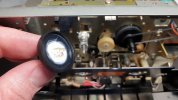
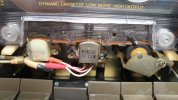
When I came to tuning this unit silly me I was still ahead of the actual job as the tape spilled after the pinch roller, there wasn't enough back tension... so in the end one Jeez clip lost and found again I was able to restore tension with some heavy duty lithium grease inside the supply reel hub, clearly these folks had never seen a SONY TC-K61 (same age as this) which has a slipping pad with adjustable tension. Finally I was able to verify the speed was 3.21 kHz on a 3.15 kHz tone which is sweet, it makes you realize you've done a proper job cleaning, greasing and lubricating the transport. Also the unit is on the original pinch roller which had a good scrub and rubber treatment and it is again as tacky as a cat's tongue, the marvel of natural rubber. In the end I probably serviced the unit better than it was ever serviced from the factory when new as the rear capstan bushing was dry, some metal to metal contact places lacked grease completely and I don't believe anybody touched the motor pot as much as I needed to turn it down. It's got less friction now than it ever did 50 years ago, also the cassette light that I've added powered from the same place the motor takes power from, unswitched (unlike the motor) so it's lit at all times as long as the deck is powered on, now acts as a bleeding resistor for some fairly large cap as it takes several seconds for the light to fade away at power off.
Clean unit before enclosure - Photshoot for the sale
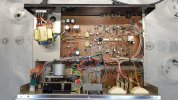
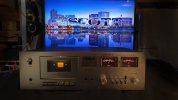
So how's the sound you may ask? Lovely I might say... there is something in these vintage decks that have a frequency response to 15,000 kHz on ferric that makes them sound nice. They lack the extension in the lows like most modern decks, they surely have other sonic limitations yet they sound natural and smooth... the wow and flutter is consistently low thanks to the huge metal flywheel, the FR response is biased in the highs like all the decks of this age, I then increased the (BIAS) current to tame the sound a bit and make the highs slightly brighter than source on a TDK D (factory tuning is way brighter on a TDK D). In these machines adjusting the BIAS at -20 dB is a mere academic exercise to set a base level as they always need to be brighter otherwise you end up losing the upper end. I'd say it has a vacuum tube amplifier kind of sound, and pretty much (almost) as good as it gets from the 70s.
LED cassette well light - A cassette lit by bounced light
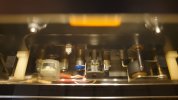
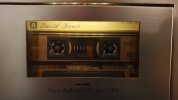
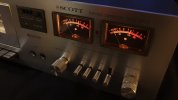
I am now imagining this machine already placed in a Hi-Fi stack, with the backlit VU meters dancing and the reels turning lit by the warm and diffused light of the newly installed LEDs (not your usual 3000°K jobie). I believe that can be a tasteful finishing touch in a vintage Hi-Fi or even as a furniture fill up. I am pleased yet a bit envious as it's now clean, good sounding, good looking with quality details like the aluminium machined knobs (mind you they're empty) and I know I have to part with it. After all I have better machines to run... it's just that they're all broken as I never find time to fix my own decks.
User friendly fuse and voltage selector - Incandescent bulb lit meters and machined knobs
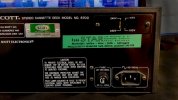
So... do you like 70s decks? Have you ever used a 670D? I believe these machines can still accompany us for a very long time...
So H.H. Scott 670D I believe this is a unit that deserves to live. Manual activated all-metal transport, big flywheel solidly build like most decks from the 70s, none of the electrolytic capacitors have leaked and it gives you the tingly eyes when you lean over it. If proof is in the pudding no components have shifted in value significantly as it sounded almost spot on from the get go, well... 45+ years after it was made but first I had to fight with it for way too many hours as it is a rascal... pointy solder joints, sharp edges, labyrinth accessible screws and 3D puzzle parts that put your brain through its paces, also the cables going to the transport are of the exact length to reach it, it's unbelievable how they managed to assemble this thing because you can't solder the wires in place from the top but you cannot also swing the deck out significantly with them on... it's like if somebody held the deck a few centimeters above its final resting place and soldered the wires both ends, what a joy...
New extended wires soldered in - Greased rear mechanism
Did I mention the sticky goo idlers? Probably some artificially produced rubber that has smeared all over the flywheel and flew in many other places around. It took me a while to de-contaminate the deck and also to source some rings as the size it's surely not written in the service manual that still costs in PDF format more than I got the the whole unit for. I wouldn't be surprised if somebody threw this thing in the trash, much like the guy disassembling an MD-3 transport from AIWA which I also repaired, disassembled and reassembled several times. But this is harder still as it's a conundrum to remove parts that in other decks are easily out with a couple of screws, here you need to tear practically all of the unit apart. It's almost like the Japanese wanted to play a trick on their American clients or they didn't really give much thought about the unit being assembled, disassembled and serviced. I had to deal with this kind of construction till the end including extending all the wires that go to the deck. At least I appreciated the butterfly (air dampened) opening of the deck that with some adjustment and lubrication of the pulleys now behaves so smoothly.
Supply reel grease refill - Checking of the tape path
When I came to tuning this unit silly me I was still ahead of the actual job as the tape spilled after the pinch roller, there wasn't enough back tension... so in the end one Jeez clip lost and found again I was able to restore tension with some heavy duty lithium grease inside the supply reel hub, clearly these folks had never seen a SONY TC-K61 (same age as this) which has a slipping pad with adjustable tension. Finally I was able to verify the speed was 3.21 kHz on a 3.15 kHz tone which is sweet, it makes you realize you've done a proper job cleaning, greasing and lubricating the transport. Also the unit is on the original pinch roller which had a good scrub and rubber treatment and it is again as tacky as a cat's tongue, the marvel of natural rubber. In the end I probably serviced the unit better than it was ever serviced from the factory when new as the rear capstan bushing was dry, some metal to metal contact places lacked grease completely and I don't believe anybody touched the motor pot as much as I needed to turn it down. It's got less friction now than it ever did 50 years ago, also the cassette light that I've added powered from the same place the motor takes power from, unswitched (unlike the motor) so it's lit at all times as long as the deck is powered on, now acts as a bleeding resistor for some fairly large cap as it takes several seconds for the light to fade away at power off.
Clean unit before enclosure - Photshoot for the sale
So how's the sound you may ask? Lovely I might say... there is something in these vintage decks that have a frequency response to 15,000 kHz on ferric that makes them sound nice. They lack the extension in the lows like most modern decks, they surely have other sonic limitations yet they sound natural and smooth... the wow and flutter is consistently low thanks to the huge metal flywheel, the FR response is biased in the highs like all the decks of this age, I then increased the (BIAS) current to tame the sound a bit and make the highs slightly brighter than source on a TDK D (factory tuning is way brighter on a TDK D). In these machines adjusting the BIAS at -20 dB is a mere academic exercise to set a base level as they always need to be brighter otherwise you end up losing the upper end. I'd say it has a vacuum tube amplifier kind of sound, and pretty much (almost) as good as it gets from the 70s.
LED cassette well light - A cassette lit by bounced light
I am now imagining this machine already placed in a Hi-Fi stack, with the backlit VU meters dancing and the reels turning lit by the warm and diffused light of the newly installed LEDs (not your usual 3000°K jobie). I believe that can be a tasteful finishing touch in a vintage Hi-Fi or even as a furniture fill up. I am pleased yet a bit envious as it's now clean, good sounding, good looking with quality details like the aluminium machined knobs (mind you they're empty) and I know I have to part with it. After all I have better machines to run... it's just that they're all broken as I never find time to fix my own decks.
User friendly fuse and voltage selector - Incandescent bulb lit meters and machined knobs
So... do you like 70s decks? Have you ever used a 670D? I believe these machines can still accompany us for a very long time...
Last edited: