

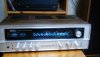
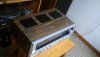
Hello, all. I know this model has been touched on before in previous threads, but thought I'd chime in with my own personal experience with it. I saw this listed on the big online auction site as "1970s Fisher 143-92551660 receiver. Works, left side static , parts or repair". By doing some research here on AK, I determined to my satisfaction that this was a RS1058. One thing that also convinced me of this is that the line current draw listed on the back of the Sears is 550 watts. By looking at online pictures of the RS1058, it can be seen that current draw is stated as 500 watts. Hifi Engine lists the rated output of the RS1058 as 90 watts per channel at 8 ohms. There didn't seem to be much interest in the unit as the bid was set at $35 and there were no bids. The receiver looked kind of forlorn because it was shown with a dark dial, no markings visible. It turned out, as I had figured, that was because all the dial lamps were burnt out. I made an offer $5 above starting bid and won it. Cost $75 all told with shipping and taxes.
Further proof this was indeed a RS1058 came when I was able to use the RS1058 schematic to troubleshoot. The circuits, at least on the power amp board matched perfectly. Besides the problems mentioned, I discovered it also had dc voltage on the speaker terminals around 300mv. There was a lot, and I mean a lot!, of flux all over the power amp board. I don't know if this was an assembly error or if that was common, but it sure looked like this flux had become conductive around some of the small transistors between the differential amplifiers and the driver transistors. Scraped that off. Eventually I found that in each channel, a small transistor directly downstream from the differential amplifiers was defective and causing the high dc at speaker terminals as well as some audible distortion. These were Q7 and Q8. They did not appear defective using the diode test in-circuit. But when I pulled them out the Peak Atlas analyser showed hfe in single digits. I replaced them with ksc 2383 transistors which showed much higher gain, around 200 as I recall. This replacement brought dc at speaker terminals down below 10 mv., and distortion was gone. (Edit: Looks as though I should have used ksc 2690 as a replacement, as it has a max collector dissipation closer to the original, listed on the schematic as 2sd600. Noticed this when double-checking for errors. Lesson to myself: Doublecheck before posting. Well, it has worked fine with long playing times, so maybe the collector dissapation isn't critical in this application. But I will change them out nonetheless.)Also checked and adjusted idle current. Then I replaced the dial lights with led's.
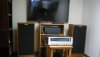
I made this purchase a couple of months ago before the coronavirus situation and, unfortunately, won't be looking again anytime soon. But for now, I'm really enjoying listening to this receiver. I think it has it's own individual sound compared to my other gear. For lack of a better term it seems to me to have a "sweet" sound. Classical music, such as violin, cello, and piano concertos really come alive. This may be one of those overlooked gems that has been neglected simply because of its association with the Sears brand.
Further proof this was indeed a RS1058 came when I was able to use the RS1058 schematic to troubleshoot. The circuits, at least on the power amp board matched perfectly. Besides the problems mentioned, I discovered it also had dc voltage on the speaker terminals around 300mv. There was a lot, and I mean a lot!, of flux all over the power amp board. I don't know if this was an assembly error or if that was common, but it sure looked like this flux had become conductive around some of the small transistors between the differential amplifiers and the driver transistors. Scraped that off. Eventually I found that in each channel, a small transistor directly downstream from the differential amplifiers was defective and causing the high dc at speaker terminals as well as some audible distortion. These were Q7 and Q8. They did not appear defective using the diode test in-circuit. But when I pulled them out the Peak Atlas analyser showed hfe in single digits. I replaced them with ksc 2383 transistors which showed much higher gain, around 200 as I recall. This replacement brought dc at speaker terminals down below 10 mv., and distortion was gone. (Edit: Looks as though I should have used ksc 2690 as a replacement, as it has a max collector dissipation closer to the original, listed on the schematic as 2sd600. Noticed this when double-checking for errors. Lesson to myself: Doublecheck before posting. Well, it has worked fine with long playing times, so maybe the collector dissapation isn't critical in this application. But I will change them out nonetheless.)Also checked and adjusted idle current. Then I replaced the dial lights with led's.
I made this purchase a couple of months ago before the coronavirus situation and, unfortunately, won't be looking again anytime soon. But for now, I'm really enjoying listening to this receiver. I think it has it's own individual sound compared to my other gear. For lack of a better term it seems to me to have a "sweet" sound. Classical music, such as violin, cello, and piano concertos really come alive. This may be one of those overlooked gems that has been neglected simply because of its association with the Sears brand.
Attachments
Last edited:


