


M Jarve
Audio Geek and NGE Freak
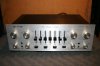
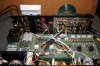
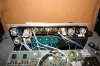
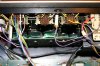
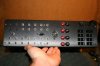
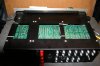
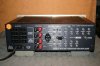
I posted an inside and out pictorial of the SAE mark IB preamplifier before, but after the server crash (AK’s or my own; I haven’t figured that out yet), the pictures disappeared into the ether of cyberspace. In any event, I recently acquired another one of these lovely vintage preamps, sans wood cabinet, and I thought that since I had to peak in there anyways, I may as well put up new pics.
The mark IB was SAE’s top preamp for the Mark series, and at $825 in 1973 (or $3,642.70 in today’s dollars), was one of the more expensive pre-amps available at the time, edging out even the McIntosh C28, a contemporary of the mk IB.
SAE designed in a couple of interesting features into the mk IB.
-First, the chassis and enclosure were made entirely out of non-magnetic, non-resonant anodized aluminum. It would take the 1980’s and 1990’s before the rest of the world discovered the virtues of this material in audio gear. A more practical side effect of this was greatly reduced weight (and shipping cost) compared to a stamped or folded sheet-steel enclosure. Still, the mk IB weighed in at a substantial 20-lbs.
-Second, the mk IB never really turned off as long as it was plugged into an active electrical circuit. Instead of powering off, the unit would keep an idling current of approximately 1/2 B+ voltage in order to eliminate turn-on thumps and to help keep capacitors well formed (important for long capacitor life). It also had the advantage of keeping all the components at a relatively constant temperature, which helped to reduce thermal fatigue.
-Finally, SAE used a “no expense spared” philosophy when it came to component selection and construction. Myself, and others, have noted that the controls feel very firm and positive with absolutely no play. Even the long-throw sliders for the EQ feel exceptionally smooth and have no binding problems. The PCB’s are military grade glass-epoxy made in-house by SAE under very tight control. Mylar and tantalum caps abound, and the fixed resistor volume control was guaranteed to track within +/- 0.1%, which was very good at the time. Other evidence of its exceptional build quality can be found in its ceramic base rotary switches and the toroidal inductors used in the EQ filters. Further, the power supply is well regulated and filtered. RCA and Motorola transistors were used throughout, when such a thing still meant something.
The sound of the mk IB can be as tame and flat as you wish, or you can customize it to suit with its built-in 7-band equalizer, which can provide up to +/- 8 or 16dB of boost or cut, or it can be bypassed all together to maintain signal purity.
The noise floor is also so low that, under almost all listening conditions, no background hiss can be heard.
These are a gem of a pre-amp, as those who have them know. Also, they are one of the more “sleeper” products out there, still costing less than a car-payment on ebay for units in fine shape.
This unit is stock, except a new double insulated power cord and new feet (the old ones were unevenly worn).
The mark IB was SAE’s top preamp for the Mark series, and at $825 in 1973 (or $3,642.70 in today’s dollars), was one of the more expensive pre-amps available at the time, edging out even the McIntosh C28, a contemporary of the mk IB.
SAE designed in a couple of interesting features into the mk IB.
-First, the chassis and enclosure were made entirely out of non-magnetic, non-resonant anodized aluminum. It would take the 1980’s and 1990’s before the rest of the world discovered the virtues of this material in audio gear. A more practical side effect of this was greatly reduced weight (and shipping cost) compared to a stamped or folded sheet-steel enclosure. Still, the mk IB weighed in at a substantial 20-lbs.
-Second, the mk IB never really turned off as long as it was plugged into an active electrical circuit. Instead of powering off, the unit would keep an idling current of approximately 1/2 B+ voltage in order to eliminate turn-on thumps and to help keep capacitors well formed (important for long capacitor life). It also had the advantage of keeping all the components at a relatively constant temperature, which helped to reduce thermal fatigue.
-Finally, SAE used a “no expense spared” philosophy when it came to component selection and construction. Myself, and others, have noted that the controls feel very firm and positive with absolutely no play. Even the long-throw sliders for the EQ feel exceptionally smooth and have no binding problems. The PCB’s are military grade glass-epoxy made in-house by SAE under very tight control. Mylar and tantalum caps abound, and the fixed resistor volume control was guaranteed to track within +/- 0.1%, which was very good at the time. Other evidence of its exceptional build quality can be found in its ceramic base rotary switches and the toroidal inductors used in the EQ filters. Further, the power supply is well regulated and filtered. RCA and Motorola transistors were used throughout, when such a thing still meant something.
The sound of the mk IB can be as tame and flat as you wish, or you can customize it to suit with its built-in 7-band equalizer, which can provide up to +/- 8 or 16dB of boost or cut, or it can be bypassed all together to maintain signal purity.
The noise floor is also so low that, under almost all listening conditions, no background hiss can be heard.
These are a gem of a pre-amp, as those who have them know. Also, they are one of the more “sleeper” products out there, still costing less than a car-payment on ebay for units in fine shape.
This unit is stock, except a new double insulated power cord and new feet (the old ones were unevenly worn).
Attachments
Last edited:


