• The move to the new server is done. There are some software and database maintenance updates in process. This has us passing the hat around to help out. We appreciate any donations. Seriously, even a dollar helps. The payment page may be found here - https://www.audiokarma.org/support.html

Sherwood S-7100A Receiver

I usually use film caps below 3.3 uF, at that value I have gone either way (electrolytic or film) depending on my budget, mood, and view of the model. By the time you get to 3.3 uF they get expensive and also will they fit in the spot of cap they are replacing. Small caps like tantalum or solid aluminum seem to develop high esr (equivalent series resistance) as they age which should throw the circuit off. Have used the WIMA MKS2 (popular choice) but more often go with the Kemet R82 if you watch part # can get them with long leads. If cut tape (not common) the WIMA have long legs, if not like some Kemet they will only have 5 mm long legs. Supposed to be more stable long term than electrolytics.

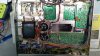
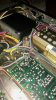
Here are pictures of the S-7200 interior layout. The transistors are on the back panel under a cover. Two resistors in the power supply circuit tended to run in the 250-270 F range when running, replaced them with 25 W chassis fuses thermal pasted to a metal plate (for joining joists found at the local HD). The new resistors and plate (works as heat sink) stay about 140 F so it no longer smells like something was burning if it is on for a while. The old resistors would cause an area of the wooden top to get really hot, only gets mildly warm now.
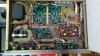
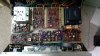
Bottom view.jpg top view.jpg power resistor mod.jpg
 
The really big cap should be the filter cap. Sherwood had the filter caps tucked on the bottom side of the receiver. Cap coupled amps have one sided power supplies, just the +ve side. The two identical large caps clamped together should the output caps, they basically take out a large dc offset so that a +/- signal goes to the speakers. If an output transistor shorts, the caps should keep a woofer from getting fried. Direct coupled amps like the S-7200 that use fuses and not protection relays can potentially fry woofers in that situation. The fuses are supposed to protect the woofers, but apparently at times the woofer voice coil expires before the fuse does. Many early solid state designs were cap coupled, but the design faded out in the early 70s as direct coupled designs took over the market.

If you did not find the S-7200 review at select45rpm it was on this page. It is listed as 1971 between the Sansui 5000X and the Sony models. Scroll to the bottom of the page then step back up, the review is above the 1971 Sony models.

http://select45rpm.com/pages/hifi/vintage-hifi-reviews.html

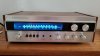
Picked up another fix or repair about two weeks ago. Like the 3000A had long been curious about this model. The dismembered picture is on my work table, other picture was from the ad. Tuner works well (fed signal to 3000A out tape monitor and 4-channel out) but very low level signal out of amp. Some sleuthing so far indicates the signal path dies somewhere in the tone control board. Will be pulling some components to check this weekend. Parts order from Mouser should arrive today. Until that is solved won't know how the amp circuit is, at least the relay clicks and dc offset is low. Looking to get this Chicago built S-8900A singing again. Curious about the Dynaquad circuit, part of the 4-channel fad of the 70s. I think it and the 7900A were the last ones built in the US. S-8900A is FM only, 7900A FM-AM. Tuner dial bulbs did not survive shipping, but they were #53 mini bayonet incandescent that most of the local Advance auto parts stores carry according to their website. Not out on the hooks had to ask and they were behind the counter. Apparently an old automotive bulb and easy to replace. Knobs are dark, either very dirty aluminum or could be tarnished bright brass. It should clean up nicely if I succeed in getting its electronic problems solved.
View attachment 1412921 View attachment 1412922

That S-8900A is supposed to be the bee's knees, the cat's meow, a ringer and a singer---let us know how it sounds when you get it going again. I was hooked when I saw some random pics of its guts---anything executed with that level of care couldn't possibly sound bad.

Thank you for the clarification on the caps I replaced. I feel like a surgeon asking whether he replaced someone's kidneys or their spleen.

Ah, there's that Sherwood S-7200 review. Thank you! He makes many interesting observations, doesn't he? (I'm assuming he is a he and not a she; probably shouldn't be doing that).
 
Last edited:
I usually use film caps below 3.3 uF, at that value I have gone either way (electrolytic or film) depending on my budget, mood, and view of the model. By the time you get to 3.3 uF they get expensive and also will they fit in the spot of cap they are replacing. Small caps like tantalum or solid aluminum seem to develop high esr (equivalent series resistance) as they age which should throw the circuit off. Have used the WIMA MKS2 (popular choice) but more often go with the Kemet R82 if you watch part # can get them with long leads. If cut tape (not common) the WIMA have long legs, if not like some Kemet they will only have 5 mm long legs. Supposed to be more stable long term than electrolytics.

Here are pictures of the S-7200 interior layout. The transistors are on the back panel under a cover. Two resistors in the power supply circuit tended to run in the 250-270 F range when running, replaced them with 25 W chassis fuses thermal pasted to a metal plate (for joining joists found at the local HD). The new resistors and plate (works as heat sink) stay about 140 F so it no longer smells like something was burning if it is on for a while. The old resistors would cause an area of the wooden top to get really hot, only gets mildly warm now.
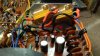
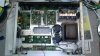
View attachment 1412978 View attachment 1412979 View attachment 1412980

Wow, really nice work in there, especially the metal plate mod! Beautiful work, in fact. And a very good upgrade; if it was making the darned wooden case hot that had to be addressed (if you know what you are doing, and I do not). I always toy with the idea of fitting in a tiny computer fan to cool things off, but you solved the problem at the source! Good on you, man!
 
I have the S-8900A playing again stripped (no top or bottom case, no knobs or face plate) tuned to my favorite FM station. Main problems were dirty/tarnished controls and switches and bad contacts in the relay (had turned black). Can still get the Potter and Brumfield relay, now part of Tyco Electronics. Not cheap at $25 from Digikey but they had 33 in stock, Mouser only 2. Digikey also has a good selection of vintage bulbs, including the ones used in this one (#53 and #756). The conditions it had obviously been stored were not good so I went ahead and recapped it. The electrolytics, film caps for the smaller tantalums, low leakage Nichicon UKL for the 10 uF tantalums which are large for tantulums - have not seen them with that high of value before. Film caps get a bit large and expensive at that value. The big tantalums were in the tuner and tone control boards. Currently driving my little KLH 403 speakers which I do for a few hours to see if a worked on unit stays stable, use IR thermometer to check some temps, and see if it behaves itself. Fried their original woofers a few years ago (neglected to check DC voltage on the output of an unknown piece before attaching speakers) but the GRS replacement woofers that were less than $6 each at Parts Express actually improved the sound of the little metal guys. Surprising sound from speakers so small. Can throw them in with some other items in reusable shopping bag when I go check a piece out. If something sounds good with the 403s, it will sound good on my bigger speakers.

It sounds good so far. As expected with Sherwood appears to have a good tuner section, its not just the tuning ability but the way they make FM sound appealing.

Like the S-7200 Sherwood kept it pretty basic for a receiver of this wattage. Seems simpler than a lot of the Japanese makes but sounds very good. Also makes recapping easier too. The tone control board can be a bit of a challenge to get out into a position to be able to work on it. Interesting lots of Motorola and BC169 transistors which I gather was Siemens back then. Finding a copy online of the Siemens transistor catalog from 1980/81 has the BC169 in it. They have a big script S with a little H across the middle. I think On (via Fairchild) now has the BC family of transistors. The modern BC550 specs look very similar to the BC169 but may take more voltage. When I replace the amp card trimmers, adjust the bias, and finish the cosmetics and have it back together it will be time to put it on the bigger speakers. I will have to listen to the 3000A for a bit then swap in the S-8900A and see if it is perceived as an improvement, step down, or just different. Will also have to try its Dynaquad 4-channel effect sometime too.

Pictures of the top and bottom inside of the S-8900A. I gather the square hole is where the AM tuner card would be in the 7900A. Apparently the 8900A has the same tuning capacitor as its sibling, just nothing is attached to the AM part.
IMG_20190303_015739.jpg IMG_20190303_015206.jpg
 
i LOVE my Sherwood S-7100A the sound amazes me every time .. i currently have a small pair of Mission speakers connected to it and it sounds really good
View attachment 1437536

After years of coveting big receivers bristling with dials and switches, I am falling in love with simplicity. The Sherwood S-7100A is so simple it's beautiful. Less is more. I just hooked it up to a pair of full-size (well, compared the Wharfedale Dentons, anyway) ADS L620s and the tiny Sherwood is digging deeper into the bass than anything else I own except a Sansui 800. The bass is rattling everything in my room, including my bones (okay, maybe not my bones but that sounded good). This may be a new way to loosen paint off walls. If the bass was any deeper it would be too much--it wouldn't sound good.

My 85 watt Scott cannot touch it at low to moderate volumes. Overall, I don't think there's a better sounding or better looking receiver to be had in this price range. Solid aluminum knobs on the lower rank. Absolutely gorgeous, real wooden case. Tiny, so it fits in places others cannot, like my desk. Yes, the screw terminals are a hassle, but I sucked it up and soldered up some custom speaker wires with spade terminals. Problem solved. You can also get screw-terminal to banana jack blocks that are pretty cool, so the screw terminal thing isn't a problem. And it is very easy to work on; I don't think I've seen a face plate that was easier to take off.

My passion for Fatboy Slim dovetails with this particular receiver and the aforementioned 800 because there is so much deep bass in his music that goes unheard on iPhones, computer speakers, and a lot of hi-fi systems. Madonna's Hung Up is just, well, something to be experienced through the Sherwood, and Tom Petty's Refugee bites deep and kicks hard, showing previously unheard respect for Stan Lynch's drumming.

Not so much through my other receivers and amplifiers. It's like they're too well-behaved or something. They look good on paper and they positively dwarf the little Sherwood physicaly, but they're too detached from the music, like they don't want to get their suits wrinkled. The Sherwood leaps into the fray, swinging both fists and ready to get dirty, all the time a huge grin on its face (if such a thing is possible). If I could only take one receiver to a desert island (that also inexplicably has electricity and ice cream), this would be the one.
 
Last edited:
I have the S-8900A playing again stripped (no top or bottom case, no knobs or face plate) tuned to my favorite FM station. Main problems were dirty/tarnished controls and switches and bad contacts in the relay (had turned black). Can still get the Potter and Brumfield relay, now part of Tyco Electronics. Not cheap at $25 from Digikey but they had 33 in stock, Mouser only 2. Digikey also has a good selection of vintage bulbs, including the ones used in this one (#53 and #756). The conditions it had obviously been stored were not good so I went ahead and recapped it. The electrolytics, film caps for the smaller tantalums, low leakage Nichicon UKL for the 10 uF tantalums which are large for tantulums - have not seen them with that high of value before. Film caps get a bit large and expensive at that value. The big tantalums were in the tuner and tone control boards. Currently driving my little KLH 403 speakers which I do for a few hours to see if a worked on unit stays stable, use IR thermometer to check some temps, and see if it behaves itself. Fried their original woofers a few years ago (neglected to check DC voltage on the output of an unknown piece before attaching speakers) but the GRS replacement woofers that were less than $6 each at Parts Express actually improved the sound of the little metal guys. Surprising sound from speakers so small. Can throw them in with some other items in reusable shopping bag when I go check a piece out. If something sounds good with the 403s, it will sound good on my bigger speakers.

It sounds good so far. As expected with Sherwood appears to have a good tuner section, its not just the tuning ability but the way they make FM sound appealing.

Like the S-7200 Sherwood kept it pretty basic for a receiver of this wattage. Seems simpler than a lot of the Japanese makes but sounds very good. Also makes recapping easier too. The tone control board can be a bit of a challenge to get out into a position to be able to work on it. Interesting lots of Motorola and BC169 transistors which I gather was Siemens back then. Finding a copy online of the Siemens transistor catalog from 1980/81 has the BC169 in it. They have a big script S with a little H across the middle. I think On (via Fairchild) now has the BC family of transistors. The modern BC550 specs look very similar to the BC169 but may take more voltage. When I replace the amp card trimmers, adjust the bias, and finish the cosmetics and have it back together it will be time to put it on the bigger speakers. I will have to listen to the 3000A for a bit then swap in the S-8900A and see if it is perceived as an improvement, step down, or just different. Will also have to try its Dynaquad 4-channel effect sometime too.

Pictures of the top and bottom inside of the S-8900A. I gather the square hole is where the AM tuner card would be in the 7900A. Apparently the 8900A has the same tuning capacitor as its sibling, just nothing is attached to the AM part.
View attachment 1437494 View attachment 1437495

Is that an aluminum chassis? I love the way the interior looks--a proper engine compartment, so to speak.
 
Looks like an aluminum face but a steel chassis, but likely the old galvanizing process where you can open a 50 year old unit and the steel still looks good inside. May be dirty but a unit that has not been stored in a rough environment will look good. This one looks like it spent a lot of time in a shed, garage, or attic.

Hopefully I will get time to bias it this weekend. I need to clear off a table and set up an old desktop with a good Asus Xonar soundcard in it. Sherwood has setting the bias based on distortion and power consumption using 1 kHz sine wave with it driving a dummy load. Did it once with the S-7200 took a little time to wrap my head around it, but driving the dummy load at a certain voltage you find that bias point where distortion has fallen off and and levels out but before power consumption starts escalating. With the S-7200 the power consumption only went up tenths of a watt.

Will take pictures when put in my workroom setup with the vintage KLHs and see how it compares to the 3000A that has been there for the better part of two months now. Based on the bench it probably has a more sensitive and selective tuner section.
 
Crap! I'm going to have to stop reading these posts because every time I make up my mind which receiver I want to buy for my bedroom, I read glowing reports like the one's here and have doubts about the one I have chosen! o_O
 
Crap! I'm going to have to stop reading these posts because every time I make up my mind which receiver I want to buy for my bedroom, I read glowing reports like the one's here and have doubts about the one I have chosen! o_O

Funny. I understand your comment. I tend to rave about what I actually have in my hot little hands, all the while sniffing around for new prospects. Do not doubt the one you have chosen (we're talking about receivers here, not spouses). Tell me what you have and I will list ten things that are awesome about it. I think most any vintage receiver from this time period is going to sound pretty damned good, especially if it was made in the U.S. or Japan.

I like this little Sherwood because it came to me working (nothing to do with me; conscientious seller!), which already prejudices me for it. I'm old, and I'm a carpenter, so I appreciate real wood cases, vs. stamped steel or vinyl wrap. I was disappointed to find that the knobs on the Marantz 2230 are mere aluminum shells over--gasp!--plastic and just love a solid metal twiddler. After all, the way we interface with the receiver is through it's knobs and that tactile experience is important to me. After removing many face plates, many times, I love how quickly the S-7100A's face plate comes off. This is a service thing, not necessarily something that actually matters, and it's offset by the hassle of getting the chassis out of the aforementioned wooden cabinet. This receiver has a capacitor-coupled amplifier, which can mean a really nice, punchy sound that emulates tubes and that also presents 0.00 volts DC to the speakers--no DC offset adjustments are needed if the output caps are good. Again, this is more a service thing but if you've ever fiddled with an amp, trying to get DC offset to safe levels, it's nice not to have to worry about it. The Sherwood has a relatively low damping factor of 30, which tends to mean loose, unbridled woofer travel and puts the 7100 in the company of revered amplifiers such as the Sansui 777a (damping factor = 15!).

Will it play loud enough to break the windows? I think not. Will it go kaput if you try to host a large dance party with it? Yes. Does it's modest little dial, lit by cobalt blue LEDs (installed by that wonderful seller), warm my heart in a darkened room? Yes. But you might listen to what I think is so great and say, "What has he been smoking? This sounds like polka music played through boiled wool!" I can think of few experiences as subjective and fraught with ambiguity as the listening experience, especially as described by human beings. It is weird, it is wonderful, and trying to write about it is maddening.

But do tell; what's your bedroom receiver? Does it have bedroom eyes? (sorry, inappropriate comment) Why do you like it? Does it have a cool face, or maybe it was something you wanted when you were younger but couldn't afford back then? I'm sure it sounds fantastic and you already have it (bird in the hand).
 
No bedroom system right now. Been considering it but need to figure out timing issues with sound card and testing software so I can create a new crossover for an old small pair of two ways. I trusted Madisound on the crossover on a small bookshelf pair years ago and realized there was a hole in a certain frequency region. They probably did not use (or have) the proper numbers on the old Philips tweeter. I would like to get that DIY pair originally built in 1987 working well. Birch plywood on the speakers each only 14x10x6" should go down to about 65 Hz. If I get time to work on the Scott and can get the hum issue resolved it has a small chassis and rated around 30 wpc. Probably a bad ground somewhere just have to figure out where. It is much smaller than any other receiver I have. That combo should make a small good sounding bedroom system relatively compact in size. The 342-C won't win any beauty contest but sound wise its right there with the 2000A and S-7200. Metal case with no vent holes. The S-7100A would work there too, but would be larger footprint.

The S-8900A was working for a bit and things died again in the tone control section. I made an adapter for a headphone amp so I can clip it in at points, and good sounding signal is coming out of the source selector but not out of the board. Cleaning the selector switch (Left, Right, Stereo, Reverse, Mono) fixed it but it went out again. Probably a bad connection somewhere. The S-7200 was fun, working on one board getting it in and out would put a lot of stress on several wires, and they used some coaxial wire with a small multi strand wire center conductor, and I kept tracing problems to a broken or nearly broken wire often at one of the control pots. I have to check the board and connections and find the culprit. Can take some time and good to do when in the right state of mind. Diagnostics and a mind that is not calm, cool, relaxed but focused don't tend to make a good combination.

I believe the 3000A its also 15 on the damping and the 2000A I think around 30. Can't find specs on the S-7200 but by the sound the damping factor is in the same ballpark. It gets noted for its tube like sound. Likely around 30 since the S-7900A/8900A have 30 as their spec. The display is a nice blue on S-7200 I think I still have mine incandescent. When those go will likely put in blue LED fuse lamps. I think they used 6.3 V to the fuse lamps and the white 8V LED tend to get more yellow at that voltage. Used green LEDs on the 3000A so the the leakage you see at the edge of the glass at certain angles is about the same green as the lettering.

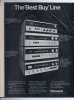
Found this ad from 1974 about the Sherwood lineup. I gather the consumer magazine in question was Consumer Reports. The S-7100A, S-7200, and S-7900A are all part of the stack. Also notice they left some dashes out of the model numbers. Gives some idea when these models were being sold.

Sherwood Best Buy Ad 1974.jpeg
 
Last edited:
We need a Sherwood forum. "Sherwood: The word should be getting around." Almost finished recapping a Sansui 800, and while it is a very fine machine, it is much more difficult to work on than the Sherwood S-7100A and is not pretty to look at. Not after you've seen a Sherwood in its (stock! it came with this stock!) lovely wooden case with blue dial lights. I ran into many issues working on the 800: cramped boards, leads in the way, leads that snapped off, switches and pots so dirty they had to be taken apart and physically polished and cleaned. There was nothing like that when working on the Sherwood--perhaps the easiest recap I've ever done and the most satisfying.

I have to say it again; If I could bring only one receiver to a desert island (that also had electricity for some reason), it would be the humble Sherwood S-7100A. It's always a joy to listen to, always a joy to work on. And yes, I just knocked on wood so I don't jinx everything!

Have you heard/seen a Sherwood S-8800A? I'm trying to find one to buy but no one has one (or wishes to part with theirs). It's very 60's looking; it makes the 7100A look positively new-fangled in comparison. The interior build is so spartan I think this receiver was designed for cavemen by cavemen!
 
We need a Sherwood forum. "Sherwood: The word should be getting around." Almost finished recapping a Sansui 800, and while it is a very fine machine, it is much more difficult to work on than the Sherwood S-7100A and is not pretty to look at. Not after you've seen a Sherwood in its (stock! it came with this stock!) lovely wooden case with blue dial lights. I ran into many issues working on the 800: cramped boards, leads in the way, leads that snapped off, switches and pots so dirty they had to be taken apart and physically polished and cleaned. There was nothing like that when working on the Sherwood--perhaps the easiest recap I've ever done and the most satisfying.

I have to say it again; If I could bring only one receiver to a desert island (that also had electricity for some reason), it would be the humble Sherwood S-7100A. It's always a joy to listen to, always a joy to work on. And yes, I just knocked on wood so I don't jinx everything!

Have you heard/seen a Sherwood S-8800A? I'm trying to find one to buy but no one has one (or wishes to part with theirs). It's very 60's looking; it makes the 7100A look positively new-fangled in comparison. The interior build is so spartan I think this receiver was designed for cavemen by cavemen!
Saw an s-8900 and an s-7900 on the bay, but no a. I like the 8900 model a lot. Sorry, I'm no help.
 
I like the Sherwood forum idea a lot.

I've got a little problem with the "desert island" thing though. How would enjoy that warm, spacious FM sound? One thing I especially love about my Sherwood(s) is how good the FM sounds. So maybe "stranded on an island just off the coast of a place with several awesome commercial-free FM stations without pledge drives" would be better. Just sayin'......;)

I haven't worked on a whole lot of gear, but Sherwood does strike me as pretty high up there on the scale for build quality and ease of service.

Since my S-7300 just happens to be lying on my living room floor (Okay, yeah, I'm single ....) here's a little detail as an example....
1554517598694472614405.jpg

Check out that hunk of metal just in front of the transformer that looks like a standoff but weighs about 50x more. That thing sits between the (very thick!) metal chassis which I cannot deflect even by pressing on very hard and the metal bottom plate which is mostly protected by the wooden case.

From a modern efficiency/economics perspective that piece is totally ridiculous. Just shove a piece of sticky foam in there and be done with it. But because of that piece (which probably would cost well over a dollar today) you can remove the wooden case from a S-7300, lay it on the ground upside down, and (with the power on and music playing) stand on it. Maybe even give it a gentle bouncy-bounce. I hope you don't, but still, you could.

That's one thing I love about vintage audio in general. People were so proud of their designs and their products that they would go to ridiculous extremes.

I worked on a Sansui AU-G77X (1980‘s) that has a truly wonderful electronic design squished into a flimsy snap-together nightmare of black plastic. You can literally feel it flex when you pick it up. It's a much better amp than the Sherwood, but nowhere near as nice a product. (Not a fair comparison: different decades. Just making a point.)


Pfew. You kind of got me going there. Maybe there should be a separate forum for this kind of stuff.... :)
 
What's the 8900 like? I saw it, too---wondered how it compared to the 8900A, which is quite popular.
The 8900 is very much like the 8900a. You won't see them as often as the a either. I have never had both at the same time, so I can't give a good side by side comparison. It has the same rich Sherwood sound the old late 60's early 70's units have. Really nice bass for a mid wattage receiver. Lots of headroom for complicated music containing lots of transients.
Power output is about the same although I don't think the 8900 was rated rms.

A great receiver to sit back and listen to while smoking a pipe and drinking scotch. Don't forget your smoking jacket and slippers. A refined distinguished product from a more civil age. :)

If you can get one for the right price you will not be disappointed.
 
Back
Top Bottom