• The move to the new server is done. There are some software and database maintenance updates in process. This has us passing the hat around to help out. We appreciate any donations. Seriously, even a dollar helps. The payment page may be found here - https://www.audiokarma.org/support.html

Sherwood S8000 Receiver... Repair?

stuessy

New Member
Hello people of Audio Karma,

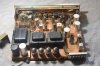
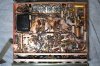
I bought this Sherwood S8000 receiver from a thrift store for $4. It was actually installed in a rather low quality cabinet, so they were selling the whole stereo cabinet setup for $4. I saw the tubes and figured I'd snatch it up.

My questions to you all:
1. What all has to be done to diagnose and test this thing to see if it's worth investing money into?
2. What is the cheapest possible way of doing this?

I really, really want to keep it, but I can't afford to spend unknown hundreds of dollars on this project. I've never owned tube gear, and never repaired consumer electronics before, but if working on it myself is the cheapest method, then I'm up for the challenge. I'm a good problem solver. I worked for an industrial robotics integrator for a little while, so soldering and using a multimeter shouldn't be a problem for me. I don't know that I will have access to any other sort of testing equipment though, depending on what it is.

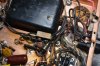
Any knowledge, help, or tips anyone can give me would be very much appreciated. I'll try and answer any questions you have, or take better pictures of whatever you need. The area of discoloration on the underside next to the transformer is of particular worry to me. It looks like it might have been caused by heat or smoke. Maybe it's normal though, I don't know.

Thank you,
-Matt
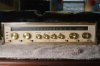
S8000 1.jpg S8000 2.jpg S8000 3.jpg S8000 4.jpg S8000 5.jpg S8000 6.jpgsherwood_s-8000_sch.jpg
 
Register to hide this ad
Nice find stuessy and welcome to AK! I'm sure others will be along to assist with your questions. I'm new to tubes also. There may also be threads in this section that you can research.

Mark
 
Really nice and in great shape. Usually the front panel on those can have issues. That one looks nearly perfect. Before firing it up, I would suggest using a variac, or a dim bulb tester. If you don't have either, you can make a dbt for about the price you paid for the unit. Also make sure speakers are hooked up, use ones you are not in love with, at least initially. With a dim bulb tester, the bulb will almost go out right after you turn the unit on, and slowly start to get bright again. If it stays bright, shut it down immediately as there are transformer or power supply issues to address before going any further, hopefully just a diode or two. Before firing it up, make sure the fuses are good and are the correct size and type. This probably uses slow blows for the main AC fuse for sure.

If it fires up, look for red plating, especially on the output tubes. If some tubes are red plating, shut it down immediately and don't turn it back on until the issue is addressed. If all looks well, feel the transformers. Any sign of a transformer heating up a lot, right away, is not good. They will eventually get warm, even quite warm to almost hot is possible, but not immediately. It's going to need some caps, even if it plays. I wouldn't worry about the discoloring for now. It's gotten hot but that's not uncommon after years of usage. It was probably on for a few extended periods sometime in it's life. I really can't see anything damaged.
 
Last edited:
The 7591 power tubes look quite good, in terms of shiny getters.

1. Get a friend with a tube tester to test the tubes; replace any that are bad. The output tubes must be replaced as a matched quad;

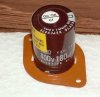
2. It's a safe bet that the 120 MFD electrolytic caps in the voltage doubler circuit are bad, as others may be. I would replace the doublers with modern caps glued onto the phenolic spacers (see photo).

3. Test the other electrolytics. You can gut and re-stuff any odd value cans. There are how-tos on other threads.

4. Install 10 ohm resistors on the cathodes of the 7591s. Install a potentiometer in the bias circuit so you can adjust and measure bias.

5. Clean the potentiometers and controls with DeOxit™ or similar.

The coupling caps in Sherwoods rarely go bad. It's a nightmare to try to replace them all. Chances are you can leave them be.

Replacement cap.JPG
 
Last edited:
I'm no Sherwood expert, but that looks like a hell of a snag to me man. Good for you, rebuild! Great stuff!
 
Welcome to AK Matt,and that is one heck of a score for your first post.In it's day,I believe this was their top of the line offering.I have the integrated amp version of this unit,and the sound quality is excellent.Owners of Sherwood tuners report the same. So,essentially you've got it all in one box.

Yeah,I know it looks like a 1950's kitchen appliance,but don't let the looks fool you.Well engineered and very well built,this is a performer!
You say you can handle a soldering iron and a multimeter? Then you are good to go.There are some components that you should absolutely replace just due to age,but parts costs are very reasonable,and there's tons of knowledge and experience available on these forums to help you along if needed.

Cheers,

Art

Edit: Just wondering,does anybody know who it was that was that designed the cosmetics for this series from Sherwood? I swear,it looks like Charles and Ray Eames got drunk with Frank Lloyd Wright one night.....
 
Last edited:
Thank you all for such quick and helpful responses. I'll test the tubes and work on a dim bulb tester. Maybe I'll be able to find someone with a variac. I'll keep you guys updated.
 
These are really nice amps. I have it's AM-FM sibling, the S-7000 and an S-5500 II integrated amp that has essentially the same power amp section. Agreed with all the advice above. They're worth fixing. Handily, they used fairly good parts to begin with, so beyond electrolytic cap replacements you may find that it doesn't need much of anything else.


You are missing the heat shield over the output tubes. If there is a copper coated sheet metal thing laying around inside the cabinet, thats the part. It sits over the output tubes and helps keep the transformers cool.
 
Great find! As mentioned well it's worth fixing it as it has really good output transformers and other high quality
parts as mentioned! The reason to replace all the PS caps and Bias PS caps is that
even if they are not all bad is that when they suddenly do you risk any or all the transformers and output tubes.

Usually you have to replace all the coupling caps , but apparently Sherwood used a type that usually lasts.
In most other brands leaving them in would risk the output transformers and tubes.

There are threads I believe to add individual bias pots for each output tube making it easier to match tubes.
apparently the new TS (Tung Sol) are the best production output tubes followed by the EH brand both made by New Sensor.

You may be able to fabricate a new aluminum heat shield for the output tubes or put aluminum tape along the output transformers facing the tubes.
 
Making a heat shield wouldn't be too hard. It wasn't exactly a complex piece of metalwork. The other thing it does is push the heat out from behind the unit when running it with a cover.
 
Sorry, I didn't respond to you guys sooner. I do have the heat shield. I just took it off for the pictures. Last night I built myself a dim bulb tester, but I still need to test the tubes.
 
Back
Top Bottom