• Please note that Audiokarma will be offline briefly for updates early on Monday morning, September 28th.

Shorted out a section of can cap on a ST70

Hecubus

Active Member
I just installed a new can cap in my ST70. Before I powered it up I hooked up some multimeters to the first and second sections of the cap. When I turned it on everything went fine for a few seconds and then one of my leads fell off and shorted the first section (80uf) against the ground. Sparks ensued. I quickly shut it off but the damage was done. I turned it on for a second and it hums like crazy now and voltages at that first cap are something like 1000vdc.

Will I have damaged just one section of the cap or will the whole can cap be bad? Will anything else like the transformers have been damaged? Tubes?

This sucks. I was even trying to be safe and hook up my leads beforehand so I didn't have to manually probe around in there. I was so close. I have already replaced the bias supply and the coupling caps. With the can cap done I was finished with my refurb. All I need to do was to check a few voltages and set the bias and I was done. Not anymore.
 
Register to hide this ad
It happens. If it were mine I would feel a whole lot better with a new can. Not just bypassing one section with a single cap.
 
I just installed a new can cap in my ST70. Before I powered it up I hooked up some multimeters to the first and second sections of the cap. When I turned it on everything went fine for a few seconds and then one of my leads fell off and shorted the first section (80uf) against the ground. Sparks ensued. I quickly shut it off but the damage was done. I turned it on for a second and it hums like crazy now and voltages at that first cap are something like 1000vdc.

Will I have damaged just one section of the cap or will the whole can cap be bad? Will anything else like the transformers have been damaged? Tubes?

This sucks. I was even trying to be safe and hook up my leads beforehand so I didn't have to manually probe around in there. I was so close. I have already replaced the bias supply and the coupling caps. With the can cap done I was finished with my refurb. All I need to do was to check a few voltages and set the bias and I was done. Not anymore.

Man I feel your pain!! Big Time! I was just doing final adjustments on my Sansui 9090 and the same thing happened to me, the probe fell against the face plate! It actually "welded" it to it!! Smoked a ton o'****. But I did get it fixed and it is singing beautifully again. So there is light at the end of the tunnel, hopefully.

Best of luck..
 
I just installed a new can cap in my ST70. Before I powered it up I hooked up some multimeters to the first and second sections of the cap. When I turned it on everything went fine for a few seconds and then one of my leads fell off and shorted the first section (80uf) against the ground. Sparks ensued. I quickly shut it off but the damage was done. I turned it on for a second and it hums like crazy now and voltages at that first cap are something like 1000vdc.

Will I have damaged just one section of the cap or will the whole can cap be bad? Will anything else like the transformers have been damaged? Tubes?

This sucks. I was even trying to be safe and hook up my leads beforehand so I didn't have to manually probe around in there. I was so close. I have already replaced the bias supply and the coupling caps. With the can cap done I was finished with my refurb. All I need to do was to check a few voltages and set the bias and I was done. Not anymore.
Electrolytic caps normally survives shorting.
I would recommend this sequence of actions :
1- pull the 5AR4
2- with an external DC supply with ammeter that can be regulated, apply DC to the cap while
measuring the current. As no tubes are hot, nothing will draw current , the only current that will
flow is to charge the caps. Voltage at this stage might be 20 - 50 Volt. See if current
drops to zero (= caps charged). If so increase voltage slowly and observe current.
3- see that the all the cap element has same voltage, if the choke has been destroyed some
of the cap element won't charge, if so check and replace choke

4- without 5AR4 , turn on AC power, check that bias voltage appears, also see that
tubes will start glow.
5- if you can charge caps and current drops to zero then get another 5AR4 m plug in
and apply power while observing that normal voltages will be in place.

at this point i expect the amp to work. Junk the old 5AR4, they don't like shorting.
 
Connect order on the larger can should be, 40uF from rectifier to choke, 80uF from choke to opts and resistor to 30uF section, then resistor to 20uF section.
The 1000 dcv measurement doesn't make sense, it shouldn't be much higher than half that.
 
Something doesn't add up. Caps usually aren't harmed from being shorted (not that it's good for them). It's not unheard of to discharge caps by shorting them with a screwdriver, but it's better to use a resistor to limit the surge current. If you did damage the cap, it's more likely it went open circuit if an internal connection melted from the current. If it was shorted, you would measure close to 0v on it, not 1000v.
 
I installed a new 5ar4 and powered it up. I got no voltage at the first section of the cap. After about 10 seconds it blew the fuse. I replaced the fuse and did a dim bulb test and the bulb stayed bright.


Clearly there is a problem somewhere and it wont get turned on again until I find it. Suggestions on where/how to look are always appreciated
 
I installed a new 5ar4 and powered it up. I got no voltage at the first section of the cap. After about 10 seconds it blew the fuse. I replaced the fuse and did a dim bulb test and the bulb stayed bright.


Clearly there is a problem somewhere and it wont get turned on again until I find it. Suggestions on where/how to look are always appreciated
As you did not use an external DC you have to travel the heavy route.
The 5AR4 is not the voltage source you need when pinpointing a possible short.
Any external source that is current limited is what you need.
In absence of that you have to use a DVM and measure resistance to ground.
Start with measuring the resistance B+ to ground. Somewhere you have a short. Disconnect
the leads to the cap to see where. And the first cap ( closest to the 5ar4 should be 40uF )
Then get a new 5AR4 ( they don't like shorts / overcurrent )
 
Last edited:
I disconnected everything from the can and I am getting a short from the 80uf to ground. The choke measures out at 62 ohms exactly.
 
I installed a new 5ar4 and powered it up. I got no voltage at the first section of the cap. After about 10 seconds it blew the fuse. I replaced the fuse and did a dim bulb test and the bulb stayed bright.


Clearly there is a problem somewhere and it wont get turned on again until I find it. Suggestions on where/how to look are always appreciated

You have a Variac or a DIY dim lamp kit? You'll need to replace the indirect 5AR4 with a direct rectifier, like a 5U4GB or 5Y3GT (just for the ramp-up test). Follow the link's instructions. You need to find that short. Good luck! :thumbsup: :)

EDIT: Sorry didn't see the dim-bulb test, in your QUOTE. :oops:

https://antiqueradio.org/dimbulb.htm

I use a Variac and a DVM clipped to the B+ post. Slowly ramp-up the AC voltage and watch the voltage rise on the B+ point. It should rise as the rectifier conducts. Check your other B+ rail taps, to see they are reflecting the same relative voltages scale --- as what is indicated on the schematic. As an example, the tap for gain stage tubes is rising at a rate proportional, but 20VDC lower compared to PT B+ point. Following photo shows the amp's B+ point and idle bias (not important for your problem).

bias and voltage.jpg
 
Last edited:
solid state diodes work better for that test. They conduct basically immediately so you'll know if caps are shorted right away.
 
Why did you put the 80uF section first off the rectifier?

If you suspect that section is now shorted just leave it disconnected and put a 30-40uF single cap on that position and retest. But trying to test a large value cap with an ohm meter like you are doing can also give a false short reading because the cap will use the meter voltage to charge and that will give a low false resistance reading during that process. Different meters will react differently so it's not a given that the cap is shorted yet.

I misspoke. The 40 is first off of the rectifier but the 80 is the one that reads shorted.
 
solid state diodes work better for that test. They conduct basically immediately so you'll know if caps are shorted right away.

I sub one of these, into GZ34/5AR4 rectified amps, while doing ramp-up tests. Or sub a 5U4GB, which is directly heated. The B+ will change, but I'm only using these subs to monitor the relative changes in voltage, as I ramp-up the AC.

https://www.tedweber.com/wz34
 
I installed a new 5ar4 and powered it up. I got no voltage at the first section of the cap. After about 10 seconds it blew the fuse. I replaced the fuse and did a dim bulb test and the bulb stayed bright.


Clearly there is a problem somewhere and it wont get turned on again until I find it. Suggestions on where/how to look are always appreciated

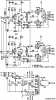
I'd use the schematic with amp unplugged and main caps drained. Tubes removed. Check the continuity from (+) rail of power supply section to chassis ground. It prolly will show a short-to-ground. Now, remove each B+ rail tap (A,B, and C), until the short-to-ground disappears.

This should isolate the miss-wired section.

BTW... you are using the proper 3-amp Slo-Blow fuse?

Dynaco-ST70-Tube-Amp-Schematic.png
 
Back
Top Bottom