• The move to the new server is done. There are some software and database maintenance updates in process. This has us passing the hat around to help out. We appreciate any donations. Seriously, even a dollar helps. The payment page may be found here - https://www.audiokarma.org/support.html

Single ended triode strapped pentode amplifiers.

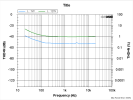
My daughter and I built a Kegger-style stereo KT88 UL SE amp and I didn't find the distortion that high--I forget what it was but maybe 5% at 10 watts, something like that. It sounded great.

Also AnTeks say 115 primaries, but the actual voltages at the secondaries are measured at 120VAC input. So don't expect any over-voltage using a 120VAC source.

ETA: Actually, 1% THD at 12 watts!

IMG_1063.png
IMG_1064.png
 
Last edited:
We have run a (stock) Leben CS300F - triode strapped JAN6197 (Pentode) PP amp - as our reference for nearly 8-years.

Owned it from new and - at the time - compared it to the bigger brother, the Leben CS600, which runs 6L6GC or EL34 in pentode / beam tetrode mode.

To our ears - listening through a pair of the very nice Devore Fidelity Orangutan 93 loudspeakers - the Leben CS600 was a great sounding amp (no question), but the feisty, fleet-footed little CS300F won the day with a bit more life and sparkle.

Meanwhile, as a learner amp, I purchased very cheap a (modified, but failed) Bewitch 6550 Chi-Fi amp, switchable between UL and triode. I have spent the last 6-years teaching myself tube amps and modifying the Bewitch to improve the sound - using our Leben CS300F as the reference.

(Slow learner... :biggrin: )

Just this month I finally struck gold with the Bewitch, which is hard-wired for triode and has been running cheap Shuguang KT88-98 for several years now.

Finally, the Bewitch is the superior sounding amp in our camp - despite the Leben CS300F being treated to the fresher tubes. :thumbsup:

The Leben CS300F is now packed away in the cupboard.

MY TAKEAWAY: There is nothing wrong with well implemented pentodes, running triode-strapped, but the circuit must be completely optimised for the purpose.
(Forget triode/UL switches... :rolleyes: )

For reference, we have owned Cary CAD300SE Signature monoblocks, First Watt J2 (Papa-built), and other great sounding amps.

The Bewitch KT88 stays. :biggrin:

IMG_1593.JPG

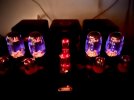
BEWITCH 6550 TUBES AGLOW 2.jpg
 
Last edited:
My daughter and I built a Kegger-style stereo KT88 UL SE amp and I didn't find the distortion that high--I forget what it was but maybe 5% at 10 watts, something like that. It sounded great.

Also AnTeks say 115 primaries, but the actual voltages at the secondaries are measured at 120VAC input. So don't expect any over-voltage using a 120VAC source.

ETA: Actually, 1% THD at 12 watts!

View attachment 3851030
View attachment 3851031
I'll take a look at the Kegger amp. The power trany I have is actually a dual 320V-0, or wired in series for 320V-0-320V. I'm looking over the 6L6GC "Spalted Alder" amp from Casodetubes at the moment. He built it so it could be used with KT-88's too. That trany doesn't have a 5V winding, so I would probably use a coppertop WZ34 SS rectifier instead of having to drop one of the 6.3v windings down to 5v.
 
I'll take a look at the Kegger amp. The power trany I have is actually a dual 320V-0, or wired in series for 320V-0-320V. I'm looking over the 6L6GC
"Spalted Alder" amp from Casodetubes at the moment. He built it so it could be used with KT-88's too. That trany doesn't have a 5V winding, so I would probably use a coppertop WZ34 SS rectifier instead of having to drop one of the 6.3v windings down to 5v.

Maybe use a full-wave 1N4007 bridge. And forgo the 5VAC issue.

:idea:
 
I could I guess.
Power-Supply-Schematic-SE-6L6-5881.png

Something like the above. I don't think that you need to bypass the diodes. I would use the 6.3 VAC tap for the heaters and not rectify it to DC. For SE amps, I like keeping things simple. That is the attraction, to me, of single-ended topology.

:)
 
Power-Supply-Schematic-SE-6L6-5881.png

Something like the above. I don't think that you need to bypass the diodes. I would use the 6.3 VAC tap for the heaters and not rectify it to DC. For SE amps, I like keeping things simple. That is the attraction, to me, of single-ended topology.

:)
I saw that one, but he used a 250V-0 transformer. Going up to the 320V transformer I have is quite a bit more voltage.
 
I saw that one, but he used a 250V-0 transformer. Going up to the 320V transformer I have is quite a bit more voltage.
The basic LC filter stages will work; you'll just need 500 VDC-rated caps. I like the way he included a bleeder resistor (R1). You could prolly go with 220 k-ohm and not need a 5-watt resistor (maybe just a 2-watt metal-oxide). The drain time would be longer.

And I would prolly not have so many caps in the power supply. Maybe a total of 4. Two before the B+ tap and two for the A+. You could run it through a PSUD simulator to get the values. I'm not big on film bypass caps in the power supply. :idea:

EDIT: I'd prolly put another resistor between those C2s before the B+ tap (or a choke after the first C2). Might as well add pi-filters and not just have caps in parallel, to get better filtering and isolation between stages.
 
Last edited:
I built that Novar spud amp using 6LR8's as a SUEL amp. It can be wired UL or triode mode using a jumper, or a switch. I just used a jumper for UL mode so I could get the full 5wpc.
I'm really looking for a schematic thats fairly simple. Maybe something with a single dual triode driver stage. I would really like to be able to use the JJ 6L6GC's, or the Russiqn 6P3S-E's I have on hand. If I remember right, I got around 290v to 295v after a couple added diodes out of that toroidal transformer I have. Thats unloaded though. There just doesn't seem to be that many schematics out there for this kind of amp that I could find. Especially using 6L6 tyoe tubes.
the 6LR8 is pin compatible with a 6GF7A. The G2 pin doesn't go anywhere on the 6GF7 if you had any particular desire to A/B a triode-strapped pentode for an actual triode. The high mu triode looks pretty much identical so you should be able to just swap them and listen, possibly with a re-bias for the output tube, not sure on that point.


Probably not many schematics for a 6L6 in triode because they just don't make much power. At 290 to ground, you're ~270 across the tube with cathode bias. Datasheet has triode conditions at 250v, close enough, and its just shy of 2 watts at the plate. With transformer losses you're looking at maybe 1.75 to the speaker.

wouldn't be real hard to do though, need about 20 volts peak which is easy to get from really anything. 6SN7 will give ~15 and should be pretty close to 1 volt input for max power out with no feedback. If you want feedback and reasonable input sensitivity, use a higher gain tube. I wouldn't get super complicated with it though, just a regular old cap-coupled triode voltage amp into the grid of a cathode biased output stage. Plate to plate feedback would probably get it done, or you can do global loop but with a triode it shouldn't need much to get decently low output impedance. Voltage amp component values can come straight out of the resistance coupled amplifier chart, output is close enough to straight out of the 6L6 datasheet that you may as well just copy it. Tweak the cathode resistor if needed to account for a bit of extra voltage.
 
the 6LR8 is pin compatible with a 6GF7A. The G2 pin doesn't go anywhere on the 6GF7 if you had any particular desire to A/B a triode-strapped pentode for an actual triode. The high mu triode looks pretty much identical so you should be able to just swap them and listen, possibly with a re-bias for the output tube, not sure on that point.


Probably not many schematics for a 6L6 in triode because they just don't make much power. At 290 to ground, you're ~270 across the tube with cathode bias. Datasheet has triode conditions at 250v, close enough, and its just shy of 2 watts at the plate. With transformer losses you're looking at maybe 1.75 to the speaker.

wouldn't be real hard to do though, need about 20 volts peak which is easy to get from really anything. 6SN7 will give ~15 and should be pretty close to 1 volt input for max power out with no feedback. If you want feedback and reasonable input sensitivity, use a higher gain tube. I wouldn't get super complicated with it though, just a regular old cap-coupled triode voltage amp into the grid of a cathode biased output stage. Plate to plate feedback would probably get it done, or you can do global loop but with a triode it shouldn't need much to get decently low output impedance. Voltage amp component values can come straight out of the resistance coupled amplifier chart, output is close enough to straight out of the 6L6 datasheet that you may as well just copy it. Tweak the cathode resistor if needed to account for a bit of extra voltage.
I actually looked at the 6GF7 when I was deciding on what tube to use when I was building that sweep tube amp. There's another one with a pentode section that puts out a little over a watt also. I even thought about using the version of the 6LR8 that had an anode cap. I can't remember the tube number without looking it up. A 6L6 won't put out much in triode mode for sure. Still, I may add a switch anyway. I'm looking to take a closer look at Kegger's KT88 Blue Glow amp also.
 
I saw that one, but he used a 250V-0 transformer. Going up to the 320V transformer I have is quite a bit more voltage.
I found this generic PSU. Of course, you may need to adjust the line resistance to get the tap voltages you want. But this one is a lot simpler and easier to modify,

PSU-6L6 single ended power supply.jpg
 
If a transformer has two separate HV secondaries, wiring it for a center-tap rectifier wastes abut a third of its current capacity (or makes regulation a third worse). But tube rectifiers always used center-tap rectifiers, so that's what the transformer makers keep supplying. With the Antek, parallel the windings and use a bridge. You can use a tube rectifier for half of the bridge if you like, or use a solid-state bridge and a damper diode for a slow start.
 
I do like the option of parallel windings vs the full wave center tap. Kind of surprised more aren't supplied this way so people can use either method with no fuss.
I've been using Toroidal power transformers more and more. I've seen the secondary HV winding wired in parallel and even amps wired like mono blocks with seperate power supplies and a HV winding per channel.
 
Last edited:
If a transformer has two separate HV secondaries, wiring it for a center-tap rectifier wastes abut a third of its current capacity (or makes regulation a third worse). But tube rectifiers always used center-tap rectifiers, so that's what the transformer makers keep supplying. With the Antek, parallel the windings and use a bridge. You can use a tube rectifier for half of the bridge if you like, or use a solid-state bridge and a damper diode for a slow start.
Yup. I was looking at the Cascode schematic again about an hour ago.
I defenetly want to go with a bridge rectifier instead of a tube rectifier.
Maybe go with 600v caps instead of 500v filter caps? I should be able to get away with paralleling the two HV windings and get the voltages close to whats needed. I haven't tried wiring them in series. I actually prefer SS rectifiers to tube rectifiers. I only have two SE amps and one preamp out of all my amps and preamps I own that have tube rectifiers.
 
Maybe go with 600v caps instead of 500v filter caps?
Wouldn't you make a model of the PS and see what makes sense?

Unless you use a delay of some sort with SS rectifier the B+ will peak up until the load comes on.

In my last build with SS rectifiers I used time delay relay to short out some limiting resistors to manage the startup peak voltage and caps in series with balance resistors rather than seek out caps with such high voltage ratings.
 
I found this generic PSU. Of course, you may need to adjust the line resistance to get the tap voltages you want. But this one is a lot simpler and easier to modify,

View attachment 3851449
Since my power transformer has a 115V primary I may have to go regulated DC heaters. One of my preamps has regulated DC heaters because the heaters are wired for 12V and the power transformers 115V primary causes the heater winding to run high, around 14V. If the 6.3V winding in my power transformer winds up supplying anything over 6.5V I'll regulate it.
 
Just this month I finally struck gold with the Bewitch, which is hard-wired for triode and has been running cheap Shuguang KT88-98 for several years now.

Finally, the Bewitch is the superior sounding amp in our camp - despite the Leben CS300F being treated to the fresher tubes. :thumbsup:
Can I ask what turned the tide for this amp?
 
Wouldn't you make a model of the PS and see what makes sense?

Unless you use a delay of some sort with SS rectifier the B+ will peak up until the load comes on.

In my last build with SS rectifiers I used time delay relay to short out some limiting resistors to manage the startup peak voltage and caps in series with balance resistors rather than seek out caps with such high voltage ratings.
Did you happen to jot down a sxhematic drawing for it?
Ive seen a few small delay board kits that also had a slow ramp up. I didn't save the links to them from an older phone though.
 
Back
Top Bottom