• The move to the new server is done. There are some software and database maintenance updates in process. This has us passing the hat around to help out. We appreciate any donations. Seriously, even a dollar helps. The payment page may be found here - https://www.audiokarma.org/support.html

SL-1210 Static discharge

Robertkj

New Member
My SL-1700 Mk2 has a high resistance static discharge path between spindle and ground, my SL-1210 has no resistance, open circuit. The result is that when I lift a disc from the platter a static discharge causes the speed to change from 33 to 45. I'm worried that this discharge my damage the electronics, I guess this is not normal and is a fault with the TT but I don't how to diagnose where the fault is.

Could anyone with knowledge of the construction of the SL1200 mk2 help me find the problem. I guess It's not a missing wire as that would not be a high resistance path.
 
Register to hide this ad
This sounds weird. Very weird. In theory static can affect an IC but...
Just to clarify... Why is this accounted for as a static discharge? Can you hear static? Feel it? Does the record 'stick' to the mat?
When you lift a record from a stationary platter at 33 rpm setting, do you mean the 45 led comes on and it appears as if you've switched to 45 rpms?
 
Hi Tom,
Yes I can hear one or sometimes more clicks when I lift the record and yes it appears as if I have switched to 45.
 
OK, lemme dig into this. Static is weird... I need to go over the schematics and zap my own 1210 to test this (neah, just kidding, not really)... I'll get back to you, but please just run a sanity test first. Run the platter at 33 rpm for a few minutes (no record, no stylus on), stop it, tap it lightly - did the speed change?
 
OK, first finding is a bit of a surprise. My SL-1210 Mk-II spindle to ground connection displays quite a good electric discharge path of less than 5Ω.

aWl48Ob.jpg


Do you think you can retest yours, and if it shows no connectivity, get to the motor and deoxit the bearings contact area with it's base?
 
I had the exact same problem when running an Applied Fidelity gen 3 sapphire bearing. It had a polymer bushing and a sapphire thrust pad. Because of this, there was no path to ground from the lp.
When I told Jim Howard (RIP) about this, he replaced the bushing with a bronze one. I still had a lot of static here in Michigan during winter months, but not enough to make the SL-1200 change speeds.
 
OK, first finding is a bit of a surprise. My SL-1210 Mk-II spindle to ground connection displays quite a good electric discharge path of less than 5Ω.

aWl48Ob.jpg


Do you think you can retest yours, and if it shows no connectivity, get to the motor and deoxit the bearings contact area with it's base?

My 1210MK5 (2010 model) measures around 4 ohms as well. (no real static problems, at least not like OPs (changing speeds, etc.)).

What preamp is the OP using? Also, what mat are you using? And, do you do record cleaning on the table while the record is spinning? (Me thinks you are running a static generating factory).
 
Hi,
For your interest the mat is the Boston Audio graphite mat and preamp is Graham Slee Amp 2, the SL1700 has Dynavector P75 preamp (17D3 cart) and as recommended by Dynavector the earth lead from the TT is grounded at the power amp. Further checking shows on my SL1700mk2 and another SL1700mk2 zero ohm between outer casing of spindle bearing and ground but open circuit on the SL1210mk2. I have had the TT apart before, maybe I've not re assembled correctly, I will pull it apart and check. Previously I said there was a high resistance on the SL1700 but this was a capacitance effect and once discharged by the meter it was also showing open circuit, but the difference still is the resistance from outer casing of bearing to ground, short on SL1700 and open on SL1210.

Thanks for your replies
Robert
 
FWIW, my SP-25 initially seemed like a perfect static generator, too. I've never measured spindle-to-ground resistance - probably should. I had to stop using a carbon fiber brush on this table. I use a moistened Discwasher brush now, and the static problems are down to ordinary levels.

I also bought the KAB poly/metal mat, which may be helping a bit, although I'm not sure how.
 
SL1210 1s.jpg SL1210 2s.jpg
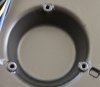
I may have solved my problem. Paint on the main TT casting was insulating the bearing housing, I've now scraped the paint from the mounting points to ground the spindle housing. It now measures the same as my SL1700 as described earlier. I have played both sides of an LP and lifted without a problem but I will need to test for longer to be sure.
 
Last edited:
I may have solved my problem. Paint on the main TT casting was insulating the bearing housing, I've now scraped the paint from the mounting points to ground the spindle housing.
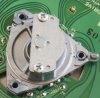
That's very good. I hope it solves the mysterious spontaneous speed switching, which is, kinda weird. However, I'm pretty sure the stock form of that bearing housing doesn't insulate because of paint issues. I was actually referring to the bushing (yellow arrow) and the bearing contact point (underneath the yellow circle). If the problem is solved, so be it, but for reference, I include this reworked image showing the points of contact consisting the electric path from spindle to housing and to ground:

oCVF3mj.jpg
 
Hi Tom, would this explain why you have 4 ohms spindle shaft to casing while both my TT's show open circuit after a discharge period through the meter? I think Jeff is right, the 3 bolts should make electrical contact between the bearing assembly and TT, could it be grease insulating the bolts where they pass through the bearing housing?

Anyway I have now played 4 lp's with no problem.

Regards
Robert
 
Anyway I have now played 4 lp's with no problem.
That's the bottom line. It works!

Yes, it could be grease, it could be some tolerance in the bushing, maybe oxidation, who knows... As long as the spindle can discharge static to ground it's OK.

If you use alligator clips for the measurement, you might get a different result. That spindle is too slippery for the pin probes.

Anyway, well done! Another happy ending. :thumbsup:
 
Back
Top Bottom