• The move to the new server is done. There are some software and database maintenance updates in process. This has us passing the hat around to help out. We appreciate any donations. Seriously, even a dollar helps. The payment page may be found here - https://www.audiokarma.org/support.html

SL-1700 speeding up after 30 minutes

TomSc

AK Subscriber
Subscriber
Hello all,

I have a nice SL-1700 that has developed a speed issue after about 30 minutes of use. I can usually get through one side of an LP and a song or two on the other side, then the speed slowly ramps up. Looking at some of the previous threads about issues with this model, I cleaned all the pots, connectors and speed select switch - multiple times. No dice. I replaced all the electrolytic caps. That didn't help, so I touched up most all the solder joints on both the speed control and motor boards. Thinking it might be a heat issue, I replaced the 2SC828A with KSC1815YTA, the 2SD389 with an MJE15030G and applied new thermal paste to the chassis/heatsink interface. Still no change.

I noticed it pulses (the strobe dots) back and forth lightly and it slowly speeds up. Garage Band's metronome tells me the pulsing starts ~120 bpm. The ticking seems to start a few minutes after the pulsing and it follows the the speed as the platter gets faster.

Is this Technics just jealous of the TD-125 I brought home last week?

Any ideas?

Thanks in advance,
Tom
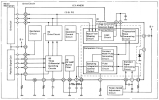
SL-1700 Schematic.JPG
 
Register to hide this ad
CAUTION: Mechanical Engineer here.

Is there any way to attach leads to pin 24 of IC1 and measure voltage while you are running the table? Appears that it should be 16.4V @ 33. If that was wandering with speed that might explain things.

Interestingly, similar schematic for the SL-1950 (IC1 = AN630U).

1736934118756.png

You might check with member TommyTomTom as it appears he's rebuilt many 1700s.

Good luck.
 
Thanks - I'll see if I can come up with a jig to let me get some test leads on the board while it's running. I'm just hoping it's not the IC.
 
Yes - same issue at 45 too. Not entirely sure if the ticking is faster though. I'll have to check tonight.
 
Hello all,

I have a nice SL-1700 that has developed a speed issue after about 30 minutes of use. I can usually get through one side of an LP and a song or two on the other side, then the speed slowly ramps up. Looking at some of the previous threads about issues with this model, I cleaned all the pots, connectors and speed select switch - multiple times. No dice. I replaced all the electrolytic caps. That didn't help, so I touched up most all the solder joints on both the speed control and motor boards. Thinking it might be a heat issue, I replaced the 2SC828A with KSC1815YTA, the 2SD389 with an MJE15030G and applied new thermal paste to the chassis/heatsink interface. Still no change.

I noticed it pulses (the strobe dots) back and forth lightly and it slowly speeds up. Garage Band's metronome tells me the pulsing starts ~120 bpm. The ticking seems to start a few minutes after the pulsing and it follows the the speed as the platter gets faster.

Is this Technics just jealous of the TD-125 I brought home last week?

Any ideas?

Thanks in advance,
Tom
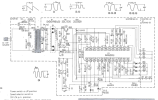
View attachment 3400035
I'd carefully dribble some component cooler on the IC and see if it returned to speed. The clicking sound, is that a mechanical sound you hear.
 
I got it running with the board out of the chassis. The voltage on Pin 24 increases slowly with time. After ~25 minutes, the speed started to increase and the voltage eventually climbed to 17.1v before I pulled the plug at 30 minutes. The heat sink was maybe 83 degrees, but it's hard to tell with my flaky IR thermometer. Room temp is ~70. I hit nearly every component I with freeze spray, to no avail.

The ticking is more like a quiet tapping with the top plate off. It's definitely coming from the motor.

I think my next step will be to monitor the supply voltages before and after TR1 and see if they creep up at all.
 
Potentially useless

1737019062705.png
I've run through several threads on this in different forums and haven't seen any consistency.

Now I'm more worried that I have a lot of turntables that use this IC and it is an obsolete chip. If I were faced with this I'd build a database of tables that use this chip (seem to be many) and look out for them. For all I know I have several in donor tables laying around.

It doesn't make sense that pin 24 voltage creeps up. (Reminder - mechanical engineer).

Wish I had more time to try and understand how this works and what is going wrong.
 
I got a hair-brained idea to bypass the basic internal power supply late last. night. I pulled the dual diodes and powered it using a bench supply. It was pulling .045A when it started up, but after 20 minutes the speed increased and current rose to ~ .060A.

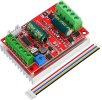
Yeah - I'm hoping I don't have just a parts unit thanks to that old IC. I see pulled boards with the AN630U, but I'm not sure it's the same as the non U version used here. Plus, the prices vary from a $50 gamble to more than I would want to spend. I'll sit on this for a few weeks and see if anyone else has any input. After that, I'm temped to see if I can get one of these cheap brushless speed control boards to work. Strictly a Hail Mary plan.

81oiZ-LNlfL._AC_SX679_.jpg
 
If the motor is spinning faster it'll consume more current - not sure that really tells you anything. I'd measure the supply voltage from the emitter of TR1, and from the common side of S2. If the supply voltage increases then you've a problem there. If it doesn't but there's a change at S2, then the VRs are likely an issue. In that case, as a second step, you could bypass them with a fixed R of approximately the same total value. Likely the 'table won't be at the correct speed, but it should be at a consistent speed, and it shouldn't change.
 
The ticking sound, mechanical. That shouldn't be there. The feedback coil, is the distance adjustable? Too close and thermal expansion might decrease the gap area enough to affect operation through increasing contact altering its output. Might be nothing but that ticking should not be there.
 
No, they are not adjustable. I know in RC cars some ESCs can make the motor coils "sing". Maybe it's something similar happening here.

Last night I put the diodes back in and measured voltage at the TR1 emitter & S2 by clipping on to R10. Both rose slowly until the 25 minute mark when things really ramp up and the tapping begins. The total delta up to that point was ~160ma for TR1 and 60ma for S2. Once it started making noise, the TR1 voltage bounced between 21.17v - 21.324v - S1 was 19.07v - 19.13v.
 
I don't understand why you keep looking at current. The output of the VR chains for each speed are a voltage reference for the speed comparator, so all we really care about right now is the voltage. Specifically, what is the voltage of that PSU rail doing and what is the voltage of the reference doing (common of S2) doing from cold start and speed ramp-up. Once it starts really misbehaving your voltages are going to be all over the place, so you'll not getting any useful readings then.
 
Sorry - my mistake. Yes, they were all voltage measurements. Double checking my notes - from a cold start I had 21.167v at TR1 emitter and that rose to 21.324v once the pulsing and tapping started. Voltage at S2 (R10) rose from 18.96v to 19.13v. So they both increased by roughly 160mv.
 
Ok - can you explain the events a bit more clearly? My read is on cold start it runs fine, then slowly increases speed (how much and over how long?), and then finally it starts pulsing and making the tapping noise.
 
No problem. The actual platter speed increase is very slow. I see only a very slight increase in the strobe speed. When listening to an LP, I never really noticed it until it seems to hit a threshold and starts to really take off.

*edit - at some point just before the tapping starts the strobe begins pulsing back & forth, like it's trying to surge ahead. It's usually less than half the width of the strobe dot.

Here's what I have in my notes from monitoring voltages last night.

9:15pm - TR1 E=21.167v, R10=18.96v
-- 9:22pm - 21.25, 19.08
-- 9:25pm - 21.27, 19.09
-- 9:30 - 21.295, 19.11
-- 9:35 - 21.304, 19.12
** 9:39 - 21.324 to 21.17, 19.13 to 19.07 - Tapping
 
Last edited:
Doesn't seem like it's the VRs or the PSU - the changes seem too slight. As a last check, when it start pulsing, if you lower the speed adjust VR to get the voltage back down to where it started cold, does it start behaving normally again? From cold, when you adjust the speed VR to increase speed to where it pulses when warm, does it still pulse in the same spot? What we're looking for is a correlation between the reference voltage to the IC and the motor behavior. My guess is that there probably isn't one, but these quick checks will give a lot more confidence.

I think it's likely time to get more aggressive on finding cracked solder joints, or components that are drifting excessively with temperature. A can of freeze spray is very handy if you have it.
 
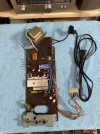
Thought I should update this thread with the resolution. I had put this 1700 on the shelf as other projects took priority. I don't spin a lot of vinyl, but I really missed the auto return on this, so I decided to have another look at it last month. I had previously replaced the TR-1, TR- 2 and nearly all the e-caps. All the resistors were within spec, so it had to be either the motor or the AN630 IC. I pulled the motor, checked the resistance on each winding and reflowed all the joints again. No dice. I happened to be cruising eBay and found someone in Japan selling a pulled, said to be working control board for a reasonable price. The board is slightly different than mine, with the strobe bulb mounted on a raised metal clamp instead of a separate board. It all fit just fine. I swapped the 100v transformer for my 120v version and it's been playing like a champ for many hours over the past two weeks!
s-l1600.webp
 
If I remember correctly the speed pots need to be desoldered to deoxit correctly. Is that the case?
 
The two standard pots next to the speed switch are easy to reach with Deoxit. If the trimmers are problematic, I would opt to replace them with a sealed Bourns or equivalent.
 
Back
Top Bottom