• The move to the new server is done. There are some software and database maintenance updates in process. This has us passing the hat around to help out. We appreciate any donations. Seriously, even a dollar helps. The payment page may be found here - https://www.audiokarma.org/support.html

Slight Hum (‘61 Motorola Console)

jpatti75

Amazing I haven’t electrocuted myself, yet.
Subscriber
Hi gang,

I am getting a slight hum from the speakers on my ‘61 Motorola SK70 console, and I assume I am picking some interference due to poor power and speaker cable routing on my part when I restored all the innards. The unit originally had a very pronounced 60hz hum, but that was resolved after replacing the filter caps. I have no video equipment in the same room or anywhere near the console. You can hear the hum when either the tuner or the phono input is turned on (this unit only has those two inputs), and the hum is present when you turn the volume all the way down. The hum is hardly noticeable while music playing, but it is present nonetheless. The hum actually seems a little more pronounced when you switch the tuner from FM over to AFC, for what that’s worth. (I could have a crappy antenna, too.)

Tomorrow, I intend on taking the back off to see if there is some smarter routing of the speaker wire that can be accomplished. When I re-wired the speakers I believe I used 14ga Monster speaker wire. Any recommendations on how to approach this task would be appreciated!

JP
 
Register to hide this ad
Pull the 12AX7/12AU7 preamp tubes and see if it still hums. If it doesn't, it is most likely a microphonic tube. If it still hums, you still have some power supply issues in which maybe there is a capacitor that isn't grounded or soldered properly.

Are there any flourescent lights hanging overhead? :idea:
 
Last edited:
Thanks, Cademan. All of the tubes are still original, so maybe I do have one that has gone microphonic. I have replacements tubes, but I left the originals in since they were all at least firing after I cleaned the tube sockets. On the soldering — when I replaced the filter cap can, I do remember getting the solder to adhere to the chassis for each ground connection was a pain ... like trying to solder to aluminum. I built up the solder and it seemed to create a solid bond, but is there a special technique? The original soldering (or perhaps brazing?) had a very strong bond to the chassis.

No fluorescent lights anywhere close.

Thanks!
JP
 
wattage is the secret. The chassis just gobbles up the heat so you need an iron with enough power to overcome that. Once its been soldered once, new solder will flow to the old without much trouble so long as you can get it hot enough.
 
wattage is the secret. The chassis just gobbles up the heat so you need an iron with enough power to overcome that. Once its been soldered once, new solder will flow to the old without much trouble so long as you can get it hot enough.

I use this. Old 100-watt iron.

solder iron big 100watt.jpg

Can you post a photo of the wiring? You may have half of the heater line grounded to the chassis. With only one insulated line to each tube. They often did that in the olden days. :) This makes hum elimination almost impossible.
 
Thanks for the tips, guys! Mr. Boochie, that is one impressive soldering iron!!

I went back in today and checked everything over. I ended up replacing the pre-amp tube, which was microphonic and since I had new ones, I also replaced the amp tubes. I’m holding onto the old ones, as my friend has a Hickok tester, and I am curious to see how they actually test (they’re Motorola tubes marked from Great Britain). For the filter caps, I did enhance the soldering a bit and I have to believe each of the 4 caps has a very solid ground. The cathode cap connection was in need of some more solder.

There still is the slightest hum from the unit, but maybe I am just being far too sensitive.

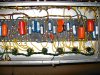
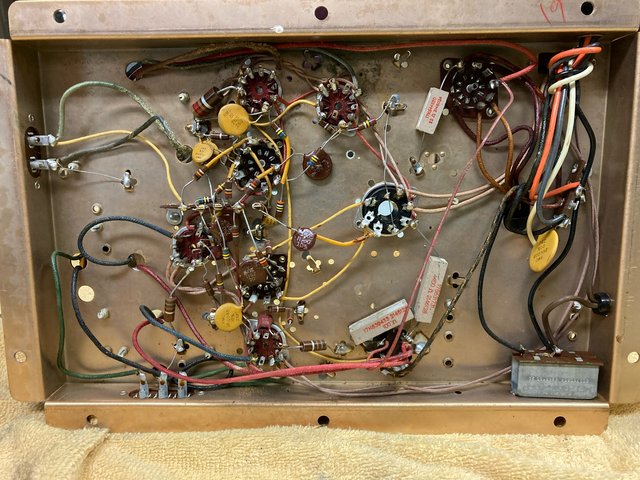
Mr. B, here is a picture of the amp before I replaced the can:
934341-C0-39-EA-489-E-9-BDA-B0-C1-C0-E9-D5-DD.jpg


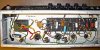
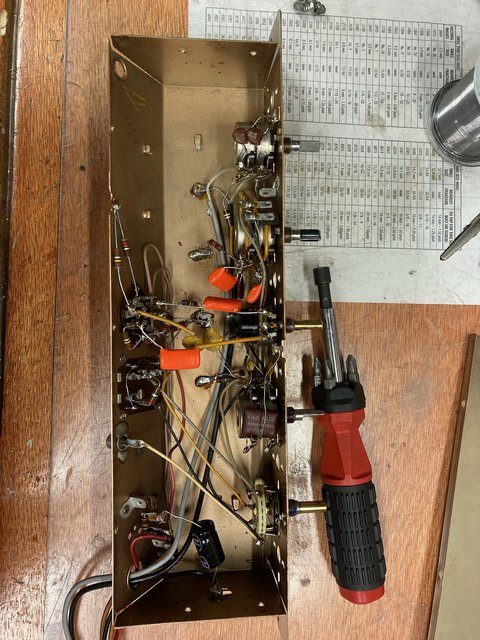
Here is the pre-amp after I replaced the electrolytic caps:
Preamp.jpg
 
Last edited:
Thing is, there should be no hum. Tube or solid state. :no:

Yeah, you need one of those high watt soldering irons if you are going to reattach electrolytics to the chassis. I have one but never used it as I personally don't replace the cans. I just do individuals under the chassis. Works for me. :thumbsup:

I can't tell if my Motorola console is ever on except that I see the pilot light if I accidentally go away and leave it on. :oops: :biggrin:
 
Thanks for the tips, guys! Mr. Boochie, that is one impressive soldering iron!!

I went back in today and checked everything over. I ended up replacing the pre-amp tube, which was microphonic and since I had new ones, I also replaced the amp tubes. I’m holding onto the old ones, as my friend has a Hickok tester, and I am curious to see how they actually test (they’re Motorola tubes marked from Great Britain). For the filter caps, I did enhance the soldering a bit and I have to believe each of the 4 caps has a very solid ground. The cathode cap connection was in need of some more solder.

There still is the slightest hum from the unit, but maybe I am just being far too sensitive.

Mr. B, here is a picture of the amp before I replaced the can:


Here is the pre-amp after I replaced the electrolytic caps:

Your unit has paired AC heater lines. Some areas are twisted, some are not. If you really wanted to, you could redo the twisted leads and raise them above the signal lines --- to minimize picking up the hum from the AC lines. :)

heater line_twisted_934341-C0-39-EA-489-E-9-BDA-B0-C1-C0-E9-D5-DD.jpg


Pro_amp_192_chassis_after.jpg
Bias board -after.jpg
Like how the heater lines (green wires) are twisted and raised in my Fender Pro amp. :)
 
Last edited:
I also replaced the amp tubes. I’m holding onto the old ones, as my friend has a Hickok tester, and I am curious to see how they actually test (they’re Motorola tubes marked from Great Britain).

Good call, I'm willing to bet they test well, plus it sounds like you have some Motorola branded Mullards

If you care to learn more about them this is a good resource and the codes should look similar to these (see attached pic). You're in good hands with the current respondents so hopefully they'll help you get that hum figured out.

http://www.tube-classics.de/TC/Tubes/Valvo ECC83/ECC83.htm

Screen Shot 2021-05-31 at 7.43.07 PM.png
 
Thanks for all of the replies!

Perhaps the next rainy weekend I get I’ll consider re-wiring the heater wires to twist them and get them out of the path of the signal lines. I’m not sure the best path for the heater wiring given the tube placement, however. (MR. B- that Fender wiring is a work of art.) Pretty confident that at least the filter caps are properly grounded at this point, as the troubleshooting continues.

Gswankey- thanks for the tube info!
 
Thanks for all of the replies!

Perhaps the next rainy weekend I get I’ll consider re-wiring the heater wires to twist them and get them out of the path of the signal lines. I’m not sure the best path for the heater wiring given the tube placement, however. (MR. B- that Fender wiring is a work of art.) Pretty confident that at least the filter caps are properly grounded at this point, as the troubleshooting continues.

Gswankey- thanks for the tube info!

Really, the twisting and placement of the heater line will help a little. Just what percentage of benefit is amp and ear dependent. If you can live with the baseline hum, let sleeping dogs lie. I do my DIY circuits based on what has worked before. So that I don't need to go back into the unit and rewire it. :)

VC_BF-1966Circuit before.jpg
One heater line grounded to chassis.


BFVCwtihtwistedheaterwire4.jpg
Same amp, with twisted pair. Lifted off chassis (electrically and physically).
 
Last edited:
imbalanced output tubes can also produce hum in a push-pull amp. Possible swapping one tube from each channel will get a better match and settle it down. Worth a shot anyway. Try maybe swapping the two outer-most tubes.
 
Well, I went back through the amp looking for bad soldering connections and anything microphonic and all seems to be good on that front. I don’t think the remaining faint noise I am hearing is actually coming through the speakers ever since I added solder to ground for the cathode capacitor ground (when I replaced the filter capacitor can). I didn’t want to disconnect the speakers and risk blowing up the amp to confirm, so I am going to trust my ears. What I believe remains is just a slight noise coming from the main power transformer. I tightened the screws holding it down to the chassis. You can still hear a faint noise at the back of the unit, but at this point I think I am just going to leave it. It certainly isn’t noticeable when music is playing, and hardly noticeable otherwise.

Thanks, again, for all the help, gents!
JP
 
If you have to really pay attention to hear it, its not enough to worry about.

Agreed!, I used to be obsessed with the slightest of hums when I was right in front or bending over the amp. As long as it isn't/wasn't coming through the speakers I could care less now.
 
@jpatti75

Did you ever decipher the tubes for manufacturing dates, etc?

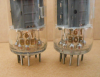
From what I can tell, the tubes are original and are Mullards. The 12AX7As are I61 B1F, and that puts them in the 1959-69 production range, according the website. The 6BQ5/EL84s are really hard to read and it took me a bit to realize the codes were printed upside down compared to the 12AX7As. If I am reading them correctly, they are rX1 B1E(?). All four are really tough to read. I can’t seem to find an exact code match, but I believe they are early production Mullards. One of the 12AX7As is pretty noisy, but two seem OK. I’ll get them tested at some point.
 
^ Nice!!!!, I love when amps come with their original tubes and you are correct that the 6BQ5 codes are printed upside down.

"rX1 B1E(?)"

rX = 6BQ5/EL84 1= 1st iteration

The (B1E) B for Blackburn, Mullards main plant, 1 is for 1961, and the E which is for May (A for January, B February etc), (?) would be the week of that month, however I could be wrong about that aspect.
 
Back
Top Bottom