• The move to the new server is done. There are some software and database maintenance updates in process. This has us passing the hat around to help out. We appreciate any donations. Seriously, even a dollar helps. The payment page may be found here - https://www.audiokarma.org/support.html

Small amp project; finally finished!

grindfix

Full time hobby
Subscriber
1.jpeg

2.jpeg


This project started several years ago. With various design changes, it presented different challenges but is now finally finished.
It started its life as The Fisher Philharmonic console. I purchased the almost working receiver on the FBM. Replaced several burned resistors and got it to produce the sound. I haven't investigated the channel imbalance and other issues of the original design, ELL80 outputs were very tired, so I decided to use transformers to build a small standalone stereo power amplifier.
First, there was a prototype exercise built with 6BQ5 output tubes but that didn't look good on the scope. If anyone is interested in reviewing that trial, the thread is here:


So, I decided to build with EL95 tubes, which by specs seem to be the exact half of ELL80 tube. Since I was using the PT that came in the receiver, I utilized one of the 6.3v windings to knock the incoming voltage down. I ended up with near near-perfect 6.3v for filaments and my B+ is at 298v.

I'm overall satisfied with the outcome. It took me a while to find a laser engraving shop that would be willing to do this hobby project, I guess the brass is difficult to work with. Other than that, the amp was finished in the spring.

Power Output 8W into 8ohm load
Input Sensitivity 0.9v
15.5dB of Global NFB
Frequency response is flat 20Hz-35KHz

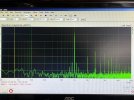
Full power THD:
50Hz = 1.3%
1KHz = 0.34%
15KHz = 0.8%
5.jpeg


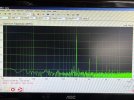
THD at 1W output:
50Hz = 0.2%
1KHz = 0.19%
15KHz = 0.4%
6.jpeg

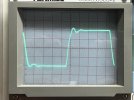
Stable into a variety of loads. Tested up to 1uF unloaded. I can make a square wave look ugly, but it doesn't break out into oscillation.

4.jpeg

3.jpeg


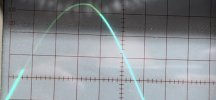
One thing is looking questionable to me. Can anyone tell me what this sine wave peak shift means that only happens at lower frequencies?
8.jpeg

7.jpeg
 
Register to hide this ad
Now there is a tidy build - well done!
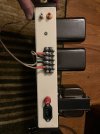
(If available, I would like to see a photo of the back side w/connectors)
 
Talking about that slight corner near the pesk? Is that close to full power? Might be the very beginning of saturation in the transformer. They aren't exactly massive transformers.


If the rest is bound for scrap, I'd be interested in the detector transformer and the mpx unit.
 
Is that close to full power?
That's at 1W. I took those shots during frequency response measurements.

If the rest is bound for scrap, I'd be interested in the detector transformer and the mpx unit.
The rest of the original Philharmonic receiver chassis is still here. I have 2 Fisher receivers and 2 tuners so I plan to keep bones for spare parts if I ever need them and they actually match. No Idea about tuners though.
 
I may have the same Fisher receiver that worked when removed from cabinet. It had a Magic Eye tube.
Also a working Fisher Integrated amplifier using those tubes.
Thought of doing the same build with the two tubes verses the one dual.
Giving me ideas now.
Nice work!
 
Very nicely done sir.
The simplicity and basic layout suggest it could have been built any time in the last 60 years. Simple, clean, with no extra flashy garbage.
You really hit the nail on the head.
 
Thanks for the compliments, everyone.
As with anything that you do for the first time, I had a mishap with epoxy potting the OTs.
I wanted to pull the vacuum on it so I taped transformer covers with masking tape so I wouldn't get any accidental epoxy on the powder coat. I didn't expect (or just simply didn't think about it) that anything liquid boils under a vacuum at room temperature. This is the reason we evacuate the AC system before charging with freon - to boil any remaining moisture out. So, epoxy boiled and spilled over just a bit one time. I didn't think too much of that since transformers were taped over. Well, if I would (second thing I didn't think through) start taping around the bottom (upside down) and finish at the top, kinda like roof shingles are laid, I would have been fine. I left the tape on while working on the amp so the powder coat wouldn't get scratched. When I was all done, there was a surprise for me when I got all the tape removed. I was so pissed and had to walk away. I ended up taking both OTs out and had a body shop match paint as closely as it was reasonably possible to match the powder-coated bells of the PT.

There is always a takeaway with every project, this one seemed so simple from the start but it took me the longest to complete. But I wanted it to be as perfect as it could be done from electronic and sonic perspectives as well as being aesthetically pleasing. This one is for my HS graduating daughter. She loves it!
 
I wouldn't have figured the vapor pressure of epoxy would be low enough to boil under any sort of normal vacuum, unless you put it in a chamber and used an HVAC vacuum pump to really draw a hard vacuum on it.

I've only vacuum charged things using the little MightyVac hand pump for car use. Only get 22 inches or so from that, not enough to boil much less active than acetone.
 
I rigged up the vacuum chamber from a large mason jar and used automotive AC gauges and a vacuum pump. I only had High-side fitting lying around so I don't even know what the actual vacuum was but I had to turn the pump on and off to control boiling. I seriously doubt that vacuum reached even 22"Hg. The pump doesn't have a check valve so it quickly drains when it is switched off.

1.jpeg
 
and it was actually boiling, not just releasing trapped air from the mix or pour? Interesting.

Thats a larger version of what I use to re-oil oillite bushings though. The fitting on mine is a grease zerk that I pulled the check ball out of. Its just the right size for the rubber hose from my hand pump. Pulling vacuum on those makes it fizz like slightly shaken beer.
 
and it was actually boiling, not just releasing trapped air from the mix or pour? Interesting.
At first, I thought it was just air, but it kept boiling every time the pump was on. I must have turned the pump on and off in short cycles close to 20 times to make sure no bubbles were trapped when it hardened
 
I just compared the EL95 with 6AQ5. They aren't that far apart and have the same pinout. Interesting. They aren't quite the same but a circuit for the EL95 could probably be adapted to 6AQ5 which are much more common.
 
I was considering those and some other tubes but if I remember correctly, EL95 plate load specs are closer to what these transformers measured.
 
Back
Top Bottom