• The move to the new server is done. There are some software and database maintenance updates in process. This has us passing the hat around to help out. We appreciate any donations. Seriously, even a dollar helps. The payment page may be found here - https://www.audiokarma.org/support.html

So I got obsessed over a CD changer

duncan

flâneur in training
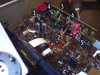
A few months ago I posted about picking up an inexpensive broken Yamaha CDC-585 and getting it to work. I'd wondered from the start about replacing op-amps in its analog section, but that turned out to be just part of what it's been subjected to in the meantime.

I'll be posting a sort of "recipe" later with pictures and a list of locations and parts (mostly capacitors), but until I get those pictures taken I want to mention the loading drawer belt issue.

As some besides myself have noticed, it can be hard to find replacement belts that are a good match for the OEM part unless you're willing to do some measuring and fudging. This model uses Yamaha part VQ776900, but apparently Yamaha no longer supplies it, and if you look for it on Amazon or That Auction Site, what you are most likely to find are knockoff suppliers who will provide a belt of the correct length but only a 1 square millimeter cross section. Because it lacks the right surface area, it won't transmit as much torque as it should, which is important for moving that big 5-disc drawer around. It probably won't last very long either. Being short of wit, I ordered bad belts from two different Chinese vendors, each time having to wait for the proverbial Slow Boat to deliver those little envelopes of disappointment.

Here's a reliable replacement: part SBM4.65 made by PRB ("Projector Recorder Belt") Corporation. In their nomenclature SB is "square belt," M is a thickness code, and 4.65 is the full length in inches. And there's a seller on That Auction Site who provides SBM4.65 in bags of four for a pretty reasonable price.

MX1_1599.jpg

According to service manuals, all of the following Yamaha changers use the same loading belt:

...clears throat...

CDC501, CDC502, CDC505, CDC506, CDC555, CDC565, CDC575, CDC585, CDC600, CDC655, CDC665, CDC675, CDC685, CDC697, CDC900, CDC901, CDC902, CDC905, CDC906

Edited to add Ghetto Tip: if you have one of these players with a slipping or broken loading belt, and you've already started down my path and bought a subpar replacement, one short term strategy is to swap it with the belt that raises/lowers the optical pickup unit. It's the same part, but that belt doesn't have as tough a job, so maybe it has some life left in it.
 
Last edited:
Register to hide this ad
In my ideal universe: we would never have to throw away, an otherwise functional device, because of replaceable part. After watching a lot of Techmoan videos, I can imagine how frustrating it must be when you can't find the right belt.

I hope that you can find a source.
 
In my ideal universe: we would never have to throw away, an otherwise functional device, because of replaceable part. After watching a lot of Techmoan videos, I can imagine how frustrating it must be when you can't find the right belt.

I hope that you can find a source.

After all that verbiage, I realize I didn't say it quite straight out: I consider the PRB belt to be correct, and I do have a source for them. (No affiliation here, but an ebay search for SBM4.65 qzty finds them.) So it's a happy ending, and I hope other Yamaha changer owners can take advantage too. And yeah, I agree with you: a device that can be repaired should be repaired, unless it's truly obsolete for design reasons rather than just because of a simple part -- especially a hunk of rubber.
 
After all that verbiage, I realize I didn't say it quite straight out: I consider the PRB belt to be correct, and I do have a source for them. (No affiliation here, but an ebay search for SBM4.65 qzty finds them.) So it's a happy ending, and I hope other Yamaha changer owners can take advantage too. And yeah, I agree with you: a device that can be repaired should be repaired, unless it's truly obsolete for design reasons rather than just because of a simple part -- especially a hunk of rubber.

I'm glad that you were able to find a source. I wonder if there's something akin to a 3d printer to accommodate very small runs of custom belts
 
So, the rest of the story. When a parts order went astray, the op-amps I wanted to use for this took a month to get here. But I had the unit apart and was eager to play, so did all the stuff I could first with parts on hand.

Summary:
yamaha-summary.jpg

1. The only change on the main board was to beef up filtering for the linear power supply. C201 & C202 are supposed to stabilize the +/- 5v lines for the entire player. Originally tiny 100uf6.3v cans, they were replaced by Muse KZ 220uf/25v. Not shown: 0.1uf ceramics bypassing these on the other side of the board.

2. Supply rails for the op-amps are filtered by C108 & C111. Originally 100uf/6.3v, no room for boutique caps here, replaced by Panasonic FM 220uf/25v. Not shown: FC 3.3uf/50v bypassing each of these on the back side, jammed kinda tight inside the frame.

3. Output couplers C107 & C112 were 22uf/16v polar electrolytics. I did several rounds of experimenting with these and settled on a rather odd combo: green-can Muse bipolar 100uf/16v, bypassed on the back with Panasonic SU 1uf/50v bipolars and also with 0.01uf ceramics.

4. Removed the four muting transistors Q101-104. The player does spit and pop alarmingly when it's first powered on, but only then, not during pause or stop or disc changes. So if you hit the power buttons in the right order it's not a problem. Still, I might rig up a mute relay later.

5. Four input couplers C47-50 (between the DAC and the op-amps) were 1uf/50v polar electrolytics; replaced with WIMA 1uf film caps.

While waiting for the op-amps to arrive I had plenty of time to listen to it like this, and it was already somewhat improved: imaging was more solid, percussion had better "slam" and presence. But then the parts came, and...

How did the op-amp swap work out?

6. IC101 & IC102 were NJM2068 op-amps; replaced with a socketed LME49720 pair, and ran a 0.1uf ceramic cap between pins 4 & 8 of each socket on the back side.

This was definitely the delayed-gratification step. Any harshness and fatigue was just gone, and the upper midrange started to shine. It's a much sweeter sounding player now, and close to a toss-up if deciding to listen to it through a DAC or by itself.
 
Quick addendum to point #3 in the previous post. At first I'd replaced the stock 22uf couplers with Silmic II 47uf electrolytics by themeselves. The change produced a smooth, darkish sound, certainly pleasant and non-fatiguing, but a touch veiled. For the remedy I want to give @Bratwurst7s credit for helping me think about coupling caps. After seeing this post I did a little "research" (you know, University of Google) about the impedance curves of capacitors and how they can matter not only for power decoupling but also signal coupling.

The combo of 100uf+1uf+0.01uf made intuitive sense because the three points are equidistant on a logarithmic scale - verifiable without a calculator since each step is a factor of 100 - also because I had those parts lying around - but 0.01uf is probably smaller than necessary for audio frequencies, and I imagine 100+3.3+0.1 would work at least as well.
 
Sounds like you are having fun. :):thumbsup:

I've been constantly amazed by the positive results of even a few simple mods to a cd player. By all means, addressing the output coupling caps is worthwhile. And anything that you can do to clean up the power supply pays dividends through the entire machine.

Keep on Truckin'!
James
 
Just wait until you break the bounds of using a five disk player with that of an infinite player...

Ha ... you're reminding me of the old Steve Martin bit,

"So I got rid of that and got the dodecaphonic with the 12 speakers. This was more to my liking -- for a while."
 
I left CD players/changers behind seven years ago. Having a single digital library that includes 24 bit content instantly accessible from multiple players along with access to internet radio and services with literally millions of tracks like Tidal an Qobuz is a beautiful thing. There will never be a question of "for a while". :)
 
Having a single digital library that includes 24 bit content instantly accessible from multiple players along with access to internet radio and services with literally millions of tracks like Tidal an Qobuz is a beautiful thing.

I do have a media server too, but like to think there is more than one kind of beauty in audio pursuits. Now kindly excuse me while I dump out and disinfect the punch bowl.
 
Enjoy your pursuits. I prefer spending more time listening than feeding transports and waiting for changers to clunk to another disk.
 
Duncan: Thanks for posting all of these neat upgrades, and drive belt suppliers. I found one of these exact Yamaha CDC-585 players in a pile of 6 or 8 that I was given for free while helping a friend clear out an estate. He does this for a living for lawyers that are clearing up estates for people with no relatives and gets some neat audio stuff from some of his estate clear outs and sometimes calls me to help as he has way too much stuff already. Just one question is : What was the purpose for step 4) ? removing the 4 muting transistors Q101 thru Q104 ? This will make a grand winter useful project for me.
Mr. Bill
 
Last edited:
Might be time for a followup! A few months ago I gave the player to a sibling whose CD changer stopped reading discs.

But while I was still using it here, I ended up changing my mind about the muting transistors ("step 4" above), and putting them back in. I like equipment to behave as designed in general, and if there had been a sonic benefit to removing them in the first place, it was dwarfed by the benefit from changing the op amps.

Also I went through a few more variations on the output couplers ("step 3") before settling on the 100uf nonpolar Nichicons each bypassed with just a smallish Wima film cap.... those were 0.47uf if I remember right.

Anyway, I hope you enjoy your project and get to hear the improvements. The capacitor choices aren't that critical in my opinion, though wherever you can get away with film instead of (or in parallel with) electrolytic it is usually a plus, especially in the signal path. I thought in this case the op amps made the biggest difference.
 
Duncan: Thanks again for the update - all good info for modifying mine. I appreciate you taking the time to post all of this. I hope I like the sound of mine when done. I still have not yet ordered all the parts I need but I did order the belts from the guy on the Bay you pointed out so at least that is done they are due here tomorrow then I need to order the rest of the parts I don't have after I see what I have in stock.
BEST to you
Mr. Bill
 
Back
Top Bottom