
• The move to the new server is done. There are some software and database maintenance updates in process. This has us passing the hat around to help out. We appreciate any donations. Seriously, even a dollar helps. The payment page may be found here - https://www.audiokarma.org/support.html

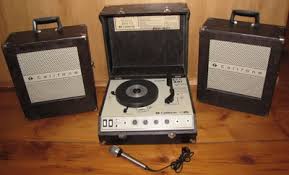
So I just bought a Califone 1925

SpinninTimmy

Active Member
I bought a vintage tube portable, and a G.E. Trumline 500, but not really satisfied.

I wanted a portable with some room filling power.

Is this going to be "The One"?

Nice detachable speakers, lots of pro features.

This one has been completely restored.

Cheers/Jeers?

Also, can anyone provide a link to a good history of Califone?

I'm happy to have returned to the land of vinyl!


P.S. this is a stock photo.
My set has not arrived yet but looks almost identical.

 
Register to hide this ad
The official record player of square dance lessons in the school gym.

According to their web site, Califone started out in 1946 as a division of Roberts Electronics, a popular manufacturer of reel-to-reel tape recorders. Later they were owned by Rheem -- yes, the same Rheem that makes water heaters and furnaces. Califone's record players and cassette recorders were ubiquitous in schools and churches when I was growing up in the '80s and '90s.

Interesting, thank you!
I think I read somewhere that for a while, Califone was headquarted in Vancouver, B.C ., and there are actually some Canadisn made sets.

Odd there isn't a Wikipedia entry for the company.
 
Last edited:
Califone's products were intended as institutional products. Classrooms were where I first saw them in the 1960's.

I am a native Vancouverite and became acquainted with an employee of Califone Industres in the 1970's. My understanding was hardware was shipped to his location which was then installed into their respective cases. I suspect that the cases were made locally. Purpose built for playing loud enough to be heard throughout a classroom or small auditorium.

I imagined record players were their stock in trade but tape machines were on the menu. Roberts was mentioned and that's what those were. Through this fellow, I was able to buy a Roberts branded Akai 1800 open reel/8 Track combo and a Roberts indash 8 Track receiver for my wife's car.

His Califone branch also had access to LG (psuedo Luxman) stereo receivers and turntables plus Coral speakers. Those speakers sure looked a lot like Sansui's. Umpteen drivers in a too small lattice fronted box.
 
Califone players get loud, but they're not going to blow you away with sound quality. No low bass or high treble, thanks to the high efficiency full range drivers, and the heavy tracking ceramic cartridge. They are good for what they are, but will sound a lot better playing the audio version of Edgar Allan Poe stories, or the sound track for Grade 8 social dance class, than for listening to King Crimson in your living room.

There's lots of videos on YouTube about how to clean the drive mechanism and check the cartridge, etc.

I believe the ones made in Vancouver were for the Canadian school market, back before NAFTA put an end to Canadian assembly of things like record players. Similar to how we had Canadian made RCA television, GE radios, Hoover vacuum cleaners, etc etc.
 
Last edited:
Califone's products were intended as institutional products. Classrooms were where I first saw them in the 1960's.

I am a native Vancouverite and became acquainted with an employee of Califone Industres in the 1970's. My understanding was hardware was shipped to his location which was then installed into their respective cases. I suspect that the cases were made locally. Purpose built for playing loud enough to be heard throughout a classroom or small auditorium.

I imagined record players were their stock in trade but tape machines were on the menu. Roberts was mentioned and that's what those were. Through this fellow, I was able to buy a Roberts branded Akai 1800 open reel/8 Track combo and a Roberts indash 8 Track receiver for my wife's car.

His Califone branch also had access to LG (psuedo Luxman) stereo receivers and turntables plus Coral speakers. Those speakers sure looked a lot like Sansui's. Umpteen drivers in a too small lattice fronted box.

Interesting!

Thanks for the great historic information!
 
Califone players get loud, but they're not going to blow you away with sound quality. No low bass or high treble, thanks to the high efficiency full range drivers, and the heavy tracking ceramic cartridge. They are good for what they are, but will sound a lot better playing the audio version of Edgar Allan Poe stories, or the sound track for Grade 8 social dance class, than for listening to King Crimson in your living room.

There's lots of videos on YouTube about how to clean the drive mechanism and check the cartridge, etc.

I believe the ones made in Vancouver were for the Canadian school market, back before NAFTA put an end to Canadian assembly of things like record players. Similar to how we had Canadian made RCA television, GE radios, Hoover vacuum cleaners, etc etc.
Cool!

I believe my particular model has something called "soft track".

Not sure what that means.

Also has a rather high quality cartridge, iirc.
 
Cool!

I believe my particular model has something called "soft track".

Not sure what that means.

Also has a rather high quality cartridge, iirc.

Oh, that's just a slightly less heavy tracking ceramic cartridge. A high quality ceramic cartridge is something like saying you are eating a high quality TV dinner.. there's a limit to how good they can ever be. The main design goal here though is to not be ruined by students, and to be loud and clear enough to fill a classroom with sound. You won't get the sort of transparent sound which high fidelity record players are all about, but it will probably be enjoyable to listen to. As a machine it is quite interesting. Come to think of it, I have a Califone in the garage, which I bought a few years ago and have never tried... maybe I'll bring it inside today and play with it!
 
Califone players get loud, but they're not going to blow you away with sound quality. No low bass or high treble, thanks to the high efficiency full range drivers, and the heavy tracking ceramic cartridge. They are good for what they are, but will sound a lot better playing the audio version of Edgar Allan Poe stories, or the sound track for Grade 8 social dance class, than for listening to King Crimson in your living room.

There's lots of videos on YouTube about how to clean the drive mechanism and check the cartridge, etc.

I believe the ones made in Vancouver were for the Canadian school market, back before NAFTA put an end to Canadian assembly of things like record players. Similar to how we had Canadian made RCA television, GE radios, Hoover vacuum cleaners, etc etc.

I love King Crimson!

Ironically, there is a great "experimental" indie band called "Califone", that released some of their music on vinyl.

I intend to listen to Califone on my CALIFONE! :)
 
Oh, that's just a slightly less heavy tracking ceramic cartridge. A high quality ceramic cartridge is something like saying you are eating a high quality TV dinner.. there's a limit to how good they can ever be. The main design goal here though is to not be ruined by students, and to be loud and clear enough to fill a classroom with sound. You won't get the sort of transparent sound which high fidelity record players are all about, but it will probably be enjoyable to listen to. As a machine it is quite interesting. Come to think of it, I have a Califone in the garage, which I bought a few years ago and have never tried... maybe I'll bring it inside today and play with it!

Sounds like a great way to spend a Saturday morning! :banana:
 
Oh, that's just a slightly less heavy tracking ceramic cartridge. A high quality ceramic cartridge is something like saying you are eating a high quality TV dinner.. there's a limit to how good they can ever be. The main design goal here though is to not be ruined by students, and to be loud and clear enough to fill a classroom with sound. You won't get the sort of transparent sound which high fidelity record players are all about, but it will probably be enjoyable to listen to. As a machine it is quite interesting. Come to think of it, I have a Califone in the garage, which I bought a few years ago and have never tried... maybe I'll bring it inside today and play with it!

I also have a 1961 "Stereophonic High Fidelity" Zenith enroute from epay.

Strangely, it uses miniature tubes!
Unfortunately it is still Friday ;)
Yes, but Saturday morning is my traditional vinyl day!
 
I also have a 1961 "Stereophonic High Fidelity" Zenith enroute from epay.

Strangely, it uses miniature tubes!

Yes, but Saturday morning is my traditional vinyl day!

Nothing strange about that, most tube electronics after 1955 or so used miniature tubes unless it ran high power.

I think you will have fun with these old record players, just don't expect too much from them.
 
New Harley Davidsons have belt drive, electronic ignitions, no vibration, and lots of bells and whistles.

They will run circles around the old Knuckleheads and Panheads of bygone years, which left puddles of oil when parked in one spot for long, vibrated like a massage chair, had to be kick started, and half the bolts had to be retightened on a weekly basis Some had two sets of chains to rattle and wear out, requiring constant adjustment.

But somehow, to me anyway, the new machines seem like appliances, washing machines or dishwashers, soulless and commercialized.

They try but fail to capture the grace, beauty and soul of the old iron

I believe vintage record players are the same, in relation to the modern digital gesr that to some is state of the art, but to me is a betrayal of art
 
Pro features alone does not make it professional. Califone is generally school phonos of average quality, or low end square dance phonos. Yours is higher end by Califone standards, when it was new. but Newcomb was higher end in school phonos and square dance phonos, and Hilton was extremely higher end with more powerful amplifiers, and speakers of higher quality, and Statler made for me the best Square Dance phono system I ever saw. But those latter two brands were much more expensive when new too. Square Dance groups weren't lowest bidder, and usually spent more money than school phono lowest bidder prices.

Your Califone is a very decent, around 20 watts school phono/Square dance phono, and while it has a ceramic cartridge, it has a much better one than the 89T the cheaper mono models suffered with. In your era, your Califone was the top model or nearly top model, much better than those 1420K, 1430K, and 1450K models. Also, the Voice Of Music nicer school phonos are really nice, especially once you get past the 89T and General Industries mechanism economy models. I'd rather have a better School phono or Square Dance phono than a Crosley portable as a rule, and they're better built save for the very cheapest and the last DC motor equipped Califone models.
 
Last edited:
I think the same way, but to me "old iron" is a Garrard 401, or a Thorens TD124 - the old Zenith or Califone sets are more like a VW bug or something.

NTTAWTT! I've never had a Bug but I did have a Porsche 914 for a while, that little car was a kick in the posterior. (slow, but fun to drive. See SpinninTimmy's comments about Harleys above, same principle applies here.)
 
Back
Top Bottom