• The move to the new server is done. There are some software and database maintenance updates in process. This has us passing the hat around to help out. We appreciate any donations. Seriously, even a dollar helps. The payment page may be found here - https://www.audiokarma.org/support.html

So my brand new JVC RX-517v from Goodwill is having a few issues...

ExcitableOne

Active Member
Now to start this off, I don't even know if this is the right place to put this since my JVC isn't exactly "vintage". It's from 1993 and actually looks newer, so I honestly don't know. Second, I'm new here...as you can probably tell. Alright, now on to my problem. So a while ago my poor JVC was having some balance issues, so me, having no idea what I was doing, remembered something called a "service manual". I looked up the service manual on my receiver and got it from some Hungarian site I think, and found what I thought were internal balance trimmers. They were actually bias trimmers, at least I believe that's what they are, I still don't know. But I then decided to spin the around like crazy and every now and then turning the volume up to see if it worked...until the relays started having a stroke and I lost all sound output. Eventually the relays stopped clicking too and I decided it was time to look stuff up and track down the issue. I eventually came to the conclusion that two opamps were bad, BA15218Ns. So I bought two used ones from eBay for about $8, and just soldered them in today. I got everything reassembled, and plugged it in. I was greeted by instead of the relays clicking like they used to and a nice orange screen, the relays clicking and a bright flash from a fuse and a screen that isn't displaying anything. So there are 2 other lower power fuses that appear to be fine. I believe that this fuse is controlling the actual amount or something. I also don't really know what I'm talking about and would like somebody(s) to teach me a thing or two and guide me through this project that has gotten a bit out of hand. Thanks in advance!
 
Register to hide this ad
Welcome to AK.

They were actually bias trimmers, at least I believe that's what they are, I still don't know. But I then decided to spin the around like crazy and every now and then turning the volume up to see if it worked
This is precisely what you SHOULDNT have done. Any internal trimmers in equipment shouldnt be touched unless you know exactly what you are doing.

Given that you had that reaction from the relays, my guess is that you were actually mucking around with the DC offset trimmers (if these exist in this amp). Can you confirm if there was only one pair of trimmers you touched, or was there more than one pair?

If they were DC offset trimmers - chances are they just need to be brought back to the proper level, and your relays will engage. If you also touched bias trimmers however, chances are you will have blown your output transistors.

Chances are that your original opamps were actually fine. It will behard to know if you put dud ones in or not.

I take it you can use a soldering iron. Do you also have a digital multimeter?
 
Welcome to AK.


This is precisely what you SHOULDNT have done. Any internal trimmers in equipment shouldnt be touched unless you know exactly what you are doing.

Given that you had that reaction from the relays, my guess is that you were actually mucking around with the DC offset trimmers (if these exist in this amp). Can you confirm if there was only one pair of trimmers you touched, or was there more than one pair?

If they were DC offset trimmers - chances are they just need to be brought back to the proper level, and your relays will engage. If you also touched bias trimmers however, chances are you will have blown your output transistors.

Chances are that your original opamps were actually fine. It will behard to know if you put dud ones in or not.

I take it you can use a soldering iron. Do you also have a digital multimeter?
There is only one pair of trimmers, and I do not currently have a digital one, just a big analong one from the 80s that does AC/DC volts, DC amps, and ohmmeter. It's on my list of things to purchase when I have a bit of money and patience to research.
 
A new semi decent meter shouldn't cost you more than $10 or so. The readings you will need on it for starters are millivolts - mV. I recommend you get one. We can walk you thru the rest.

OK -those trimpots are for the bias. Does the meter you have now work correctly? To test - measure a 1.5v or 9v battery with the meter set to DC volts.

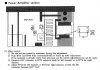
Essentially the attached procedure is what you want to do, once you have a meter that you can trust.....

Capture.JPG
 
A new semi decent meter shouldn't cost you more than $10 or so. The readings you will need on it for starters are millivolts - mV. I recommend you get one. We can walk you thru the rest.

OK -those trimpots are for the bias. Does the meter you have now work correctly? To test - measure a 1.5v or 9v battery with the meter set to DC volts.

Essentially the attached procedure is what you want to do, once you have a meter that you can trust.....

View attachment 1022238
While my analog meter does infact work, it can't got down to mV, so I'll have to pick one up. Hopefully it won't be long. What should I do about the fuse though? Because in my head it blew because of a short.
 
If you blew the fuse, you most likely cranked up the bias and blew the output transistors. This, along with possibly driver transistors, emitter resistors, etc. Your original problem was most likely a flaky protection relay.
 
If you blew the fuse, you most likely cranked up the bias and blew the output transistors. This, along with possibly driver transistors, emitter resistors, etc. Your original problem was most likely a flaky protection relay.
Well it did have to do with the transistors, and they might be blown, and it might be because if a protection relay, but it's not because of bias. I lost a screw, which for some reason are copper, and it bridged between the emitter and collector of a transistor. I'm testing them all now.
 
A new semi decent meter shouldn't cost you more than $10 or so. The readings you will need on it for starters are millivolts - mV. I recommend you get one. We can walk you thru the rest.

OK -those trimpots are for the bias. Does the meter you have now work correctly? To test - measure a 1.5v or 9v battery with the meter set to DC volts.

Essentially the attached procedure is what you want to do, once you have a meter that you can trust.....

View attachment 1022238
I now have a meter, only problem is the receiver only works without a fuse and even then the amp doesn't turn on because it doesn't receive power, all output transistors appear to be fine though. Although the do now all appear to be NPN even though the last time I checked I could have sworn that half were NPN and the other half PNP.
 
Back
Top Bottom