Been working on getting a blown up Yamaha M-60 up and running after another shop butchered it. Fairly easily got the amp section all worked out as I've done a few now and it's pretty much always been the same parts blown in each.
This one, though, was probably the 2nd worst I've seen from a butchering standpoint as it was missing transistors.
But anyway, onto the main thing I learned, apparently TO-3P packages can fail as a short between the collector and the screw hole. I guess the plastic isolation isn't that thick, but it's just a bizarre thing to see. I had gotten everything sorted out, popped on the DBT and had a nice bright light. After messing around for a bit I thought I just had a short at my insulator since it is possible to accidentally screw through them with the metal screws Yamaha used. After I thought I had it sorted out and no more bright DBT it was time for full power.
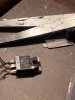
Unit worked nicely for about an hour unit I heard a nice pop and saw a decent amount of smoke. Transistor had shorted from rail to chassis... Upon testing the transistor actually still tested good, but when mounted to the unit it it was showing a dead short. Decided to test the screw hole for continuity and found that it was a short from collector to screw on one side of the hole. One other transistor in the power supply section was behaving similarly, and upon testing I found it also had a partial isolation failure.
I guess I got extremely lucky because nothing actually blew from the short, (or maybe that's just how it is since the collector is the input voltage).
But anyway, I guess my lesson is that I shouldn't trust that a TO-3P transistor that tests good but was messed with by someone else is still good. Goes to show you never know what kind of history the unit you're dealing with has.
This one, though, was probably the 2nd worst I've seen from a butchering standpoint as it was missing transistors.
But anyway, onto the main thing I learned, apparently TO-3P packages can fail as a short between the collector and the screw hole. I guess the plastic isolation isn't that thick, but it's just a bizarre thing to see. I had gotten everything sorted out, popped on the DBT and had a nice bright light. After messing around for a bit I thought I just had a short at my insulator since it is possible to accidentally screw through them with the metal screws Yamaha used. After I thought I had it sorted out and no more bright DBT it was time for full power.
Unit worked nicely for about an hour unit I heard a nice pop and saw a decent amount of smoke. Transistor had shorted from rail to chassis... Upon testing the transistor actually still tested good, but when mounted to the unit it it was showing a dead short. Decided to test the screw hole for continuity and found that it was a short from collector to screw on one side of the hole. One other transistor in the power supply section was behaving similarly, and upon testing I found it also had a partial isolation failure.
I guess I got extremely lucky because nothing actually blew from the short, (or maybe that's just how it is since the collector is the input voltage).
But anyway, I guess my lesson is that I shouldn't trust that a TO-3P transistor that tests good but was messed with by someone else is still good. Goes to show you never know what kind of history the unit you're dealing with has.