• The move to the new server is done. There are some software and database maintenance updates in process. This has us passing the hat around to help out. We appreciate any donations. Seriously, even a dollar helps. The payment page may be found here - https://www.audiokarma.org/support.html

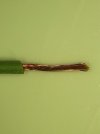
[Solved.. kinda :)] KAB Superflex: how the heck do you strip that thing?

fidot

AK Subscriber
Subscriber
Guys - I know there's a lot of good words on this board for KAB Superflex tonearm wire.

How do you strip that? :)

So far, I have tried:

- My nails (insulation too thin and just stretches, doesn't make a tear)
- Heat (silicone does not mind heat, my hottest butane torch does pretty much nothing to it)
- xActo - yes, but that can nick strands (and it did; causing some tear out).

I am at a loss here :( Frankly I'd be very apprehensive of anything with a cutter for such a thin wire...

Any advice for a moron chasing his tail here? :)
 
Last edited:
Register to hide this ad
Ha!

I don't know of any solvent that would do that - and Perplexity seems to be of the same opinion :). Some solvents might *swell* it, but not truly destroy it.

I am afraid of strong solvents - any solvents in fact, because they will naturally wick into the wire and may mess with insulation's integrity from the inside.


Since posting the above, I tried high heat - and remembered that after a significant application of it, silicone actually ashes (this is why it's used as fire sealant sometimes!), and the ash can be rubbed off. Problem is, the temp you have to get it to causes copper to severely oxidize and become effectively non-solderable. Given each strand's thickness, that's a no go as well :(.
 
Guys - I know there's a lot of good words on this board for KAB Superflex tonearm wire.

How do you strip that? :)

So far, I have tried:

- My nails (insulation too thin and just stretches, doesn't make a tear)
- Heat (silicone does not mind heat, my hottest butane torch does pretty much nothing to it)
- xActo - yes, but that can nick strands (and it did; causing some tear out).

I am at a loss here :( Frankly I'd be very apprehensive of anything with a cutter for such a thin wire...

Any advice for a moron chasing his tail here? :)
As Kevin says in the advert, use a good quality mechanical wire stripper, nothing else works.
Chris
 
I read that as well - any recommendation on a specific one? My experience with small wire strippers - and generally mechanical ones is 50/50 ...
 
Maybe all AI's are not created equal. mine suggested vinegar or some other natural substance to soften the silicone and then try scraping it off.
 
LOL. That would mean that that AI's kitchen sink is leaking all over the place :).
 
Seems to me if you stretch the wire and slowly and carefully cut the insulation with a fresh Exacto you could do it without cutting the copper.
 
Guys - I know there's a lot of good words on this board for KAB Superflex tonearm wire.

How do you strip that? :)

So far, I have tried:

- My nails (insulation too thin and just stretches, doesn't make a tear)
- Heat (silicone does not mind heat, my hottest butane torch does pretty much nothing to it)
- xActo - yes, but that can nick strands (and it did; causing some tear out).

I am at a loss here :( Frankly I'd be very apprehensive of anything with a cutter for such a thin wire...

Any advice for a moron chasing his tail here? :)

don't use a mechanical stripper, you'll just fustrate yourself as the wire snaps.

The super flex has a 155C melt temp coating on it. You will need to either buy or borrow a solder pot. You don't need a big one, a small one will work. And you will need to buy some bar solder.
 
You could ask Kevin (KAB)

Thank you! I did in the end :)

Mr. Kevin said that:

- He uses a Teledyne Stripall thermal stripper. Despite silicone not melting, apparently heat does do it's magic regardless, and it works for him just fine.
- Mechanical variety, he recommended the Jonard ST450 - it's the same one as CK 330009.
- His manufacturer also told him that nicking with a razorblade and pulling with nails can work; but it didn't for me - maybe I'm too clumsy :).

The super flex has a 155C melt temp coating on it. You will need to either buy or borrow a solder pot. You don't need a big one, a small one will work. And you will need to buy some bar solder.

Superflex has an outer insulation jacket of silicone - I described my attempts at melting that insulation in post #3 above. Wire is lacquered Litz underneath, and for that tiny a wire, a bead of flux on the wire + a bead of solder on the tip of my iron work perfectly as a "solder pot" for melting Litz lacquer and tinning the wire. It's stripping the outer, silicone jacket, that is presenting a problem.

CK Tools 330009 is one of the best small gauge mechanical strippers that I've used: Adjustable Prec Wire Stripper | CK Tools

Yes! I tried one of those - on Mr. Kevin's recommendation as well (except that the variety seems to be called Jonard ST450 - same stripper, different name).

It operates on a principle of two closing blades with V-notches and a fixed stop adjustable to wire gauges to control the opening between the Vs.
Basically, a very fancy "quick adjust" version of these:
1766729048760.png

I originally was super excited for it; but it seems that it wasn't good'nuff. The blades are coarse ground (they aren't mirror finish); and with silicone being super squishy, instead of cutting it, they squish it. The three settings that were close enough for the wire - 30, 32, and 34 - we all not too good. 30 would work ~50%, 32 would nick or rip out 1-2 strands, and 34 would rip out a few strands and nick the remaining strands.


My final solution to this adventure was this.

- I did buy a thermal stripper for the future.
- But for now, I spent ~15-20 minutes adjusting the Klein manual stripper above to a setting where it will reliably rip the silicone; and not damage the wire. See, because - unlike CK and Jonard - it's *infinitely* adjustable, I was able to dial it just so where it'll reliably strip (by - admittedly - ripping, rather than cutting, the insulation off) w/o damaging the strands.

My strands' damage test BTW involved inspecting the insulation "straw" that was taken off to make sure there aren't any ripped strands inside, and pulling back the remaining insulation a bit to make sure there are no nicks or damage around the rip line.

My resistance checks are also good and check out (re-wired the head with the newly stripped wire and proceeding to the assembly).

Thank you all who chimed in guys!

 
I originally was super excited for it; but it seems that it wasn't good'nuff. The blades are coarse ground (they aren't mirror finish); and with silicone being super squishy, instead of cutting it, they squish it. The three settings that were close enough for the wire - 30, 32, and 34 - we all not too good. 30 would work ~50%, 32 would nick or rip out 1-2 strands, and 34 would rip out a few strands and nick the remaining strands.

I've had great performance out of mine. An overwhelming majority of the world would consider me a perfectionist, but I'd not sweat over something as completely inconsequential as a strand or two getting damaged.

IMG_0702.jpeg
 
I'd strip the stuff by placing it on a flat surface and rolling it via a single edged razor (maybe assisting by twisting with my fingers), just enough pressure to cut the insulation and not enough to damage the conductors. Takes a tiny bit of practice but goes quickly after that.

Same way I strip coax back to the shield.
 
See pics. I bought these strippers to use on the KAB super flex. Strippers for small gauge wires. 22 -34 gauge. Super sharp, made in Japan. Bought on Amazon. Not cheap but a quality tool.
 

Attachments

  • 20251227_100441.jpg
    20251227_100441.jpg
    92.4 KB · Views: 18
  • 20251227_100454.jpg
    20251227_100454.jpg
    98.3 KB · Views: 20
Thank you! I did in the end :)

Mr. Kevin said that:

- He uses a Teledyne Stripall thermal stripper. Despite silicone not melting, apparently heat does do it's magic regardless, and it works for him just fine.
- Mechanical variety, he recommended the Jonard ST450 - it's the same one as CK 330009.
- His manufacturer also told him that nicking with a razorblade and pulling with nails can work; but it didn't for me - maybe I'm too clumsy :).


Superflex has an outer insulation jacket of silicone - I described my attempts at melting that insulation in post #3 above. Wire is lacquered Litz underneath, and for that tiny a wire, a bead of flux on the wire + a bead of solder on the tip of my iron work perfectly as a "solder pot" for melting Litz lacquer and tinning the wire. It's stripping the outer, silicone jacket, that is presenting a problem.


Yes! I tried one of those - on Mr. Kevin's recommendation as well (except that the variety seems to be called Jonard ST450 - same stripper, different name).

It operates on a principle of two closing blades with V-notches and a fixed stop adjustable to wire gauges to control the opening between the Vs.
Basically, a very fancy "quick adjust" version of these:
View attachment 3662363

I originally was super excited for it; but it seems that it wasn't good'nuff. The blades are coarse ground (they aren't mirror finish); and with silicone being super squishy, instead of cutting it, they squish it. The three settings that were close enough for the wire - 30, 32, and 34 - we all not too good. 30 would work ~50%, 32 would nick or rip out 1-2 strands, and 34 would rip out a few strands and nick the remaining strands.


My final solution to this adventure was this.

- I did buy a thermal stripper for the future.
- But for now, I spent ~15-20 minutes adjusting the Klein manual stripper above to a setting where it will reliably rip the silicone; and not damage the wire. See, because - unlike CK and Jonard - it's *infinitely* adjustable, I was able to dial it just so where it'll reliably strip (by - admittedly - ripping, rather than cutting, the insulation off) w/o damaging the strands.

My strands' damage test BTW involved inspecting the insulation "straw" that was taken off to make sure there aren't any ripped strands inside, and pulling back the remaining insulation a bit to make sure there are no nicks or damage around the rip line.

My resistance checks are also good and check out (re-wired the head with the newly stripped wire and proceeding to the assembly).

Thank you all who chimed in guys!
That's the one (Klein) I use for the finest wires. It has to be sharp, and you have to nibble a few times around before pulling, but it works well enough. I have one similar with a dial preset that I use for larger wires, but this one allows setting for much finer wires.
 
See pics. I bought these strippers to use on the KAB super flex. Strippers for small gauge wires. 22 -34 gauge. Super sharp, made in Japan. Bought on Amazon. Not cheap but a quality tool.

Very interesting! Ordered :) [I also now have 3 more ft of each color of KAB's wire to play with - bought to have a stock of I liked it so much ;)]. Will report.
 
Thank you! I did in the end :)

Mr. Kevin said that:

- He uses a Teledyne Stripall thermal stripper. Despite silicone not melting, apparently heat does do it's magic regardless, and it works for him just fine.
- Mechanical variety, he recommended the Jonard ST450 - it's the same one as CK 330009.
- His manufacturer also told him that nicking with a razorblade and pulling with nails can work; but it didn't for me - maybe I'm too clumsy :).


Thank you all who chimed in guys!
Klein Tool has several good wire strippers. I use their model 11061.

I'm not familiar with your specific silicone insulation, but sometimes it helps to make a small cut into the insulation first — with a small, precise, sharp tool, like a scalpel (to avoid nicking the wires). Cut on both sides of the wire, then use the stripper.
 
See pics. I bought these strippers to use on the KAB super flex. Strippers for small gauge wires. 22 -34 gauge. Super sharp, made in Japan. Bought on Amazon. Not cheap but a quality tool.

Japanese PA-14 is a beaut! The blades are indeed razor sharp; and the fact that it's actually a *round* hole rather than a "rhomboid" type hole helps a ton (comparing to both Klein and CK / Jonard).

Definitely a keeper.

The safest procedure for me yielding good results was to "score" on hole #32, and then "strip" with hole #30. On hole #32, if your pull angle isn't perfect, you may nick / rip a strand or two because it's so close it may catch on the edge of the hole.
 
Back
Top Bottom