• The move to the new server is done. There are some software and database maintenance updates in process. This has us passing the hat around to help out. We appreciate any donations. Seriously, even a dollar helps. The payment page may be found here - https://www.audiokarma.org/support.html

Sony 570ES left channel hissing

KinoRodori

Member
Hi all it's my first post here and it's about my first purchased Hi-Fi amp on this audio journey. It's a Sony TA-F222ESA (aka 570ES in the west) and I admire it being a little beast with 100W @ 6 ohms with a very clear and neutral output.

However the topic at hand is I'm experiencing a hissing problem in the left channel. Here are key points:
  • only in the left channel
  • unaffected by volume
  • occurs in all inputs also direct input
  • present in headphone output
  • unaffected by tone controls, balance and tone defeat
  • unaffected by mute
  • unaffected by all switches except the speaker A off switch (where it is hooked into)
  • present in speaker B terminals
  • gets louder as the amplifier is on for long hours
  • hissing is sometimes inexistent upon start for 20 or so mins if i turn the amp on after 2 days of rest (cold start)
  • hissing also gets louder quickly if the volume is loud at start
  • hissing is instantly present if I use the amp again the next day
  • hissing is not insanely loud but it is a nuisance if the song on play is mellow or has silent parts
  • the hiss sounds the same as cheap old cassette deck hissing on play
  • unaffected by any of the wires and interconnects. no interference at all
I've deduced as much that the problem is within the amplifier's circuit but I need help figuring out the board to focus on and if possible to find the faulty part. If someone could look at the schematic for me, that'd be great because i'm lost when I look at the diagrams. Also, i only know the slightest about how and where signals travel on the circuits so I only know what's on the surface. (sorry, still a junior in HiFi)

I've cleaned the dust off of the internals with compressed air and contact spray but the problem is still unchanged. Speaker connections are in phase and the speakers are fine when tested with a different amp.

I have a guy to work on it but he's not keen with 80s-90s integrated amplifiers, only tube amps and solid states with barely any PCBs present. He'll only work on it when the fault's location is narrowed down.

I'm here in behalf of him but primarily as the owner of the amp that wants it repaired and not replaced.

Any input is appreciated. I am desperate, I can't bear the hissing anymore. It ruins the music for me :(

Here's the hiss in video: http://imgur.com/gallery/b3PZ5v6

I've also found a burn mark under resistors on the EQ board(?) maybe it can help trace the culprit (keep in mind the key points though): http://imgur.com/gallery/Gv1O9gP

Happy holidays btw :beerchug:
 
Register to hide this ad
If it happens only to the left channel of power amp section, it will be easier to find the problem.
Check for cold/dry solder joints as parts of board got dark/burned. Can also be a bad grounding due to it.
The amp have also a few fusistors in the main board, and these go higher in resistance (but sometimes also open, as in an F333ES that I had). You need to measure and replace them with same wattage good resistors.
Pretty often these series have dried electrolytic capacitors also due to heat, and you can replace them with 105°C new ones and of higher voltage rate.

 
The old style Sony ES amps have relatively few filtering components. That is part of the pure sound philosophy behind these amps. It slso means that hum, hiss and noise can leak through the amp with relative ease.

One thing to keep in mind is that hum or hiss can be a result of DC saturation of the toroidal transformer. Therefore, these amps are quite sensitive when used on power lines that are polluted with DC. Common DC culprits are LED lights, USB chargers, household appliances and wall warts in general. If you can, put it on a separate branch of wiring from the kitchen and pull all DC culprits to see if the problem diminshes.

Second, I would say that to successfully eliminate a problem with hum or hiss you may have to go through all boards, change electrolytics, upgrade filtering components etc.

I had a different amp of the same era with a persistent hum problem. I never found an exact source of it but it went away only after I had refurbished every single board in the amp. On other amps, I've fixed hum and hiss just by upgrading the main snubber cap.

Thanks for the reply. I've deduced that it's unlikely a problem with the power line as it's not a hum and the hiss is only in the left. Zero hiss at the right. I've also tested the amp on an empty wall outlet far from the kitchen and the hiss persists in headphones.

I've figured as much that replacing everything will fix it but pinpointing the fault is important to learn more about the problem. It also saves a significant amount of money:banana:

I believe hissing problems are a sign of a faulty circuit while hums and ringing buzzes are signs of grounding or power line interference. It's been a trusty rule of thumb since :bigok:
 
If it happens only to the left channel of power amp section, it will be easier to find the problem.
Check for cold/dry solder joints as parts of board got dark/burned. Can also be a bad grounding due to it.
The amp have also a few fusistors in the main board, and these go higher in resistance (but sometimes also open, as in an F333ES that I had). You need to measure and replace them with same wattage good resistors.
Pretty often these series have dried electrolytic capacitors also due to heat, and you can replace them with 105°C new ones and of higher voltage rate.

Thanks for the reply and the effort in looking over the schematic. I feel more confident when I read technical instructions. I keep them noted for my repair guy.

Copy on the solder joints. Do fusistors have tendency to cause hiss upon warmup? Or might they be in cahoots to causing other parts to fail? Either way copy on this.

I have prior research and I read about failing transistors which is why I emphasize on the warm up. It might (or not) be the give away for all we know. :bigok:

Also for replacement fusistors, if I should choose higher voltage, how much higher can i go? Is there a rule of thumb in choosing? I don't want to make a silly move in ruining the sound
 
The fusistors on these can be a problem. I've had them cause channel imbalance and generally muddled sound. Not hum though. Also if you replace them with non fusible resistors, you should test the amp thoroughly to make sure it's perfectly stable. Otherwise you can get runaway currents in the transistor circuits, which is v. bad news.
I also have a slight channel imbalance but it hasn't bothered me very much yet. Nevertheless I'll have this on my To-Do list. I wouldn't really experiment with significantly different parts just yet... i'll go for direct or slightly difft replacements for now. So i'll stick with what was in the amps design which is fusible resistors.
 
Do fusistors have tendency to cause hiss upon warmup? Or might they be in cahoots to causing other parts to fail? Either way copy on this.
Usually they don't have. Actually they are there more to protect the parts to fail by going high in resistance or even open. But they do cause imbalances to the circuit which is a problem, too. I'm curious to know their actual values. An F333ES was suffering from ALL drifted fusistors, most of the caps were under specs.
You can replace them with other (new) fusistors if you want, but then need to keep them always working properly by having the correct voltages constantly well supplied, with all the capacitors fresh new. Almost always these Sony series amps have dried electrolytics to be replaced.
But first I'd look what's causing the hissing in the left channel. From bad grounding, to cold/broken solder joints, or leaky/dried cap or faulty/leaky transistor, etc. :)
A DMM is handy for measuring voltages, DC offset, etc...
 
Yeah, replacing everything is not ideal. I had to do it that one time though as no clear culprit presented itself. It was also a good candidate for a full refresh and now functions as my bedroom amp. The best part is that I know that it's safe because I put everything (almost) in there.

Fusible resistors can be a bit tricky to replace and Sony used a lot of them. One tip is to check out Vishay industrial resistors, they are sometimes fusible, even if not billed as such. You'll find the fusible characteristics on the datasheet.

Another thing is that this type of amplifier can often have a faint hiss as a perfectly normal background sound. On modern transistor amps they'll sometimes even open the speaker relays when you turn volume to 0. That is to cover the hiss and prevent consumers complaining about it.

The short of it is that the fault could actually be in the right channel, which is silent...

I've done quite a lot of work on Sony ES amps recently, and they are always worth the effort, imo. The one time I had a curious hum on one, I just beefed up the snubber to a hefty RIFA and the problem went away.

The hissing I have on the left channel is abnormal. It gets in the way of the music. Far worse than the noise floor of my 60s Sansui AU-555 (non obtrusive). The Sony's right channel is not exactly dead silent, it still has a very VERY faint hiss quieter than breathing. The music coming from the right channel is not subdued either. So i can say for sure, the right channel is the least of our concern.

And copy on the fusible resistors.
 
Usually they don't have. Actually they are there more to protect the parts to fail by going high in resistance or even open. But they do cause imbalances to the circuit which is a problem, too. I'm curious to know their actual values. An F333ES was suffering from ALL drifted fusistors, most of the caps were under specs.
You can replace them with other (new) fusistors if you want, but then need to keep them always working properly by having the correct voltages constantly well supplied, with all the capacitors fresh new. Almost always these Sony series amps have dried electrolytics to be replaced.
But first I'd look what's causing the hissing in the left channel. From bad grounding, to cold/broken solder joints, or leaky/dried cap or faulty/leaky transistor, etc. :)
A DMM is handy for measuring voltages, DC offset, etc...

I see I leaned more now on fusistors, thanks for the info. I've read that one way to test flaky transistors is freeze spray? Is this practical? After all we do have an idea that warming up leads to the problem
 
Yes, sometimes transistors (and diodes) measure "good" off board, but are still noisy/leaky. Not having curve tracer or other tester, a spray could be helpful to see if any variation happens.
Please, keep us updated if you find the source of hissing.
 
Yes, sometimes transistors (and diodes) measure "good" off board, but are still noisy/leaky. Not having curve tracer or other tester, a spray could be helpful to see if any variation happens.
Please, keep us updated if you find the source of hissing.

You got it!
 
Yeah, looked at some photos and saw they have the dreaded Elna for Audio power filter caps. I've never found a good set of those in a vintage amp. Nor have I found a fresh set that soundes nice. I would certainly look closer at them and look to replace them. I rip them out as a matter of course. Nichicon KS are always good and they work extra well with the pure sound philosophy in the ES amps.

Thanks for the pro tip! I've ways thought ELNA is one of the upper echelon brands in capacitors. But you having experience servicing ES amps, I'll take your word for it.

As for now I'll see into the hissing problem first. I'll keep in touch with my findings as well.

Don't hesitate to add any more ideas if you have any. I trust you might have more ideas in store as a pro. The amp is aged ~30 years after all. I can have long list of tasks for the repairman to check into.
 
Nothing wrong with the Elna brand per se. The large "Elna for Audio" caps used for power filtering weren't all that though. They had muddy sound and dried out quickly. You'll typically find them in entry level units. The higher units had Nichicon Gold Tune.

Sony also used a lot of Elna Starget (cherry red sleeves) in ES amplifiers. Sonically they're fine but they also dry out and generally need replacing. When you take them out they hardly weigh anything.

Elna has some awesome caps, like Silmic II but also some confusingly bad ones. Same goes for Nichicon etc. Audio is a very specialised thing.

If you would suggest me some caps to
bring out the ES definition, what would be best? Per board like the EQ board, tone board etc. It'd be great help so I can purchase them soon
 
Sure, I'll have a quick look at the schematic and get back. Shouldn't be difficult. If you're changing the main filter caps, I think Nichicon KS are superb for ES amps. That's a no-brainer in my book.

That'd be swell! Looking forward to it Bigbeard my Lord :bowdown:

I've also taken a look around AK and I've stumbled upon the 'Top 10 noisiest transistors and their replacements' thread. Looks like things are brightening up sooner than I thought. What's left is to try the freeze spray tactic (my wallet's torn between buying freeze spray or local Diatone speakers atm)
 
I looked at the schematic, and the pictures you attached. Great description of the problem and troubleshooting steps you have taken :beerchug:

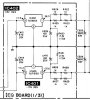
I would focus on the Power supply to the phono section as step-1. You have heat damage from the dropping resistors on this area of the board (refer to your pic).

1. Increase R430/431 to 1W Metal oxide resistors (https://www.mouser.com/ProductDetail/Vishay-BC-Components/PR01000102401JR500/?qs=sGAEpiMZZMtlubZbdhIBIDqBBcd6vlUvDULgmcVPMW4=) and install offset from the board for heat circulation
2. Increase R422 through R425 to 1K 1/2 W PR01 series
3. Replace C409/C410 - up the voltage to 50V (Nichicon UPW or Panasonic FM)
4. Replace C413/C414 (Nichicon UPW or Panasonic FM)
5. Check the mainboard for broken solder connections and reflow (as suggested by @Karl vd Berg )

Another quick option to try is to remove IC402/IC403. You will lose phono section due to loss of +/- 15V to NJM4560 opamp. You can check if these regulators have gone noisy if the amp noise floor reduces. Wallet friendly option as well :)

Sony 550ES - Phono power supply.JPG


You have both @Karl vd Berg and @Bigbeard in this thread, you are in good hands. Replacing Fusistors is required but IMO may not be the reason for the elevated noise floor you are seeing.
 
Last edited:
I looked at the schematic, and the pictures you attached. Great description of the problem and troubleshooting steps you have taken :beerchug:

I would focus on the Power supply to the phono section as step-1. You have heat damage from the dropping resistors on this area of the board (refer to your pic).

1. Increase R430/431 to 1W Metal oxide resistors (https://www.mouser.com/ProductDetail/Vishay-BC-Components/PR01000102401JR500/?qs=sGAEpiMZZMtlubZbdhIBIDqBBcd6vlUvDULgmcVPMW4=) and install offset from the board for heat circulation
2. Increase R422 through R425 to 1K 1/2 W PR01 series
3. Replace C409/C410 - up the voltage to 50V (Nichicon UPW or Panasonic FM)
4. Replace C413/C414 (Nichicon UPW or Panasonic FM)
5. Check the mainboard for broken solder connections and reflow (as suggested by @Karl vd Berg )

Another quick option to try is to remove IC402/IC403. You will lose phono section due to loss of +/- 15V to NJM4560 opamp. You can check if these regulators have gone noisy if the amp noise floor reduces. Wallet friendly option as well :)

View attachment 2072735


You have both @Karl vd Berg and @Bigbeard in this thread, you are in good hands. Replacing Fusistors is required but IMO may not be the reason for the elevated noise floor you are seeing.

Thank you so much for he comprehensive instructions! I'm thinking of doing this myself for now as the repairman may be busy with the family holidays. I can handle a soldering iron and I have desoldering wick only thing missing is a multimeter I can buy from the local hardware. I'll open this bad boy up soon.

@p4spooky @Bigbeard @Karl vd Berg you guys are the greatest. I'll surely get back to you during or after the holidays.

Merry Christmas :beerchug:
 
Great, let us know your progress. Remove the two regulators first and check for noise. If noise is gone, we will have to find you a proper replacement. Will do that once you confirm.
 
Hi all! Sorry for the hiatus. Hope you all had a great new years and valentines day! I held off from doing anything to the amplifier until the freeze spray arrives...and it did this morning :banana:

Now why I opted for this was because of the circumstances I have at the moment. I couldn't set aside some money for a decent DMM nor afford time to take the amplifier apart piece by piece (due to architecture---work). So this freeze spray should help me in pinpointing the faulty part from the surface.

I'll have an update soon, probably by the weekend. By then we could get started on your professional opinions on replacement transistors and caps so I could do a shopping list :D I will do the suggested methods on the fusistors and regulators soon, when I get the day off after a Sunday
 
Last edited:
Yes, sometimes transistors (and diodes) measure "good" off board, but are still noisy/leaky. Not having curve tracer or other tester, a spray could be helpful to see if any variation happens.
Please, keep us updated if you find the source of hissing.

I have found the culprit! It's a C2259-13F transistor at Q301. It lessened the hissing noise when I freeze sprayed it. I also sprayed too much that it started making popping noises through the left channel. Eventually it put the amp ito protection mode.

I've also sprayed the nearby parts and they didn't affect the hiss. It has to be this C2259 transistor. I plan to replace this and the one of the other channel. I might as well replace all transistors with better alternatives too.

Can I have your say in this, guys? @Bigbeard (where art thou?) @Karl vd Berg @p4spooky
Any advice on replacement parts would be great too :bigok:

I plan to do the tasks you listed on the day I'll be doing surgery on it @p4spooky , just when I have all the parts ready.

https://imgur.com/gallery/0tQDo1m here's pictures of the part. who'd have thought?
 
Great job tracking this down to 2SC2259.

2SC2259 is a SIP-5 transistor with bcecb pinout. You may want to replace both channels

You can use 2 KSC1845FTA facing each other with emitter pins tied together and both transistors bonded with heat-shrink tube. If you go this route, make sure you source the KSC1845 from a reliable source. Appears to be out of stock from reliable sources.

Hope this helps.
 
Last edited:
Is KSC1845FTA better than 2SC2259? I'm not sure I can imagine how to hook 2 KSC's as 1 transistor to take 2SC's place.

Is it better than using 2SC2259? Performance wise? Reliability? I hope to understand this
 
Back
Top Bottom