• The move to the new server is done. There are some software and database maintenance updates in process. This has us passing the hat around to help out. We appreciate any donations. Seriously, even a dollar helps. The payment page may be found here - https://www.audiokarma.org/support.html

Sony PS-5550 W&F Issues - Troubleshooting (Solved: bad belt)

Johnny_Law

o.O
Subscriber
My PS-5550 has w&f issues (audible, and measured via the w&f app at around 0.38%) - I am troubleshooting. I've checked the motor (see https://audiokarma.org/forums/index.php?threads/sony-brushed-dc-motor.997159/), cleaned the pots, and installed a new belt. Next up is the thrust bearing which is unique.

The "thrust bearing" is simply a sleeve with a c-clip at the bottom. Originally, it appears Sony used some kind of washer that was held in place by the c-clip. The spindle has a captured ball bearing (similar to the AR TT spindle and others I'm sure) at the end that rotates on the washer.

I'll borrow some pics of the original design - credit to paul401 over on vinylengine:

Sonyspindleunderside.jpg

Bearing Clean + Washer.jpg

I believe this Sony-style thrust bearing was used on a variety of turntables of the era, and I've read other discussions / potential fixes:

https://www.vinylengine.com/turntable_forum/viewtopic.php?t=92998&start=15#p781596
https://audiokarma.org/forums/index.php?threads/sony-ps-2350-info-etc-please.357748/
https://www.vinylengine.com/turntable_forum/viewtopic.php?t=123497

But rewind to this specific turntable. When I got it, it was obvious that something was wrong. To start, it had REALLY bad w&f (measured above 1% on my app) and sounded horrible. Then I spotted some clues ...

To start, there is a circular scratch in the plinth than aligns with the platter. Clearly, the platter had dropped down and scratched the plinth as it rotated. Look closely:

PXL_20220521_165247896.jpg

When removing the spindle, I noticed an out-of-place washer (which had grease on it before I cleaned it off). The previous owner had noticed the platter drop, removed the spindle, and put this washer in place to use as a bearing.

The spindle's arm-return gear was riding on the washer - problem kind of solved ... but not really. As an added bonus, the plastic gear cracked under the stress and is ready to fall apart (you can see the cracks in the pic).

PXL_20220521_175547305.jpg

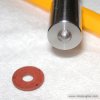
So, I removed the thrust bearing to inspect. Turns out, it's a straight sleeve with a constant diameter of ~7.04mm. The clip at the bottom is at its widest 6.35mm I.D., and it's 0.45mm thick. I positioned the spindle in the correct axial position for the arm return gear, and sketched out the approximate dimensions.

PXL_20220521_170536621.jpg

PXL_20220521_171619642.jpg

So, it seems I need a thrust washer or functional equivalent that is around 7.00mm in diameter and (5.00mm - 1.25mm - 0.45mm =) 3.3mm thick.

Ideas used so far ... none of which result in acceptable w&f.

(Interestingly, each solution below yields approximately the same w&f measured on my app (~0.38%) - so, maybe this means that in fact these ARE working fine, and it's something else causing the problem.)

-SS ball bearing
-two stacked nylon #2 washers
-stack of 6 or so copper #2 washers

PXL_20220521_170629800.jpg

I also polished the ball end of the spindle.

PXL_20220521_183948349.jpg

So - any other suggestions?

Next up may be to purchase a sapphire thrust bearing that the AR camp seems to like, e.g. https://www.swissjewel.com/product/sapphire-windows/sapphire-circular-windows/w7-05/.

Of course, there's a chance I've got another issue from the motor, thrust bearing, or pots, but that's too many unknowns in one equation. I'm trying to solve one potential issue at a time.
 
Last edited:
Register to hide this ad
Another thing I did was to spin the platter up by hand without the belt attached, and measure w&f with the phone app while it spun down. I did this with the BB in place in the thrust washer sleeve.

The bad news, it didn't report anything statistically meaningful, and spin-down time was rather short - i.e., it lost speed pretty quickly.

The good news, visibly the speed graph didn't show any huge deviations as it spun down. So at least it SEEMS to spin down evenly, despite losing speed quickly.

However, I realized that I feel some scratching when I put the spindle in place (with oil as recommended by the SM) and spin it by hand. So I'm wondering if I need to re-finish the spindle ... it does look a bit worn.
 
Did a couple things, no change.

Cleaned up the end of the spindle. It looked pretty gnarly so I hit it with 400 / 800 / 1500.

PXL_20220522_152135134.jpg

Second, re-deoxited the pots (speed control knobs and speed adjustment pots on board).

No change from either. I also tried running it at a higher / lower speed so that the speed control pot would be in different positions, no change from that either.

Here's what I'm seeing:

Screenshot_20220522-084031.png Screenshot_20220522-084026.png

Of course, I don't necessarily believe this to be 100% accurate in the abstract, but it's interesting in a relative sense. With the same phone I measured my Luxman PD121 and saw ~0.05% in the same app.

The period information is interesting. A full w&f cycle is about ~1.7-1.9 seconds (in the screen shot, ~3.90 to 5.65 = 1.75s). At 33.27 rpm, that means each period is exactly 1 complete platter rotation.

(Here's the math: 33.27 rev/min / 60 sec/min = ~0.6 rev/sec; 0.6 rev / sec * 1.8 sec/wfperiod = 1.0 rev per wf period)


So, given that we conclude the w&f period is 1 rev on the nose, what hypotheses can we make? Maybe: The issue is mechanical. The issue is related to the platter. The issue is NOT related to the motor.

EDIT: This math in italics was wrong! I fudged by rounding! Read below:

At 33.27RPM, that's 0.5545 revs per second. From the graph, the Wow cycle was 1.75s. Well, 0.5545 rev/sec * 1.75 sec/wow cycle = 97% of a revolution every wow cycle. CLOSE but not EXACT! The difference can now be explained by the belt rotation relative to the platter rotation.

But what about the motor feedback circuitry? Even if the platter does have a mechanical issue, the platter is tied to the pulley via the belt. So shouldn't the motor's circuitry immediately adjust speed to cancel out any mechanical speed issues from the platter?

Puzzling.
 
Last edited:
Tried a couple other things.

First, different lubricants. No difference in w&f, so went back to 3-in-1 for this testing. (Big difference in spin-down though, as could be expected, the grease stopping almost immediately... I only tried the grease because the SM literally says "grease" although that may be a lost-in-translation thing...)

PXL_20220522_201821583.jpg

Also tried a different thrust bearing method. One of the posters in those threads I had found said that he tapped his sleeve and threaded in a screw which worked fine. I found out that a 1/4-20 threaded screw actually threads into the c-clip, so I gave it a shot. Unfortunately it didn't solve anything.

PXL_20220522_204950779.jpg

So, I put the BB back in place.

Finally, a closer examination of the spin-down without the belt attached. Zooming in, I actually can make out a slight periodic oscillation in the speed. One screen shot is the whole recording period during spin-down, the other screen shot is a zoom-in view of the graph where you can make out the oscillation if you look closely.

Screenshot_20220522-132213.png Screenshot_20220522-132240.png

Haven't disproven the hypothesis that it's a mechanical issue related to the thrust bearing / spindle ... any other suggestions of things to try?
 
After some time thinking through the measurements, I had what I think is an accurate epiphany.

The main source of the w&f from the app was a cyclical speed deviation that repeated at once per rotation almost exactly (so I guess it's wow and not flutter to be precise). So, it must be related to the platter or spindle itself.

I observed the platter closely under rotation and noticed that it isn't perfectly flat. Whether it's because of a poorly machined spindle bore or who knows. If this is getting picked up by the phone's accelerometer, it might be the cause of the cyclical speed deviation. But, since the tone arm will track up/down movement, it shouldn't matter when listening.

So, I reassembled using the copper washers. I've been listening to records. It sounds fine. I'm really hunting to pick up w&f so occasionally I think I notice something, but most of the time it just sounds like ... Music. So. Perhaps this was a witch hunt.
 
Last edited:
Well - I got a new neon lamp in there, and the once per rev speed pulse is visible. So, it seems it's not totally the fault of the up/down movement messing with my phone's accelerometer.

I put the extra counterweight on the platter, so you can see that the speed oscillation corresponds to 1 rev of the platter.

33RPM:


45RPM:

 
So I left the table on all night, and upon inspection this morning it's clear that the oscillation phase has shifted.

In other words, it's not perfect 1:1 to the platter rotation.

If this is true, on the one hand it may mean the platter, spindle, and thrust bearing are all OK, but on the other hand, it means a problem with something else. Something in the servo electronics? All electrolytic capacitors are new, save the 2200uF cap that drives the pickup light (which is fine).
 
Figured it out. I took a few videos to explain ...

First, as mentioned above, I noticed that the position of the platter relative to the wow phase shifted over time.

Part 1: Initial observation. Note the position of the blue tape on the platter relative to the phase of the wow as shown by the strobe.


Part 2: Follow-up. The table had been left to run for about 5 minutes. Note the shift in the position of the blue tape on the platter relative to the phase of the wow as shown by the strobe.


Sooo ... what rotates with the platter, but at a slightly different phase relative to the platter? THE BELT!!

The belt rides on an inner lip of the platter. This means that the belt is effectively rolling around the inner lip - like a hula hoop rolls around your waist. While the RPM of the belt is close to the RPM of the platter, it will rotate more slowly in proportion to how much larger it is (while stretched around the pulley) compared to the platter ring.

To test this hypothesis, I fished around and found a spare belt - too small but it fit, albeit tightly.

Part 3: With the alternate belt. LOOK! Hardly any wow. Conclusive evidence that the wow was caused by the belt.


The belt causing wow was bought off eBay, this auction: https://www.ebay.com/itm/192312157007. I've requested a refund and I'll look for a better new belt (any suggestions?).

With the alternate (and too small) belt, here's the app's W&F measurement now. Not perfect but WAY better:

Screenshot_20220601-101628.png Screenshot_20220601-101632.png
 
Last edited:
So I measured the wow-inducing new belt I have, and it's a 23.6" belt.

I found an old thread (here) where it was noted that 23.6" is the wrong size for the PS-5520, which is the closest thing I could find. I couldn't find any discussion about the PS-5550.

For the PS-5520, it was noted in the thread that 25.2" may be the correct belt size, because the number "64" appears in the part number (4-804-642-00), and 64mm = 25.2". But, that seems like it would be way too big for this table. Perhaps the belts aren't the same anyway, as the PS-5550 SM calls out part number 4-836-884-00. If the same part # deciphering applied, that would make it a 88cm belt = 34.7". I don't think so! Maybe I can dig around to see what else uses that part number, and see what size replacement belts they take.

Back to my table - I measured the smaller belt that eliminated the wow ... it's only 21.25"! Unfortunately the original PS-5550 belt is long gone. So I may need to take a shot in the dark somewhere between 21.25" and 23.6".

Edit: I used a string to measure the belt path. Wouldn't you know it ... 25.2". So that seems to be the STRETCHED dimension. The correct replacement belt would be something smaller, since it would need to stretch to 25.2". Here's a table with some math (ignore the sig figs):

Belt Chart.jpg

Edit2: Most replacement belts are 23.6". I ordered one, so let's see if it works. Maybe the bad belt was the right size, but just defective?

The belt specs called out by Dynamiclamps are: Flat Belt, Medium Width, Rubber, .187" (3/16") to .203" (13/64") (4.8-5.2mm) FBM 23.6" (60.0cm)
 
Last edited:
Got a replacement 23.6" belt on it, and it's problem-free (bought from seller "needledaddy").

Still SOME w&f based on the app (it's at about 0.16% now, almost exactly what it was with the other belt above), it's inaudible to my ears and sounds great.

So I guess replacement-belt-buyer beware, not all belts are created equal.
 
Last edited:
For the sake of science, I couldn't leave it alone. To pick the best bearing solution, I compared the W&F readings between the copper washers, the SS BBs, and 7mm delrin BBs I picked up off ebay.

The 7mm Delrin balls produced on average the lowest W&F. Installing one is really easy - just drop one down into the sleeve with the c-clip in place, add some oil, and you're done. For anyone who finds this in the future, the name of the auction is "7mm Delrin Polyoxymethylene ( POM ) Solid Plastic Balls Precision Sphere". It was about $4 shipped for 10 of them.

(To compensate for the added platter height from the size of the ball, I added a washer on the thrust bearing threads under the plinth.)

PXL_20220607_214701181.jpg

PXL_20220607_214707900.jpg

Using the Delrin balls, W&F was lowered to approx 0.10%, occasionally a little better or worse. Here's a couple screen caps from a better measurement. Note the cyclic period of the wow in the measurement, so the belt still seems the main culprit. A perfect belt - if it existed - would likely make the speed even more consistent.

Screenshot_20220607-141826.png Screenshot_20220607-141823.png
 
Last edited:
Not to beat a dead horse, but I ordered a third belt from a third supplier (a "Durpower" belt from River City Electronics via Amazon, advertised specifically for the PS-5550 and some others) ... and it is also bad.

It not only produces bad w&f (measured at about 0.25% on the app), but also is way too fast. If you tried to use this belt on a table without speed adjustment, you'd be SOL.

Swapping back to the good belt with no other changes immediately corrects the w&f and speed. I've requested an exchange from the vendor, just in case it's an out-of-spec part, so I'll reserve judgment until I get the replacement and see how it does.

In sum: 66.7% (with n=3) of the belts I've ordered for this table have been bad. It makes me wonder how one goes about finding a reliable source of decent belts.
 
Last edited:
Back
Top Bottom