


I find facinating the product evolution of the early Sony stereo receivers.
The first was the STR-6060FW developed circa 1965. It was aimed at the McIntosh niche and was a knockout of restrainted, classy styling and best-in-class engineering. No gimmicks or doodads - just performance with class. 45 wpc.
It was replaced by a larger frame with the same capacitor-coupled output at 65 wpc - the STR-6120 about 1968. Two years later the STR-6200F came out with unchanged styling and output power but with some of the new FETs and a direct output connection.
Now that Sony's brand name was established in the US market and the buyer demographics seemed to be moving younger, the STR-7065 came to market at the same power but with a slightly smaller frame and a bit more glitz and sparkle. The market was no longer lawyers and dentists but more college students. Integrated circuits started to appear in low voltage signal and RF applications such as the phono amp and the MPX.
Freshed with a STR-7065A model with unknown but probably minor internal changes, it was completed restyled about 1977 into the STR-6800 model. Styling became much more heavy handed (IMHO) and the output power modules appeared to replace discrete output transistors. A similar looking version replaced it as the STR-V7 with a big jump in power.
Here's the STR-6060FW (top left), the STR-6200F (bottom left), STR-7065 (top right) and STR-6800 (bottom left).
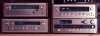
Here are the older Sonys at night:
And the newer ones:

The 6060 had the goofy flap over the minor controls and the bakelite knobs on the levers. A big omission was the center tuning meter. The knobs were smooth, solid metal.
The STR-6200F pioneered the knurled knobs for better grip - still solid metal - and had both RF meters. This is to my eye the best design in the batch.
The STR-7065 had more bling - more shiny surfaces - but plastic secondary knobs. One useful innovation was the pendant lamp on the tuning indicator.
The STR-6800 had the necessary controls but just lacks design integration to my eye.
Of them all, the STR-6200F is my beloved one. The sound is solid and authoritative and the design is matches. This is my favorite piece of all my gear.
And, no, I am NOT a collector. I'll keep the older two because I have household and office uses for them but will be letting the others go to good homes now that I have my photos.
Please see the Vintage Knob for specifications and official photos as well as insightful commentary.
The first was the STR-6060FW developed circa 1965. It was aimed at the McIntosh niche and was a knockout of restrainted, classy styling and best-in-class engineering. No gimmicks or doodads - just performance with class. 45 wpc.
It was replaced by a larger frame with the same capacitor-coupled output at 65 wpc - the STR-6120 about 1968. Two years later the STR-6200F came out with unchanged styling and output power but with some of the new FETs and a direct output connection.
Now that Sony's brand name was established in the US market and the buyer demographics seemed to be moving younger, the STR-7065 came to market at the same power but with a slightly smaller frame and a bit more glitz and sparkle. The market was no longer lawyers and dentists but more college students. Integrated circuits started to appear in low voltage signal and RF applications such as the phono amp and the MPX.
Freshed with a STR-7065A model with unknown but probably minor internal changes, it was completed restyled about 1977 into the STR-6800 model. Styling became much more heavy handed (IMHO) and the output power modules appeared to replace discrete output transistors. A similar looking version replaced it as the STR-V7 with a big jump in power.
Here's the STR-6060FW (top left), the STR-6200F (bottom left), STR-7065 (top right) and STR-6800 (bottom left).
Here are the older Sonys at night:
And the newer ones:
The 6060 had the goofy flap over the minor controls and the bakelite knobs on the levers. A big omission was the center tuning meter. The knobs were smooth, solid metal.
The STR-6200F pioneered the knurled knobs for better grip - still solid metal - and had both RF meters. This is to my eye the best design in the batch.
The STR-7065 had more bling - more shiny surfaces - but plastic secondary knobs. One useful innovation was the pendant lamp on the tuning indicator.
The STR-6800 had the necessary controls but just lacks design integration to my eye.
Of them all, the STR-6200F is my beloved one. The sound is solid and authoritative and the design is matches. This is my favorite piece of all my gear.
And, no, I am NOT a collector. I'll keep the older two because I have household and office uses for them but will be letting the others go to good homes now that I have my photos.
Please see the Vintage Knob for specifications and official photos as well as insightful commentary.


