
• The move to the new server is done. There are some software and database maintenance updates in process. This has us passing the hat around to help out. We appreciate any donations. Seriously, even a dollar helps. The payment page may be found here - https://www.audiokarma.org/support.html

Sony TA-F730ES opinions and tips

Sofad319

New Member
Hi guys!
I'm new on this forum but I have always read your discussions as an unregistered user.
I'm Antonio, from Italy, 22yrs old and I wanted to ask you some information about the Sony TA-F730ES amplifier, which I wanted to give myself for my bachelor's degree :-)

I paid € 390 for it including shipping in bomb-proof packaging via PayPal with Buyer Protection and I'm waiting for it with anxious expectation. The seller was very nice because we had a lot of conversation before finalizing the transition, accepted PayPal, granted the shipping (it was also written in the ad) and even gave me a discount. The amplifier looks new for 30 years apart from 2/3 wear marks including one on the input selector knob, two small marks on the right edge of the amplifier and a slight bevel on the right wooden panel.
But I think it's normal for a 30-year-old object or am I wrong?

By the way,
I had read some time ago that these amps heat up a lot because of the transistors (?) They mount. Do you have any ideas on how to handle the amplifier?
I want to combine them with a pair of Canton Quinto 520, what do you think?

Thanks to anyone for any replies!
Have a great day guys,
Ciao! :beerchug:
 
Register to hide this ad
Congratulations, you have acquired a classic, very high quality amp.
Since it is some 30+ years old you will have to make shure that some traces of aging are kept in check.

The high temperature you mentioned would certainly be a bad sign and should be fixed very soon.

First, make sure you have the service manual PDF. You will find it at elektrotanya or hifiengine or other websites.

Everything else wil depend on your experience in handling Electronics, measurement and soldering.

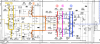
Excess heat coming out of the main heat sink tells us, thet the final stage 5 (blue) of power amplification (transistors Q416, Q417, Q418, Q419 left channel and Q466, Q467, Q468, Q469 right channel) is running with too high idle current ("bias"). The mechanism to control the bias spans multiple stages and involves other transistors and resistors, mainly stage 2 (orange) with Q410 & Q411 with surrounding resistors. Therefore, exchanging the final stage 5 changes nothing in such cases.
Most likely, some of the very special fuse resistors in previous stages could have driftet in value and could have caused this problem. They should be replaced before even thinking any further or messing with the bias adjustment. For the left channel, these are R412, R422, R426, R427, R428, R429, R430, R431, R432, R433, R442, R449. For right channell add 50 to each part's position number. The most suspicious are R429 and R426, followed by R412 and R422.
It is crucial that these resistors function properly. To my experience these can easily be replaced with regular types of better availability, not fuse resistors.


This is the right channel main amp with the different stages marked in colors.

Sony TA-F730ES schematic detail right power amp stages marked.png

- Johannes
 
Last edited:
Congratulations, you have acquired a classic, very high quality amp.
Since it is some 30+ years old you will have to make shure that some traces of aging are kept in check.

The high temperature you mentioned would certainly be a bad sign and should be fixed very soon.

First, make sure you have the service manual PDF. You will find it at elektrotanya or hifiengine or other websites.

Everything else wil depend on your experience in handling Electronics, measurement and soldering.

Excess heat coming out of the main heat sink tells us, thet the final stage 5 (blue) of power amplification (transistors Q416, Q417, Q418, Q419 left channel and Q466, Q467, Q468, Q469 right channel) is running with too high idle current ("bias"). The mechanism to control the bias spans multiple stages and involves other transistors and resistors, mainly stage 2 (orange) with Q410 & Q411 with surrounding resistors. Therefore, exchanging the final stage 5 changes nothing in such cases.
Most likely, some of the very special fuse resistors in previous stages could have driftet in value and could have caused this problem. They should be replaced before even thinking any further or messing with the bias adjustment. These are R412, R422, R426, R427, R428, R429, R430, R431, R432, R433, R442, R449. The most suspicious are R429 and R426, followed by R412 and R422.
It is crucial that these resistors function properly. To my experience these can easily be replaced with regular types of better availability, not fuse resistors.


This is the left channel main amp with the different stages marked in colors.

View attachment 2416767

- Johannes
Thank you Johannes
By the way, at the moment there aren't temperature issues. It's okay and seller has tested amplifier before ship it

Have a great day!
 
Replace all the fuse resistors first, before switching the amp on.
Hello Sir, thank you for your reply and suggestion
I want to say that before buying, this amplifier has been tested. In addition, it was tested before it was shipped.
In any case, if there are any problems, I will undoubtedly take into account your very useful suggestions!
Where can I find spare parts if needed?
 
I'm no fan of the fusible resistors often found in this era of Sony ES amps (I have several), but I'd say a blanket replacement is not typically necessary. In my (albeit limited) expeience, it's often possible to measure the majority of the fusibles, one by one, in situ, e.g., with a DMM, a set of mini-grabber leads, and the amp OFF. A lot are likely to be absolutely fine, some may measure 'low' but are still fine (check the exact circuit for anything measuring incorrectly - often it's just parallel resistors etc. altering the expected value). If you're unlucky, a few may really have drifted 'high', and should be replaced.

ps - congrats on the degree :thumbsup:
 
I'm no fan of the fusible resistors often found in this era of Sony ES amps (I have several), but I'd say a blanket replacement is not typically necessary. In my (albeit limited) expeience, it's often possible to measure the majority of the fusibles, one by one, in situ, e.g., with a DMM, a set of mini-grabber leads, and the amp OFF. A lot are likely to be absolutely fine, some may measure 'low' but are still fine (check the exact circuit for anything measuring incorrectly - often it's just parallel resistors etc. altering the expected value). If you're unlucky, a few may really have drifted 'high', and should be replaced.

ps - congrats on the degree :thumbsup:
hi sir, thank you :)
maybe i will do some measurements before done changes
 
Congratulations, you have acquired a classic, very high quality amp.
Since it is some 30+ years old you will have to make shure that some traces of aging are kept in check.

The high temperature you mentioned would certainly be a bad sign and should be fixed very soon.

First, make sure you have the service manual PDF. You will find it at elektrotanya or hifiengine or other websites.

Everything else wil depend on your experience in handling Electronics, measurement and soldering.

Excess heat coming out of the main heat sink tells us, thet the final stage 5 (blue) of power amplification (transistors Q416, Q417, Q418, Q419 left channel and Q466, Q467, Q468, Q469 right channel) is running with too high idle current ("bias"). The mechanism to control the bias spans multiple stages and involves other transistors and resistors, mainly stage 2 (orange) with Q410 & Q411 with surrounding resistors. Therefore, exchanging the final stage 5 changes nothing in such cases.
Most likely, some of the very special fuse resistors in previous stages could have driftet in value and could have caused this problem. They should be replaced before even thinking any further or messing with the bias adjustment. For the left channel, these are R412, R422, R426, R427, R428, R429, R430, R431, R432, R433, R442, R449. For right channell add 50 to each part's position number. The most suspicious are R429 and R426, followed by R412 and R422.
It is crucial that these resistors function properly. To my experience these can easily be replaced with regular types of better availability, not fuse resistors.


This is the right channel main amp with the different stages marked in colors.

View attachment 2416767

- Johannes
Hi Johannes,
Thanks for your valuable info: this was helpful to me when servicing this Sony, after the power caps in the Left channel had gone bad. After replacing these and checking all fusible resistors in the left channel, there was still too much current in the bias circuit at R442/449. Bias voltage at the Left test point was way off (60 instead of 15 mV). Tuning the adjustment pot did not have any effect. Do you have any idea? Bad regulator pot, or a suspect transistor perhaps? Any suggestions are highly appreciated, thanks! BW, Martin
 
Hi Johannes,
Thanks for your valuable info: this was helpful to me when servicing this Sony, after the power caps in the Left channel had gone bad. After replacing these and checking all fusible resistors in the left channel, there was still too much current in the bias circuit at R442/449. Bias voltage at the Left test point was way off (60 instead of 15 mV). Tuning the adjustment pot did not have any effect. Do you have any idea? Bad regulator pot, or a suspect transistor perhaps? Any suggestions are highly appreciated, thanks! BW, Martin
Checked the bias pot: no problem there. Now looking at Q410/Q460, of which one is not original. Ordered new replacements for them.
 
Apparently this was the solution: now the unit works great again. Only one thing remains strange: the bias voltage on the left side remains too high (40 instead of 15mV) , and cannot be adjusted with the bias pot (even though the pot measures OK). Think I'm gonna leave it at that for now.
 
Back
Top Bottom