• The move to the new server is done. There are some software and database maintenance updates in process. This has us passing the hat around to help out. We appreciate any donations. Seriously, even a dollar helps. The payment page may be found here - https://www.audiokarma.org/support.html

Sony TA-N7

rtacconi

New Member
Hi,

I bought a Sony TA-N7, UPS ruined the bottom panel very badly. Only one channel is working. I can see that only one speaker relay is triggered. I want to repair it and restore it. I think I am going to use carbon composite resistors, and Nichicon gold series electrolytic capacitors. Regarding the speaker relays I found little info online, I just found this ebay ad https://shorturl.at/tsgPR. If you notice there is a gray cable near the soft-start with a heat shrik, not sure what it is.

This is the first attempt I am trying to do this and I am a bit shi..ing my pant!
 

Attachments
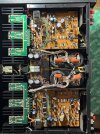
  • ta-n7.jpg
    ta-n7.jpg
    205 KB · Views: 38
Last edited:
Register to hide this ad
Hi,

I bought a Sony TA-N7, UPS ruined the bottom panel very badly. Only one channel is working. I can see that only one speaker relay is triggered. I want to repair it a restore it. I think I am going to use carbon composite resistors, and Nichicon gold series electrolytic capacitors. Regarding the speaker relays I found little info online, I just found this ebay ad https://shorturl.at/tsgPR. If you notice there is a gray cable near the soft-start with a heat shrik, not sure what it is.

This is the first attempt I am trying to do this and I am a bit shi..ing my pant!
The amp needs full restoration. The relay not kicking in is a sign of "amp past the expiration date"
The restoration is involved. If you have not worked on a V-fet amp before, this is definitely not the one to start with.

here is a hint of what is involved:

also, why it is important to use the right parts and settings:
 
yes I saw both videos
there is one more video in between. When time permits, I will make more.

There are a bunch of resistors among other things that must be replaced in your amp. Yes, it is possible the the shipping damage compounded the need for restoration, but it highly likely that only one relay clicking is due to out of spec parts.
 
there is one more video in between. When time permits, I will make more.

There are a bunch of resistors among other things that must be replaced in your amp. Yes, it is possible the the shipping damage compounded the need for restoration, but it highly likely that only one relay clicking is due to out of spec parts.
Ah yes restoration part 2. A part 1 and 1/2 is missing when you take it apart :-) The service manual is quite complete though.
 
Why use carbon comp resistors? Carbon film and metal film have tighter tolerances and are less noisy. It looks like Carbon film resistors were used throughout in that amp. Carbon film = 5% tolerance, metal film = 1% or less. I've removed many an out of spec carbon comp resistor over the years.
Before doing any replacement of caps You do really need to find out why that channel isn't working first. Repair first, restore after. I really dought those main filter caps are bad.
 
....
Before doing any replacement of caps You do really need to find out why that channel isn't working first. Repair first, restore after. I really dought those main filter caps are bad.
That is not difficult to figure out. There is a very high probability that fusible resistors in that amp section are likely dead or so far out of spec that the circuit no longer works correctly. I would start there.....
the amp needs full restoration regardless. I would test the vfets and if they pass the simple diode test, I would count my blessings and find a way to fully restore the amp. There are zero reasons to test faith with a temporary repair. The fusible resistors issue is just one of the persistent problems with these amps. There are others equally or more concerning .....
 
Why use carbon comp resistors? Carbon film and metal film have tighter tolerances and are less noisy. It looks like Carbon film resistors were used throughout in that amp. Carbon film = 5% tolerance, metal film = 1% or less. I've removed many an out of spec carbon comp resistor over the years.
Before doing any replacement of caps You do really need to find out why that channel isn't working first. Repair first, restore after. I really dought those main filter caps are bad.
I heard that carbon composite resistors are very good but I understand 5% is not great. If you have a suggestion for very good metal resistors I am all ears, thank you. What about Vishay CMF?
 
Carbon film resistors are very good at 5%, carbon composite not so much. Takman make some good carbon films, which are closer to 1% tolerance, they also make metal films, although the Vishay CMF are good too.
 
Carbon film resistors are very good at 5%, carbon composite not so much. Takman make some good carbon films, which are closer to 1% tolerance, they also make metal films, although the Vishay CMF are good too.
The Takman 1% carbon film resistors are a good choise. I've used them in several of my tube amp builds. Omite and Vishey also make very good .1% and 1% precision metal film resistors. Partsconnexion sells Tackman's and they are great folks to deal with. Even though they're based in Canada, shipping is fast. Others like Omite can be found at Mouser and Digikey.
 
That is not difficult to figure out. There is a very high probability that fusible resistors in that amp section are likely dead or so far out of spec that the circuit no longer works correctly. I would start there.....
the amp needs full restoration regardless. I would test the vfets and if they pass the simple diode test, I would count my blessings and find a way to fully restore the amp. There are zero reasons to test faith with a temporary repair. The fusible resistors issue is just one of the persistent problems with these amps. There are others equally or more concerning .....
What I meant by repair first, was whatever should be replaced to get it working properly should be done first. Then a full restore like replacing electrolytic capacitors, etc. Obviously if there are known issues with these amps, they should be addressed during the repair as well.
Sorry if I didn't get that across in my post.
Another example is when working on SS Marantz gear there are a few transistors that are known to go noisy that should be replaced when found during a repair.
 
I would test the vfets and if they pass the simple diode test, I would count my blessings and find a way to fully restore the amp. There are zero reasons to test faith with a temporary repair. The fusible resistors issue is just one of the persistent problems with these amps. There are others equally or more concerning .....
Just saying, some good advice given above from someone that knows this amp well, and from the look of it, loves it. :thumbsup:

I'll second that the first thing to do would be to SDT the V-FETs since even 1 bad 1 could be a problem to find a replacement for these days and you'll probably need a match for it. Albeit matching is a little less critical than with other V-FET amps due to the design.

I should say though that I have no personal experience with this amp but I've admired it for years. Like Pete says in his video, it's a unique design due to the cascoded BJT/V-FET output stage where the BJTs are the primary output devices with the V-FETs in cascode ...
 
Last edited:
What I meant by repair first, was whatever should be replaced to get it working properly should be done first. Then a full restore like replacing electrolytic capacitors, etc. Obviously if there are known issues with these amps, they should be addressed during the repair as well.
Sorry if I didn't get that across in my post.
Another example is when working on SS Marantz gear there are a few transistors that are known to go noisy that should be replaced when found during a repair.
Hello @Lavane , I absolutely respect and appreciate yours experience and I understand your point which definitely makes sense with other types of amps, as would be with the Marantz case. With a typical solid-state amp, if an unforeseen problem pops up after the initial repair, it can be mitigated with not too much concern.

With this Sony and other vfet amps I would advise against repair first then do the rest later for the following reasons:
1) There is nothing to gain from it. In fact the opposite is true as this process adds unnecessary risk. If you are thinking, "let's get the unit working first then see if it is worth spending the time to restore", then that logic applies a bit differently here. For vfet amps in 99% of the scenarios it goes like this: "let's test those vfet and make sure they are OK" then lets make sure that the rest of the amps is 100% before re-introducing those vfets back in action. "100%" in my book is full restoration to ensure many more decades of safe operation.

2) A repair only without comprehensive restoration might give the uninitiated a false sense of confidence that the unit can be used as is for a while longer. After nearly 50 years of existence, and due to the high risk of destroying unobtanium parts, the temporary use is not something I would ever recommend.

My $2 (2c adjusted for inflation). Please do not take my advice as "mine is better than yours". It is my humble opinion based on personal experience with vfet amps in general, of which I have worked on more than most people.
 
As rottalpha said, it's not a great place to start restoration. I am trying to see if I can send it back to the ebay seller (who said that the ampli was in working conditions). Otherwise I will have to find someone around Essex or London
 
As rottalpha said, it's not a great place to start restoration. I am trying to see if I can send it back to the ebay seller (who said that the ampli was in working conditions). Otherwise I will have to find someone around Essex or London
If you are willing to ship to France or Croatia, I can help steer you in the right direction. Both places have access to the same knowledge and custom parts you saw in the Sony video. I am sure there would be qualified technicians in UK, I am just not familiar with any of them.
 
Last edited:
I also wanted to add....there are bunch of freaking assholes out there that would tell you anything you want to hear, like your seller on ebay.
Be ware of the word restored. It is widely interpreted. You MUST know who did the work, and verify them.

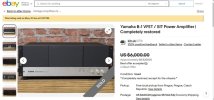
If you think you got the short end of the stick, take a look at this:
The new owner of this B-1 sold on ebay as "completely restored", called me to ask some questions and I asked him in return to pop the cover of the unit and look inside at the "restoration"

Listing1.JPG

20240705_152813.jpg

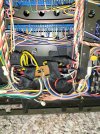
main caps rattling inside, held down by freaking electrical tape....among other "briliant improvements"
 
J! Now you make me feel lucky, even if yesterday I had a really bad day. I complained that I wanted to send it back and he did not reply but I got a second 200 euros o refund. Paid 1599, got 400 of refund, paid another 160 for shipment (60 thanks to Brexit). I am not sure sending it to France, it might get damaged in even more. I hope I could find someone in the UK.
 
VFET amps are rare & different. You would be well served to follow 'rottalpha' advice and send to a "known good" VFET amp specialist. The TA-N7 is worthy of the extra cost to ship across the channel to have properly & safely restored.

As has been stated.......... do the SDT on your VFETs before making any decision. And, confirm with your seller they know how to pack properly before your next purchase.
 
Back
Top Bottom