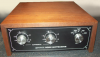
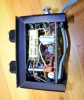
Hi....That's a crowded chassis ! Look at the quality polystyrene caps, though. That would be a tough deciphering exercise, but worth the effort. It looks like it has been "tweaked" and some caps were either added or replaced. If it sounds good....Keep on keepin' on....Enjoy this historical unit !
Here is the quintessential USA disc playback chart, acknowledged as reference grade...
https://midimagic.sgc-hosting.com/mixlabls.htm
As you will notice, your disc choices above indicate the AES playback curve for most of those labels. AES EQ uses a 400Hz Turnover with Rolloff of 63.6 uS (2500 Hz). This means the treble cut is -12 db at 10KHz from the O db reference, (centered at 1Khz). While 400Hz is +3 db, 2500Hz is -3 db from the 0 db portion of the playback curve. These plus or minus 3db "transition" points are technically known as asymptotes within the playback curve.
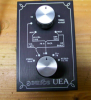
RIAA phono EQ uses a 500Hz Turnover with a Rolloff at 2122Hz (75 uSec.). RIAA bass resonance or peak is at 50 Hz. 2122 Hz is -3db from the playback curve's flat portion and 500Hz is +3 db. RIAA EQ specs the high freq slope at -13.7 db at 10KHz. Note your Treble Adjust marking at 75, which would be for most post 1954 discs. There are exceptions, so it is lovely that you can dial-in your preferred treble rolloff setting with your Source Engineering UEA preamp.
Because the RIAA and Columbia LP Turnover is 500 Hz, the "extra" 100 Hz above the AES 400Hz Turnover is just a bit more prominent than it would be if one of your Turnover (lower knob) settings was actually intended for the AES playback curve. More importantly, the difference in the 10KHz Rolloff slopes must be understood. If the two curves, AES vs. RIAA, were superimposed, the Rolloff slopes differ between 1.7 db and 2 db depending on a specific treble frequency. This is not as small a difference as anyone might believe. If you played the known AES discs with RIAA playback EQ, the sound will be better than acceptable, but that AES playback curve will allow treble upper harmonics to really shine. Horns, piano and drum "action" like cymbals will indeed sound more lifelike if the disc was "encoded" with the AES recording curve and we played that disc "decoding" using a precision engineered AES payback curve vs. the usual precision engineered RIAA phono playback curve.
In the late 1930s, phono EQ really began to develop, industry-wide, but there really were no set standards as to which recording and playback curves the studios and radio stations would use. Home (consumer) radio-phono sets usually only had a tone control, at best, at that time. After WWII, home HiFi began setting up quickly. By 1947, magnetic cartridges were in favor, thanks to companies like Clarkstan and GE offering their Variable Reluctance phono playback wares to the public. The Audio Engineering Society was formed, with professionals overseeing and having Audio Engineering (became Audio) magazine as their platform. In 1948, Columbia intros the Lp, with a 500Hz turnover, 100Hz bass resonance peak and treble Rolloff of 100 uS (or -3db at 1592 Hz, -16db at 10KHz). In 1949, RCA intros the 45 rpm discs, with yet another unique phono EQ. In 1950, the AES made a bold attempt and issued their AES playback curve to the industry, an "averaged" playback curve which they hoped would become thee standard. Their very noble intention was to convince the studios (as well as radio stations and equipment manufacturers) that their producers can record their discs with whatever recording curve and production qualities they deemed proper, but, they should make sure their discs sound "right" using the AES playback curve. In this way, more discs and equipment would get sold to the pros and consumers. Their admirable ploy worked for a while.
In 1952, RCA devises their "New Orthophonic" playback curve. Soon after, the AES recommends this curve become the new standard phono EQ playback curve, as does the RIAA, the Record Industry Association of America. With big record companies like Columbia and RCA selling the most discs, it is no surprise that RCA's New Orthophonic recording/playback curve became the RIAA phono EQ curve....
Recording curves are the inverse of our playback curves, pressed into the discs. While proper EQ was eventually standardized, having phono preamps with switchable or variable phono EQ is the way to go when playing earlier mono discs. I wrote a longer essay, which you might want to scan or read, when you have some more reading time, which includes phono EQ history and analysis, implementation in one of my fave preamps and some very cool links to many more disc playback charts. If you simply google search Phono EQ Design, it should come up as the fourth of fifth entry. Entitled "Phono EQ: Design, Retrofit and Disc Playback Charts," I hope all disc collectors will enjoy this. I separated the rather wordy thesis into three threads, in sync with the title, if you choose to scan portions as needed.
https://www.lencoheaven.net/forum/index.php?topic=25066.0
Honestly, I like to "share the knowledge to share the wealth" of enjoyment in playing and spinning discs. After all, this hobby/obsession is really about listening to the records....ENJOY !