• The move to the new server is done. There are some software and database maintenance updates in process. This has us passing the hat around to help out. We appreciate any donations. Seriously, even a dollar helps. The payment page may be found here - https://www.audiokarma.org/support.html

Speaker cabinet insulation

I'm not sure what the OP's intention is, but lining vented cabs with something absorbant is usually done to reduce mid frequency reflections inside the cabinets which can colour the sound. However, in this case the woofer is crossed over to a sealed mid range driver at 400Hz, so I doubt the addition of some rockwool (or similar) would be of much benefit at all.
https://worldradiohistory.com/hd2/I.../HiFi-Stereo-Review-1986-06-OCR-Page-0042.pdf
121614793_2385562845084449_7858482100885547383_n.jpg
My intention is to reduce reflections back onto the woofer cone. If the crossover between the woofer and midrange is 400Hz then that means that the woofer is operating up to 400Hz which is still midrange. I think any frequencies inside an enclosure are going to reflect back onto a woofer and color the sound.
 
I'm not sure what the OP's intention is, but lining vented cabs with something absorbant is usually done to reduce mid frequency reflections inside the cabinets which can colour the sound. However, in this case the woofer is crossed over to a sealed mid range driver at 400Hz, so I doubt the addition of some rockwool (or similar) would be of much benefit at all.
https://worldradiohistory.com/hd2/I.../HiFi-Stereo-Review-1986-06-OCR-Page-0042.pdf
121614793_2385562845084449_7858482100885547383_n.jpg
And I have the full review of these speakers. There’s a second page to that one.
 
My intention is to reduce reflections back onto the woofer cone. If the crossover between the woofer and midrange is 400Hz then that means that the woofer is operating up to 400Hz which is still midrange. I think any frequencies inside an enclosure are going to reflect back onto a woofer and color the sound.

yes, these poyfill help reduce the vibration in my vintage Jensen cabinets which gives a better definition and imaging. I put behind the woofer cone, corner edges. You should play around with different thicknesses. Too much damping make the speaker sound dull.
 
yes, these poyfill help reduce the vibration in my vintage Jensen cabinets which gives a better definition and imaging. I put behind the woofer cone, corner edges. You should play around with different thicknesses. Too much damping make the speaker sound dull.
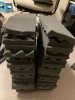
I had forgotten that I have a bunch of egg crate foam. I think I’ll just staple that to the whole inside of the cabinets. I also have some Dynamat Xtreme so I’ll go ahead and put a couple of strips on the back and one on each side wall.
 
Thank you for the input. I understand that the air is moving in/out of the port but sometimes I’ve listened at loud enough levels with heavy bass material that I can feel the air from my listening position that is 12’ away.
I've stuffed insulation into the port just to see what difference it made, as soon as the volume went up, the insulation shot straight out of the port. If it were closer to the inside of the port, I imagine it would have been sucked into the cabinet.

This was with my Paradigm Titan V1's. They do have a fairly short port, guessing that the shorter the port, the more likely it would be for the air moving through the port to clear the port. At high volume these Titans will blow the curtains behind them around quite a bit at 1 1/2' - 2' away.

Edit: I have heard of extending a rear port away from the back of the cabinet in cases where the speakers are too close to the wall, would just adding a good damping material to the wall achieve the same thing, or doesn't it work like that? Not trying to hijack the thread but the curtains behind the Titans made me think of this
 
Last edited:
I'm not sure what the OP's intention is, but lining vented cabs with something absorbant is usually done to reduce mid frequency reflections inside the cabinets which can colour the sound. However, in this case the woofer is crossed over to a sealed mid range driver at 400Hz, so I doubt the addition of some rockwool (or similar) would be of much benefit at all.
https://worldradiohistory.com/hd2/I.../HiFi-Stereo-Review-1986-06-OCR-Page-0042.pdf
The baffle would still vibrate though, could be wrong but from what I understand according to an article I read, the midrange is the biggest offender when it comes to cabinet resonance coloring sound.
 
My intention is to reduce reflections back onto the woofer cone. If the crossover between the woofer and midrange is 400Hz then that means that the woofer is operating up to 400Hz which is still midrange. I think any frequencies inside an enclosure are going to reflect back onto a woofer and color the sound.
The wavelength of sound at 400Hz is 2.8 feet, so the cabinet is a bit too small to reflect sound below the crossover frequency. Where the enclosure is smaller than the wavelength it acts more like a pressue vessel than a reflector.
 
The wavelength of sound at 400Hz is 2.8 feet, so the cabinet is a bit too small to reflect sound below the crossover frequency. Where the enclosure is smaller than the wavelength it acts more like a pressue vessel than a reflector.
Okay so here’s a simple test for anyone that has any doubt of whether any frequencies reflect back onto a woofer cone to color the sound or not. Take a small portable radio, Bluetooth speaker, or any other audio device that makes sound. Remove your woofer. Play music through your portable speaker, stick it into the speaker cabinet and re-instal your woofer. Can you hear any sound coming from your woofer? Can you only hear the mid to high frequencies or do you hear all frequencies?
 
Amen. Sing it. Then chuck some fiberglass and polyfill around in there. The standing waves don't get excited the same as from an operating driver, but cabinet sound is a very large part of the "soup" in everything (or not, by heroic efforts). Either way, it's a "sound". Walls also transmit through conduction, not just panel radiation by excitation so it's not only/entirely transmission through diaphragms. Sound inside, by degree, becomes sound outside...at a different time from a different source location.
 
I think something is better than nothing and these speakers came with nothing. That’s a weird spot for the crossover. Gonna move that.
upload_2022-8-29_19-22-18.jpeg
 
Okay so here’s a simple test for anyone that has any doubt of whether any frequencies reflect back onto a woofer cone to color the sound or not. Take a small portable radio, Bluetooth speaker, or any other audio device that makes sound. Remove your woofer. Play music through your portable speaker, stick it into the speaker cabinet and re-instal your woofer. Can you hear any sound coming from your woofer? Can you only hear the mid to high frequencies or do you hear all frequencies?
I didn't say that midrange frequencies don't reflect within a cabinet. Obviously they do, and obviously it is a good thing to minimise those reflections. What I'm saying is that you can only get refelections at 400Hz in a box which is big enough to support the wavelength at 400Hz, which is 2.85 feet. The frequencies at which those boxy internal mid-range reflections occur are not being produced by the woofer in your speakers, they're being produced by the mid-range driver, which is sealed.
The reason why it is usually not recommended to over-stuff a reflex cabinet (apart from restricting airflow in the port) is that it lowers the Q of the box, or makes it more "lossy", which affects the reflex action of the box.

 
I didn't say that midrange frequencies don't reflect within a cabinet. Obviously they do, and obviously it is a good thing to minimise those reflections. What I'm saying is that you can only get refelections at 400Hz in a box which is big enough to support the wavelength at 400Hz, which is 2.85 feet. The frequencies at which those boxy internal mid-range reflections occur are not being produced by the woofer in your speakers, they're being produced by the mid-range driver, which is sealed.
The reason why it is usually not recommended to over-stuff a reflex cabinet (apart from restricting airflow in the port) is that it lowers the Q of the box, or makes it more "lossy", which affects the reflex action of the box.
I understood what you meant but if the woofer is being crossed over at 400Hz then surely it’s still reproducing frequencies above 400Hz since the crossover doesn’t just cut off the frequencies abruptly right at 400Hz. I’m not going to “stuff” the cabinets. I’m only going to apply absorptive material to the inner walls.
 
...if the woofer is being crossed over at 400Hz then surely it’s still reproducing frequencies above 400Hz...
True, the roll-off is 12dB per octave from the crossover, and maybe a touch more from mechanical roll-off, but there will certainly be frequencies above 400Hz in the cabinet.
Just to be clear, I wasn't trying to tell you not to use any stuffing, just pointing out that these speakers are quite different from a small two-way design which may have a crossover frequency as high as 5kHz.
 
True, the roll-off is 12dB per octave from the crossover, and maybe a touch more from mechanical roll-off, but there will certainly be frequencies above 400Hz in the cabinet.
Just to be clear, I wasn't trying to tell you not to use any stuffing, just pointing out that these speakers are quite different from a small two-way design which may have a crossover frequency as high as 5kHz.
Oh I gotcha. I’m kind of surprised that they came with absolutely nothing to minimize/absorb reflections. Especially considering that the 1986 review states that the price of the D8500’s was $978/pair. The crossover is all 12dB/octave filters on all three drivers so the mid rolls off naturally I also plan on applying some Dynamat Xtreme to the backs of the sealed midranges. I don’t know if that will help but it won’t hurt and I have some. I’ll do mods to only one speaker first so I can compare.
 
Last edited:
FYI Ultratouch is a lousy acoustical batting as well as insulator for your home, no loft. Your backwaves hit it with a dull thud. All you're doing is making your cabinet smaller, not good.

Biggles
 
FYI Ultratouch is a lousy acoustical batting as well as insulator for your home, no loft. Your backwaves hit it with a dull thud. All you're doing is making your cabinet smaller, not good.

Biggles
And lots of DIYers use it? Are you saying it’s because it is too dense?
 
And lots of DIYers use it? Are you saying it’s because it is too dense?
It is too dense, it has no loft to catch your back waves. Try it, then try 100% cotton batting, poly fill. All 3 will sound and perform differently. The test is simple to perform yourself. I spent nearly $100 on Ultratouch and tried it myself, did AB tests. All the Ultratouch went into the compost bin. Contractors found the same issue with using it as insulation for homes, that’s what it is manufactured for. It’s too dense, it’s a lousy insulator. It is and was a failure.

Biggles
 
It is too dense, it has no loft to catch your back waves. Try it, then try 100% cotton batting, poly fill. All 3 will sound and perform differently. The test is simple to perform yourself. I spent nearly $100 on Ultratouch and tried it myself, did AB tests. All the Ultratouch went into the compost bin. Contractors found the same issue with using it as insulation for homes, that’s what it is manufactured for. It’s too dense, it’s a lousy insulator. It is and was a failure.

Biggles
Interesting. Thanks for sharing that. What I am going to use is some egg crate foam.
 
Interesting. Thanks for sharing that. What I am going to use is some egg crate foam.

Same performance issues as ultratouch. Go look at polyfill or 100% cotton upholstery batting on the web. Close your eyes and picture the backwaves losing themselves all very gently into those products. Oh so wonderful, right? Now picture foam, ultratouch, a 2x4. Not quite as awesome, right?

Biggles
 
Back
Top Bottom