• The move to the new server is done. There are some software and database maintenance updates in process. This has us passing the hat around to help out. We appreciate any donations. Seriously, even a dollar helps. The payment page may be found here - https://www.audiokarma.org/support.html

Speaker sensitivity Question

cleonjr

Super Member
Can some one help me to understand how sensitivity works and what to look for?,I am currently on the search for some good sounding compact model speakers and I understand Impedence and Frequency Response but sensitivity is going over my head what do I look for in specs and what are some of the tricks they use to confuse people like me? Please excuse my ignorance but with people like me the experts would be out of a job.
 
Register to hide this ad
Thank You ,I am going to study that and see if I can get it to soak in.I think I have the concept though.as long as I have been doing this ,you would think I would learn something.I know listening and specs are always different but it does help to have the info and consider it.
 
if one speaker is 3dB more efficient than another, only 50% of the power is needed to drive it to the same loudness level or SPL.
+/-3dB always means double the power or 1/2 the power.
 
Also, high efficiency is a trade off for low bass extension.

Yea that is what I am seeing in some specs and reading post's.since I listen at moderately lower levels anymore I think less efficeint speakers would suit me better or would the be the opposite?My listening area is now with speakers no more than 8 feet from me either hung or free air mounted away from the wall.looking at specs is just a nother calculating tool for choosing,nothing takes the place of wo0rd of mouth and hearing for your self.I just love Good music played as acurately as I can get it.

I will see if I can get some very efficient compacts and some low efficeincy compacts and see if I can tell a Difference.I am an outside the box and sometimes labeled a mad scientist,But I like finding outside the box good sounding music.
 
And be mindful of the units reported. Typical is XXdB at 1 watt at 1 meter.

Oddly, my KEF Corelli specs state:
19 watts for 96dB at 1m and 400Hz in anechoic conditions
 
What I am trying to get is full quoted frequency response at lower volume levels.is there a trade off were you can have this and also get the same if you do pump a little volume into it.I understand size of enclosures and sealed versus porting migh also come into play but in general what is a good rule of thumb.Hope I did not make this confusing to understand.
 
this is what I understand so far, it takes 1 watt @ 1 meter from my ears to prodce 89db's of sound,usualy a pink noise or 400 hz tone which is pretty loud,for me anyway.I would think in a perfect world they could take the same 1w and 1m and see what db a 30hz or 18khz tone would reach.is this rational thinking?I would think that would be better info.
 
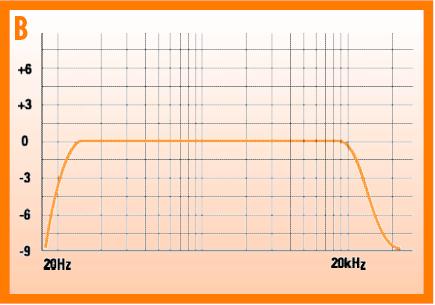
You are describing the frequency response of the speaker, which would ideally show an equal output at every audible frequency, making the curve flat:

131064.jpg


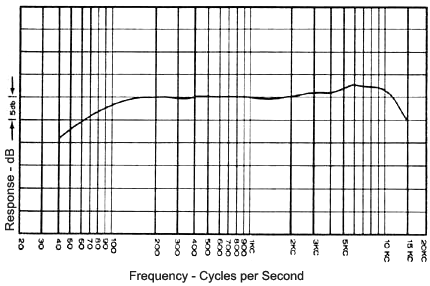
In reality, it is a alittle jaggy, and its shape is affected also by the listening environment. As but one of millions of possible examples:

mic-frequency-response1.gif


Testing for pink noise or at a given frequency is supposed to standardize the sensitivity spec, albeit somewhat arbitrarily.
 
yes in a perfect world,without variables.I can live with it though,I have everything else LOL.I actualy think I am understanding sesitivity though.Nothing is etched in stone.
 
Yup. Don't expect low bass out of a high efficiency bookshelf speaker, but a floor stander should be able to do it, as long as it was properly designed.

Indeed, I measured flat in room response to 25hz from a 100db sensitive woofer system I had. But it took about 18 cubic feet of box. :-)
 
Just to avoid confusion of terms:

“Efficiency” is NOT the same thing as “Sensitivity”

Speaker engineers use the term “sensitivity” because it is technically more precise definition of how loud a speaker will play when driven by an input signal of at a specified voltage level. “Efficiency” is usually a more colloquial term used by consumers, to informally describe how much power a speaker needs to achieve a desired loudness level: “Oh, your speakers a real power hogs. They’re not very efficient.” From a technical standpoint, “efficiency” is defined as the sound power output divided by the electrical power input—but that’s not how consumers use the word. So rather than try to turn laypeople into engineers, we’ll just concentrate on sensitivity.

The reason for quoting sensitivity rather than efficiency is that the true efficiency of a speaker varies wildly with frequency because of its impedance variation. The efficiency quote would be fairly meaningless, so loudspeaker engineers measure and refer to “sensitivity” instead.

From an article Here
 
You are closing in on what you need to know very well. Let me expand upon the dB vs perceived loudness vs power relationship.

First, you already know that a 3 dB change will double or half the power required from an amp. You also need a few more things to know.

First, a 3 dB change in volume is perceived as only a small change in volume. In fact, it is considered the smallest change that we as normal people can detect as a volume change. Smaller changes are perceived as being fuller or somehow less full, or some other subjective description.

Next: To be perceived as being twice as loud a sound has to be 10 dB louder then the quieter one. Thus, 86 dB is twice as loud as 76 dB and half as loud as 96 dB.

Third: A 10 dB change in volume is a change in amp power of a factor of 10. To get from the 86 dB to 96 dB you need 10 times the power.

Forth and last: Music has dynamics, loud, soft and average levels. The speaker sensitivity specs combined with output power can get you to a average volume number but the music is going to peak out louder then that. The amp must be capable of producing those peaks without distorting. There is no "standard" for how much louder a peak is then the average for any piece of music. There are some good rules of thumb however. The two I use are: a) assume peaks are 10 dB above the average and b) size the amp to have 3 dB of headroom above your expected peak.

So how does this act in practice:

Assume speakers of 89 dB /watt/meter. (Somewhere between the higher efficiency spec of 92 and the lower one of 86). I've take some readings in my living room and have come to the conclusion that for me, LOUD is a average of about 86 dB. In this example, to reach my average listing level, since I am 3 dB BELOW the 89 dB spec, I only need 1/2 watt. (3 dB less is half the power.) But now I need to accommodate the peaks which are 10 dB above that average. That's 10 times the power, so I need 5 watts. We want 3 dB headroom above that so that doubles and you are now at 10 watts per channel.

Lets take a look at another example, this one the speakers are at 86 dB and you are a LOUD junkie looking for 89 dB average level.

To get to the average level you want, you need 3 dB more power then 1 watt. Increase volume 3 dB and you double the power. So instead of 1/2 watt, you now need 2 watts. To handle the peaks you need another 10 dB, that's a multiple of 10 so you are now at 20 watts. Add that 3 dB of headroom and that doubles to 40 watts.

If you try to drive those 86 dB speakers to averages in the low 90's things get drastic. Lets use 92 dB average. That an increase of 6 dB, so you quadruple the power needed at average or 4 watts. Factor in the peaks at 10 dB (10 times the power) and you are now at 40 watts and add the 3 dB headroom to protect against clipping and you are now at 80 watts per channel.

I hope this is understandable and helps you get a feel for how your listening habits and speaker sensitivity can interact to effect the amount of power you are going to need.

Shelly_D

 
You know what,as much explanation as that was I actualy understood you,and all the other explanations from the others too.I would say most audio choices are hit and miss ,unless one actualy calculates every variablefrom room size,speaker box volume and all the other possibillitys that effect sound and amplification.I do have a better understanding of what I am looking for in my searching.thanks I appreciate you all for you time and Help.of course there is lots more to learn.
 
You know what,as much explanation as that was I actualy understood you,and all the other explanations from the others too.I would say most audio choices are hit and miss ,unless one actualy calculates every variablefrom room size,speaker box volume and all the other possibillitys that effect sound and amplification.I do have a better understanding of what I am looking for in my searching.thanks I appreciate you all for you time and Help.of course there is lots more to learn.

My work here is done!:D
 
Also, high efficiency is a trade off for low bass extension.

Not neccesarily, in fact the opposite is arguable.
However there is some truth in that involving Cheaply made drivers.
Simple advise is to Not Buy any speaker of Less than 89 db :-)
 
Back
Top Bottom