• The move to the new server is done. There are some software and database maintenance updates in process. This has us passing the hat around to help out. We appreciate any donations. Seriously, even a dollar helps. The payment page may be found here - https://www.audiokarma.org/support.html

Speaker Wire For Vintage Equipment Suggestions

Catfishky

New Member
Hey Guys, I have a Yamaha CR-620 receiver and a pair of Yamaha NS-670 speakers. Both are very clean. Both pieces have spring style terminals. The receiver terminals are very close together as well.
One speaker run will be about 20 feet and the other about 5 feet.
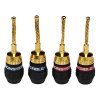
I'm pretty lost.... Was going to order Sewell Silverback cable with the pin adapters. I dont think the pins will fit next to ea other on the receiver. I also looked for pin to banana plug adapters.
Suggestions!! Should i just order some good wire and plug it in and call it a day?
 
Register to hide this ad
I use and have always used 14 gauge speaker wire or plain old 14 gauge lamp cord. Just bare the ends, twist and put into the spring clips. Over the years I've tried severel more expensive connecting cables and didn't hear any difference. A 20' run isn't that far.
 
I always tin bare ends of any speaker wire I get in my hands. Much easier to deal with, no chance of a stray strand shorting to nearest connector & killin' your output transistors or God forbid, stk packs. (Your 620 has discrete to-3 transistors ). With your setup, don't waste big money on speaker wire, you'll get no real benefit. 14 or 16 ga. wire will be fine
 
I do however add whatever ends I need to connect to any given post other than spring clips. At present I'm using spades, banana plugs and pins depending on what is on what piece of equipment.
I always tin bare ends of any speaker wire I get in my hands. Much easier to deal with, no chance of a stray strand shorting to nearest connector & killin' your output transistors or God forbid, stk packs. (Your 620 has discrete to-3 transistors ). With your setup, don't waste big money on speaker wire, you'll get no real benefit. 14 or 16 ga. wire will be fine

Just a few drops of solder on the end after twisting?
 
I always tin bare ends of any speaker wire I get in my hands. Much easier to deal with, no chance of a stray strand shorting to nearest connector & killin' your output transistors or God forbid, stk packs. (Your 620 has discrete to-3 transistors ). With your setup, don't waste big money on speaker wire, you'll get no real benefit. 14 or 16 ga. wire will be fine

Also, do you have a brand you recommend in 14 ga?
 
Put the iron on the wire and heat it so that the solder will draw into the wire. It may take a few tries to get it right if your not used to soldering or thinning
wire. If you leave the iron on the wire too long the insulation will melt. If that happened, snip it off and try again. It's just timing and amount of heat applied.
 
I do try to get the fiber stranded wire only because it's a bit more flexible, but lamp cord on a roll from Home Depot will work fine. It comes with white, brown and clear covering uaually.
 
The rules for wire never really change . 12 awg was a great choice in the 70's and will work today. I would check with Blue Jeans as one good choice. There are many others. Parts Express and Amazon. Just like everything else, don't buy the cheapest but don't go overboard either.
 
The last 100' I bought about a month ago I found on ebay. It was cut off of a roll. It came hand wound like like you would do with an extension cord.
It has heavy insulation, red stripe on one side and the strands are finer than lamp cord. The finer strands is why I bought it and it's nice wire on the cheap. Back in the 80's I bought a spool of 10 gauge hook up wire from Radio Shack. It was known for being very pure copper wire. It even got a write up in a stereo magazine back then. It was cheaper than speaker wire at the time. I used it for about ten years. And don't worry about one channel being longer run than the other. I have a 15' run to one side and a 6' run to the other side. An electron travels 11" down a wire in a nano second. :D
 
Just a few drops of solder on the end after twisting?
You need heat, flux (in the solder) & 60/40 solder, rosin core, or use additional flux. Iron must have a tinned tip. It'll wick into the wire, ideally under the insulation for maybe 3/32"-1/8" or so. Just go to your local hardware store. Peel off what you need from a bulk roll. Cut to desired length, tin ends, good to go. Hook up & :rockon:
 
Also, do you have a brand you recommend in 14 ga?
Not really, 14ga. stranded from your local hardware store will be just fine. And your cr-620 is a nice low-to-mid power receiver. I have one in upstairs system, a cr-820 in lvg. rm. Numerous other amps & receivers get rotated in & out regularly, no need to swap wire, it's all tinned for ease of connection.
 
I'm not a fan of pin connections or tinning the ends of wire (although the latter is preferable to the former). With pin connections, there are only two very small connection points between the pin and the clip. Tinned wire is similar, although solder is soft, so in most cases the clips will dig in a little bit for a slightly larger contact. With bare wire, the strands spread out and give a much larger contact point. Although those Monster ends do look interesting if they're actually flexible.
 
I'm not a fan of pin connections or tinning the ends of wire (although the latter is preferable to the former). With pin connections, there are only two very small connection points between the pin and the clip. Tinned wire is similar, although solder is soft, so in most cases the clips will dig in a little bit for a slightly larger contact. With bare wire, the strands spread out and give a much larger contact point. Although those Monster ends do look interesting if they're actually flexible.
Braided cable, so yes they're quite flexible. Used them to connect 12awg wire to the rear of a Pioneer SX1010.
 
Back
Top Bottom