• The move to the new server is done. There are some software and database maintenance updates in process. This has us passing the hat around to help out. We appreciate any donations. Seriously, even a dollar helps. The payment page may be found here - https://www.audiokarma.org/support.html

Speakerlab 7 Restoration

Ckafoweeth

Member
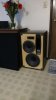
I have a set of 'new to me' Speakerlab 7's. I am guessing from looking at catalogs that they are 1975-1976 based on the orientation/location of the horns and the grill style. They look like they might have been assembled by the factory, as the silicon glue is applied very modestly compared to other examples that I have seen online.

I am pretty excited to have them, but they need some love. The sound is not too bad, but definitely has a 'vintage' quality to it. cymbals, T's and S's are not as clear as I expect, and there is a distant/hollowness to some music. I also noticed that I needed to turn up the bass a little bit more than I expected.

I had assumed that most of these issues stemmed from me not having the L-pads adjusted correctly, or "that is just how they sounded". Last night I had some time to play with them and hooked the left speaker to my A receiver output, and the right one to the B so that I could adjust them individually and together. I fiddled with the attenuators and got some of the high frequency sound to be less distracting, but its still not super clear. When I switched over to the left speaker only, I discovered that it was hardly producing any bass as compared to the other one. When played together, they bass from one fills in pretty well, so I did not notice.

So. I would like to try to make this a project and bring these back to their full potential. Before I start tearing into the speakers though, I was hoping that I could gather some insight on what might be causing these symptoms and what I should be looking for.

I would also love an opportunity to hear some Speakerlab 7s that are in good working order so that I have an idea of what I should be working to fix and what is just the character of these speakers. (I am in the greater Seattle area, so I am hoping that is not an impossible idea)

Any help or thoughts are appreciated!
 

Attachments

  • IMG_20160830_193632230.jpg
    IMG_20160830_193632230.jpg
    32.5 KB · Views: 207
Register to hide this ad
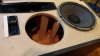
So, I think I figured out the bass issue. Both of the woofers moved while the speaker was playing, and there were no scratching sounds. I touched a AA battery to the speaker leads and found out that the 10" and 12" woofers are out of phase!

Pretty annoyed that I didn't see that when I bought them, but, silver lining, it should be easy to fix, and these guys probably don't have too many miles on them... =/
 
I checked against the other speaker to determine which woofer was out of phase, and it turned out to be the 10". When I popped it out (using a box cutter and a screwdriver), I found that whoever built it had actually labeled the bracing with the wiring instructions. Those instruction match the schematics that I have seen online, and it was wired correctly. That means that either the driver was mislabeled/wire, or the wire is coming from the wrong place on the crossover.
 

Attachments

  • 2016-09-10 14.53.05.jpg
    2016-09-10 14.53.05.jpg
    30.4 KB · Views: 89
  • 2016-09-10 14.53.19.jpg
    2016-09-10 14.53.19.jpg
    67.4 KB · Views: 91
If these were built at Speakerlab, then that guy was having a really off day. The 12" was the woofer that was out of phase, which means that BOTH woofers in the other speaker are wired up wrong. Who knows about the horns...

On the plus side, I am pretty excited to see how many of the issues I was asking about are fixed just by wiring these things up right.
 
Hey man,

Welcome to AK! You've been chugging along here all by yourself, good job. Just keep it up and don't mind us. It's amazing what you can find wrong inside speakers if you just take a fresh look and contemplate the situation. I've never heard the 7, but the internet seems to like them a lot. Keep up the good work!

I'm in the garage working on a pair of DIY Bozak B302A's. The banding veneer around the edges needed to be replaced with new stuff, I just completed it! I'm getting everything sanded up nicely, tucking everything tight and even. I've already got the guts and the crossovers taken care of. Ever so slowly, I'm getting it taken care of. My goal is to have them in the living room by the time winter hits.

Go man go!

Biggles
 
Thanks for the encouragement! Those Bozak's are an interesting configuration.

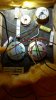
I have my first actual question for anyone reading this. I posted a picture of the crossover, and I can see the 12uF capacitor (top left, kinda washed out in the picture). It looks like the other capacitor is on the right of the image. It says "STANDARD 1.0 MFD 15%". I assume that means its a 1uF cap. All of the wiring diagrams that I can find online for the Speakerlab 7 show a 2uF capacitor there.

I will look in the other speaker here soon to see what is going on there, but am I interpreting what I am seeing correctly? Should I look at replacing the 1uF with a 2uF capacitor? Does anyone know if the crossover design changed, or have a wiring diagram that they have confidence in?

Thanks!
 

Attachments

  • 2016-09-11 10.24.46.jpg
    2016-09-11 10.24.46.jpg
    50.5 KB · Views: 118
You're welcome, kinda fun to get your fangers in there, huh? I can't help with original crossover schematics versus what you have. If what you're reading is correct, then yes it is a 1uF cap. The other speaker may reveal some answers.

That being said, you can order 1 and 2uF caps. Try them both and see what your ears tell you. The cost is going to be an extra few dollars, not even worth having a conversation over. That way you can do what you want.

Biggles
 
Do both woofers share the same internal volume?. It is possible that, depending on the X-Over design,
the polarity on one of the woofers (the smaller one) could be reversed. Make sure you look into that.
 
I would assume the mid horn to have reversed +/- leads on it. You seem to be figuring things out on your own pretty well- congrats on that!
As for the slurred "s" I seen all the inductors are oriented the same, I would flip the closet ones on their edges and away from one another to start with, then match up the capacitors with Dayton poly types of correct uF- a 1uF is crossing really high, I would be tempted to use a 2uF. While I am in there I would c/o the tweeter diaphragms with upgrades one from Crites, they EV T35 tweeter was popular among several builders and would roll easily at 15khz with its phenolic diaphragm. Good luck!
DC
 
Both the woofers do share the same volume, but they are supposed to be in phase with each other. The effect is that of having a single ~15" woofer, but with easier to manage drivers. Both of the crossovers are the same, and different from what I have found online. I did like DrBiggles recommended and just ordered a couple different capacitors. It will take a few days to get here, so that should give me some time to brush up on my crossover design theory.

Why would you assume that the mid-range horn should have the polarity reversed? I've attached the crossover diagram that I was able to find, and it looks like everything there is intended to be in phase.

That is an interesting thought about reorienting the inductors. I'll look into that.
 

Attachments

  • qRtyJv5.jpg
    qRtyJv5.jpg
    51.8 KB · Views: 121
Typically your midrange driver will be out of phase, depending on your crossover design. I would also suggest at least trying it and see if it sounds agreeable to you. While you are into them a bit of DeOxit lube on the L-Pads would not hurt. There are several items on the Web discussing speaker phasing that should help you out.
Parts Expresshas a good line of caps, electrolytic and film types. Some folks swear by any cap value under 15hz c/o to poly types, others say replace with same value electrolytic to keep "voicing" as is.

Welcome to the group!
DC
 
Are both of the woofers operating at the same frequencies? Not sure I understand two drivers that size operating in the same enclosure.
 
Are both of the woofers operating at the same frequencies? Not sure I understand two drivers that size operating in the same enclosure.
Yes, both woofers are using the same frequency range. The idea is that a single 10" and single 12" combined have the same cone area as 1 @ 15" cone, but with two magnet assemblies to control everything. The smaller cones can be more rigid and are lighter, yielding less physical distortion under load and theoretically better transient response.

Ckafoweeth, take a look at this thread. It documents a quite detailed restoration of a pair of 7's, and in there somewhere is a schematic of the x-over.
http://www.audiokarma.org/forums/index.php?threads/speakerlab-seven-restoration.241372/
 
Thanks everyone for the encouragement. That last link looks like a really interesting project. The crossover diagram they use is in one of the first links and is different yet again from what I see in my speakers and what I have found online. It looks like those might be a set of "Super 7's" with the HT350 tweeter and a different driver on the mid-range. Its interesting that he replaces the resistors as well. I haven't read that they really 'wear out' yet.

The horn tweeter is an Electrovoice. It's labeled as a Speakerlab HT3500, but the internet says that is an EVT-35. I am certainly considering upgrading it to a Crites. That's getting a little bit ahead of myself, but I'd be interested to hear if anyone has an opinion on the CT120 vs the CT125.

I quickly Googled an out of phase mid-range, and that looks like an interesting can of worms. Thanks for bringing it up, I had not heard of such a thing.
 
Wondering about correct wiring phase, can make you crazy. A 6db per octave 2-way is wired in phase, where a 12db per octave 2-way is wired out of phase. The stepper roll-off shifts the tweeter output too much, so that wiring out of phase, brings it's level back up to match the woofer.

Speakers with multiple woofers like yours, wire the woofers in phase to each other, so as to not cancel bass response. How the mids and tweeters wire to the woofers, is where the insanity starts!

Phasing in a 3 or 4 way design, can get even more complicated and confusing. If available, it's best to match a factory schematic. If not, try listening by ear. The driver wiring position, with the greatest output, is typically considered correct, as regards to phase.
 
Thanks everyone for the encouragement. That last link looks like a really interesting project. The crossover diagram they use is in one of the first links and is different yet again from what I see in my speakers and what I have found online. It looks like those might be a set of "Super 7's" with the HT350 tweeter and a different driver on the mid-range. Its interesting that he replaces the resistors as well. I haven't read that they really 'wear out' yet.

The horn tweeter is an Electrovoice. It's labeled as a Speakerlab HT3500, but the internet says that is an EVT-35. I am certainly considering upgrading it to a Crites. That's getting a little bit ahead of myself, but I'd be interested to hear if anyone has an opinion on the CT120 vs the CT125.

I quickly Googled an out of phase mid-range, and that looks like an interesting can of worms. Thanks for bringing it up, I had not heard of such a thing.

Yes, I believe the speakers in Sir.Byrd's thread are Super 7's. But I also believe they use the same woofers and mid horns as your 7's do. Also, SL sourced their tweeters from EV, so it has a decal with a Speakerlab part number, but is in fact an EV T-35. It's also possible to have an EV T-350 appear in 7's since some folks just bought parts and built their own speakers without purchasing the kit. I have no personal experience with the Crites replacements, but have only heard good things about them
 
It's a couple of years since I owned my 7's but I remember that most of them came with the T-35 tweeter but later ones had the superior 3500 tweeter. If your tweeters have HT3500 on them then the Crites tweeters will not be an upgrade.

In the past there were a few different makes of speaker that had two drivers sharing the same enclosure space. If you look at the specs for the 10" and 12" drivers you'll see that one has fairly low Qts and one has high Qts figures and that is partly why they work well together in the same space. There is an interesting series of articles on the theory behind that by Thorsten Loesch that are worth doing a search for.
 
It's a couple of years since I owned my 7's but I remember that most of them came with the T-35 tweeter but later ones had the superior 3500 tweeter. If your tweeters have HT3500 on them then the Crites tweeters will not be an upgrade.

In the past there were a few different makes of speaker that had two drivers sharing the same enclosure space. If you look at the specs for the 10" and 12" drivers you'll see that one has fairly low Qts and one has high Qts figures and that is partly why they work well together in the same space. There is an interesting series of articles on the theory behind that by Thorsten Loesch that are worth doing a search for.
Oh! interesting!. When young i always wanted to try a similar arangement (low and high QTS together) but never tried.
Thanks!
 
Brian Cheney, of VMPS, was also a proponent of this dual woofer, different Qts technique. Brian believed in staggering the woofer's resonance frequencies too. He felt if two identical woofers were used in the same box, you'd end up with a too much of an one-note bass response.
 
Last edited:
Back
Top Bottom