• The move to the new server is done. There are some software and database maintenance updates in process. This has us passing the hat around to help out. We appreciate any donations. Seriously, even a dollar helps. The payment page may be found here - https://www.audiokarma.org/support.html

Spec 2 Idle Current and Meter Weirdness

kevin b

Active Member
I got a good deal on a Spec 2 from a local guy who said it had an intermittent channel. There are a few light scratches and nicks, but not bad for something I figured I'd never own. I put it on the DBT, and it came out of protection. DC offset was good, so I plugged it in directly and tried it out on test speakers. The right channel was cutting out, but cleaning the controls took care of that and it sounded good on the bench for a couple hours that night. Until I find a SPEC 1, I think I can use my SA-9900 as a preamp after the Spec 2 gets a thorough restoration.

The next morning, I attempted to set the idle current per the service manual. Both channels were a little high at first, so I turned them down to 30mA, and then down again after 1/2 hour. Both channels kept rising for a couple hours, and I kept turning them down. The heatsinks were about 120 degrees F at that point, which seems high with nothing connected, but I don't know.

Once the idle current was pretty stable, I turned it off, and then back on a few minutes later. This time one of the meters rose to about straight up, still with nothing connected. I turned it off, stared at it for a minute asking myself WTF, and tried again. This time the other meter did the same, so turned it off quickly again. I did some searching and it didn't seem that I was in danger of blowing anything up, and tried one more time. This time one meter went up, and then slowly started coming down as the other one went up, and then it came out of protection. Both meters dropped instantly and it seemed normal.

The next morning when it was cold, I tried again. One meter went up, and then dropped when it came out of protection after a few seconds. I checked idle current, and it was close to zero on both channels. After a while, it started to rise very slowly on one channel, but not the other. I was able to adjust them as before, but didn't wait to see if it would stabilize since something is obviously wrong anyway.

I understand that the reed relays and the others should be replaced, and really the whole thing should be rebuilt, but I'd like to get it working reliably before that major work. I found a thread where someone had a nearly identical experience with one meter going up, and dropping as the other went up, then coming out of protection. EchoWars said in that thread that it would probably be the pre-drivers, Q4-Q7 rather than something wrong with the meter amp board.

So can anyone suggest what to replace or check first? Should I replace all the relays, and remove/check Q4-7? Might they test okay when cold, and fail when hot?

Thanks for any advice.

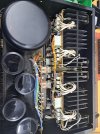
20260110_103149[1].jpg
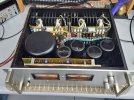
20260111_085510.jpg
20260111_085526.jpg
 
Register to hide this ad
Another issue in the bias circuit can be the trimmer resistors. Check their continuity with an ohmmeter while slowly rotating their trimmer. If they jump around that’s a problem. Start with cleaning them with some D5 followed be F5 or similar lube, then recheck. Plan on replacing them when doing restoration.

Be sure to turn them down before powering up again and reset bias. Usually takes 20+ min for resting temp to stabilize.
Will do, thanks. I was trying to figure out how it could be something on one amp or the other when both meters are misbehaving, but maybe both bias trimmers are dirty. They're touchy while adjusting for sure. I'll clean and check them, and also check power supply voltages. I think I probably should have done that first anyway.
 
When I got my Spec 2, I never managed to make it behave anywhere close to correctly until I replaced the 2SA798, reed relays, and trimmers. I understand the will to get things in a decent shape before starting a restoration, but I would still start there...
 
When I got my Spec 2, I never managed to make it behave anywhere close to correctly until I replaced the 2SA798, reed relays, and trimmers. I understand the will to get things in a decent shape before starting a restoration, but I would still start there...
Great I have some things to work on. Thanks, I'll let you guys know how it goes.
 
Well I replaced the 2SA798's, reed relays, and trimmers in both channels. Bias went up to about 100mA on both after 1/2 hour. I readjusted both to 30mA, and they seem stable now, and the heatsinks stay barely warm. The meters are still erratic though, so I'll replace Q4-Q7 next. I did order the complete list per mattsd's thread, so at least I have everything but the main filter caps for a full restoration now.
20260217_085950.jpg
20260217_090004.jpg
20260217_102437.jpg
 
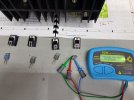
Hey that seemed to do it. :) I don't know if any leakage current is acceptable, but a couple of the transistors had some. Idle current was re-adjusted per the manual and it's holding steady. I will complete the restoration next, although it seems perfect now and there is no noise.
The main filter capacitors aren't bulging at all, so I'm not sure it's worth the cost of replacing them at this point. I also don't know where to find them other than eBay for $175 either. I think I'd rather spend $125 on a Peak ESR70 to test them with since my current LCR meter is only good for 1000MFD, and I would like to upgrade. I'd be happy to hear opinions or alternate suggestions on that.

20260218_124145.jpg
 
I've had leaking filters but never one that read bad. Probably of had 300 or so through the shop.
They can short which is easily diagnosed.
I replace them to complete a restoration. I prefer to leave leave them if its my own piece.
In fact, I reform the new caps before I install them. There is a difference in the sound if they are not reformed. It does eventually open up after several hours of operation if that step is overlooked.
Okay thank you, I think I'll try to reform them, but have never done that and will have to research the proper method. Should I test them before and after reforming? Could you explain what you mean by this- "It does eventually open up after several hours of operation if that step is overlooked." Do you mean that if it sat for a long time without being used (as this one did,) it will sound different after playing for several hours, but reforming them will make it sound better right away?
 
You need a bench supply that can handle the voltage ratings on the filter/bulk caps or a Z meter that has that function.
Its not a necessary procedure.
The capacitors are a flexible component of the circuit. I can tell after a rebuild the receiver or amplifier sounds more open and defined after a few hours of running in.
I never bought in to this breaking in process until I restored a SX1980. I thought on the first listening it sounded terrible. Very disappointed, but after some hours on it, it became very enjoyable to listen to. In fact, I almost sold it. Actually I tested it and completely checked it out and then put on the top shelf in disgust. Offering it up for sale later, I wanted to check it out once again. I had left it on all night accidently playing a local station, connected to the dummy loads and Holy cow, what a difference.
 
Got it thanks. I guess I'd rather spend money on what I need to do FM alignments first. I have gone a little crazy lately with buying other receivers, amps, etc. that need restoration also, so I'm a little hesitant to start the complete restoration on this one since it seems good. We'll see.
 
The test gear found on eBay is probably going to need work. Don’t pay up for that stuff. Most sellers don’t Know what the equipment is used for. They won’t guarantee it working. If you’re learning you need equipment that is in a known good operating condition.
The TinySA units are the way to go and some sellers know this. Like I said don’t pay a lot for that old equipment in unknown condition. Good sellers will deal.
 
Last edited:
The test gear found on eBay is probably going to need work. Don’t pay up for that stuff. Most sellers don’t Know what the equipment is used for. They won’t guarantee it working. If you’re learning you need equipment that is in a known good operating condition.
The TinyUSA units are the way to go and some sellers know this. Like I said don’t pay a lot for that old equipment in unknown condition. Good sellers will deal.
That sounds like good advice, thanks. I have never seen that tinySA (I think that's what you meant) but it sure looks like a good deal for what you get. I think I'll try one. Good to know about needing to break-in after a restoration also. I probably would have been disappointed without knowing that as well.
 
Well I guess it's time to finish the restoration on this one. I've been listening to it in the house, and now the left channel is dropping out. It can either cut out abruptly, or it fades out slowly. Sometimes it fades back on, and sometimes I have to stand up and start walking towards it. It seems to know I'm coming for it, and it fixes itself before I get there. If not, it will come back on with some static noise if I turn up the volume. A static shock could jolt it back on also. Out on the bench now, I had a hard time getting it to cut out, and it finally did just briefly after turning power off and back on.

Does that sound like a transistor or maybe a capacitor? I would suspect a solder joint, but the slow fading out and in makes me think it's a failing component.

I think that rather than trying to find and fix that, I'll just go ahead and replace all the rest parts on mattsd's BOM.

Any thoughts before I get started?
 
I've never worked on one but it sounds to me like a intermittent open circuit or bad contact.
Recommend to input a sine wave and trace the signal to the input stage.
 
I've never worked on one but it sounds to me like a intermittent open circuit or bad contact.
Recommend to input a sine wave and trace the signal to the input stage.
I would trace it, but the problem won't occur long enough to do that.
Likely the muting relay needs to be replaced or opened up and the contacts cleaned.
Which one is the muting relay? The manual says RL5, but there isn't a RL5 anywhere that I see on the board layouts or schematics.
 
AKA Speaker Relay AKA Protection Relay. Page 26 (on paper, not PDF page number) of the Service Manual approximately B3 (mounted to the chassis).
This thread will help: https://audiokarma.org/forums/threads/speaker-relay-for-spec-2.891253
You should also check your bias to make sure it is stable and read this thread regarding the bias relays: https://audiokarma.org/forums/threads/pioneer-spec-2-unstable-bias.113229
Got it, thanks. I had done the reed relays previously (higher up in this thread,) and bias adjusted fine. Yesterday I replaced all of the Amp board parts on the left channel and still had the problem, so I did the right side and then the Power Supply board. The protection relay had obviously been opened up previously, and the contacts were clean except for this slightly burned and pitted one.
20260717_195654.jpg

For some reason I failed to buy a replacement when all the rest of the parts for this were ordered, but cleaning seemed to take care of the channel dropping out. I think I'll look for a replacement now anyway. The other two relays on that board were replaced.

On the Amp boards, the C4's that Echowars identified as installed backwards at the factory didn't look too happy, and neither did the C6's next to them for some reason.

20260717_154244.jpg

Speaking of C4's, somehow I got the wrong series and am wondering if I should get the ones listed on mattsd's BOM. He calls out EEU-FC1H100L, and I got EEA-GA1H100's.

Today I'll do the Meter board, re-adjust idle current, and see if I can adjust the current limiter circuit without exploding or melting my dummy load resistors.
 
Well I ended up ordering the correct caps along with another value that was missed. My meter board didn't have the extra hole for the big film cap that replaced the bipolar one, so I just had to drill a new one where the sharpie mark is.

Cap.jpg

Here are the parts that were replaced with mattsd's BOM minus the soft start relay, which was also cleaned.

Parts.jpg

All of the adjustments went fine, and my dummy load never even got very hot switched to 4 ohms to set the current limitrer. Here is the happy amp. It sounded good before so I'm not sure if the sound really changed, but it should outlast me now I guess.

Done.jpg

I wanted to see where it would start to clip on 8 ohms and got all the way to 50V before chickening out. The input voltage had to be increased to 2.7V at 1 kHz to get there. The meters would momentarily reach 300 watts when I turned each channel all the way up to reach 50V, and then they quickly dropped down to 250. I don't know why that would be.

Scope.jpg

I expected the current limiter circuit to kick in shortly after 250 watts, so if anyone thinks I should go back and readjust that, please let me know. If not, I'm calling this one good and moving on to the next in line. My SA-9800 is also cutting out like this one did, so I may try cleaning the speaker relay on that one before it gets the full restoration.

Big thanks to everyone for the help.
 
Back
Top Bottom