• The move to the new server is done. There are some software and database maintenance updates in process. This has us passing the hat around to help out. We appreciate any donations. Seriously, even a dollar helps. The payment page may be found here - https://www.audiokarma.org/support.html

Splitting hairs with filter caps

Sergimm

Active Member
I'm deciding between the following filter capacitors to replace a 4700uF/35V in a Luxman L1, and after checking the specs, it seems like the best among the three is the EPCOS/TDK.

The thing is, while being better at ripple current and having a considerably better tan δ, their leakage equation yields leakage almost 5 times worse than the others:

Nichicon LGU1H682MELA
Ripple Current 3.3A
tan δ 0.3
Leakage Current 1.74mA

Vishay MAL225631682E3
Ripple Current 2.92A
tan δ 0.35
Leakage Current 1.5mA

EPCOS/TDK B41252A6688M000
Ripple Current 3.64A
tan δ 0.2
Leakage Current 6.8mA <------------- ?


I know I am probably splitting hairs here and it's potentially not relevant, but should I be taking the leakage into consideration for main filter caps? Why would leakage be so superior to the other caps in the same league?
 
Register to hide this ad
Only 4700uF at 35V?
You could just use Nichicon VR and be done with it, those are so small it doesn't even remotely matter.
 
Only 4700uF at 35V?
You could just use Nichicon VR and be done with it, those are so small it doesn't even remotely matter.
Thanks, I figured. The voltage at that point in the circuit is 34V, so they are cutting it very close having the main filter caps with a rating of 35V, that's why I'm increasing a bit.

May I ask why the VR series specifically? They have great specs, but I don't think I've ever used them before.
 
Thanks, I figured. The voltage at that point in the circuit is 34V, so they are cutting it very close having the main filter caps with a rating of 35V, that's why I'm increasing a bit.

May I ask why the VR series specifically? They have great specs, but I don't think I've ever used them before.
It's just Nichicon's standard series. Cheap, and yes great specs. Sizing is nice too.
 
What's the lead spacing for the caps and are their diameter or height space constraints? I recently redid an H/K A-402, original cap 4700/50 lead spacing was 12.5.. I ended up using Nichicon KW series 6800uF/63V as they fit perfectly, needing no modifications to leads, etc. Rotel I'm working on now has cap clamps and I had smaller diameter LGU caps on hand, so needed to make a spacer ring for each cap so they'd be snug.
 
What's the lead spacing for the caps and are their diameter or height space constraints? I recently redid an H/K A-402, original cap 4700/50 lead spacing was 12.5.. I ended up using Nichicon KW series 6800uF/63V as they fit perfectly, needing no modifications to leads, etc. Rotel I'm working on now has cap clamps and I had smaller diameter LGU caps on hand, so needed to make a spacer ring for each cap so they'd be snug.
They're 25mm diameter, 42mm length, and 10mm lead spacing.
 
In a power supply filler cap, a small amount of leakage will not matter although it may indicate that the cap is not a very good quality one. If the leakage is within mfr's spec, then it's no problem at all. In signal coupling, then leakage can become an issue, even though caps used in coupling applications are very much smaller than 4700uF.
 
I'm deciding between the following filter capacitors to replace a 4700uF/35V in a Luxman L1, and after checking the specs, it seems like the best among the three is the EPCOS/TDK.

The thing is, while being better at ripple current and having a considerably better tan δ, their leakage equation yields leakage almost 5 times worse than the others:

Nichicon LGU1H682MELA
Ripple Current 3.3A
tan δ 0.3
Leakage Current 1.74mA

Vishay MAL225631682E3
Ripple Current 2.92A
tan δ 0.35
Leakage Current 1.5mA

EPCOS/TDK B41252A6688M000
Ripple Current 3.64A
tan δ 0.2
Leakage Current 6.8mA <------------- ?


I know I am probably splitting hairs here and it's potentially not relevant, but should I be taking the leakage into consideration for main filter caps? Why would leakage be so superior to the other caps in the same league?

When they only list one ripple current figure I believe they are referring to ripple current @ HF only. The LF ripple figure is usually lower than HF ripple within any given capacitor, but is most often not specified and also helpful to know when making these decisions. Ripple is good, but trying to only use caps with the highest possible ripple current all the time isn't always a win/win. 3.6 amps of current @ HF is a fair amount for a 4700uf cap. Expect larger than life, overly energetic highs with the TDK that may turn fatiguing after awhile. However, if you like treble, then go for it. These high ripple caps often sound HiFi-ish (esp. w/ lower ESR) as they bring an almost crystal clear, modern sound with greater emphasis and higher impact to the music.
 
With that 4700uf value cap, 2-3 amps of HF current is closer to a more true-to-life, natural musical representation. With the super ripple caps, people will say things like top-end detail and HF extension have improved, but with that comes an increased likelihood of introducing listener fatigue at volume. They sound more "exciting", which can be a good thing- depending what you like.
 
With that 4700uf value cap, 2-3 amps of HF current is closer to a more true-to-life, natural musical representation. With the super ripple caps, people will say things like top-end detail and HF extension have improved, but with that comes an increased likelihood of introducing listener fatigue at volume. They sound more "exciting", which can be a good thing- depending what you like.
Thanks for the explanation, I didn’t think caps in the filter stage would condition the sound that much, I will keep it in mind. The calls I’m looking at are 6800uF though. I thought that I can increase capacitance while I’m at it, given that they’re the same size as the old 4700. So, in that case I believe that the ripple values are less extreme. Out of curiosity, what caps would you use?
 
Last edited:
Don't know if you'll be able to find a datasheet for the original caps, but there's a decent chance that their tolerance was -10 / +70. Most modern caps have much tighter tolerances (and many are just a little below their specified capacitance.) It's quite possible that modern 6800uF caps would actually be closer to what was in there originally than present-day 4700s.

I would agree with the above suggestions to go w/ 50v caps, if the voltage they see is 34v.
 
Agreed. If it were me, I would be looking for audio rated 4700uf 50V or 63V caps such as Nichicon LKS or LKG- Super Through or Gold Tune or something similar. However, there are Many suitable choices here. It's just that audio rated caps are typically optimized to sound better in audio applications in the first place, taking much more of the guess work out of it (if the cap has an audible impact to the sound). You're never going to hear the effect of all caps in all positions all the time. Many other non-audio caps may sound just as good, but it would depend in part on their individual specifications and relative balance and level of available current spread from LF to HF.

Personally, I find the best sounding power filter cap to be audio rated, use stock capacitance, have an increased voltage rating of 2-3 times over stock, be competitively rated @ LF ripple current but not necessarily competitively rated
@ HF ripple. This is because HF ripple is always higher than LF ripple within a cap, so competitive LF ripple matches up closer in actual amperage and output (tonal balance) when the HF figure isn't listed and therefore not competitively rated. As you increase voltage rating, you also increase ripple (even if ripple isn't competitively listed at a 2-3X voltage rating over stock). All caps will work, so yes, it's splitting hairs, but some will definitely sound better or worse than others.
 
Last edited:
I don't pay attention to size or lead spacing, except to say larger electrolytics may generally sound better than smaller ones but may also present fitment issues. Leads can be bent to minimize or expand spacing within reason (a few mm) so long as you don't damage the leads with creases or excessively sharp angles. At the same time, shorter lead length is always preferable but may limit selection. You can increase capacitance with caps, but it isn't always necessary to get more oomph or achieve what you are looking for.
 
Great, all this info was really helpful, thanks!

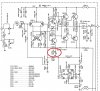
Now that we are on the topic, one last question. I have this couple of 220uF caps and I am having a hard time understanding whether they are directly on the signal cap or not. I have the choice of Elna Silmic or Panasonic FR for that position, which I guess it depends of how much it would affect the tone. What would you use?

hfe_luxman_l-1_l-1a_service copy.pdf (page 9 of 11) 2020-09-21 16-51-43.jpg
 
C205 is a decoupling capacitor. I would normally use a capacitor that's suitable for power supply duties, the FR fits that bill.

Craig
 
Back
Top Bottom