
• The move to the new server is done. There are some software and database maintenance updates in process. This has us passing the hat around to help out. We appreciate any donations. Seriously, even a dollar helps. The payment page may be found here - https://www.audiokarma.org/support.html

ST-70 Restore... And What Next?

David_NC

Super Member
I finally finished replacing caps, resistors, and selenium rectifier on my ST-70. I've got four inexpensive matched EL34's and an equally inexpensive 5AR4 sitting here in a box. I assembled a DBT today in case oe is needed and have a 60 watt bulb in it (I assume that's a good wattage to use). So now what? I always hate this part - powering on something I've worked on. I've never had a bad experience with doing a bad repair, but I'm still a wimp about it.
Do I power it on tubeless on the DBT and check voltages at the tube sockets first? If so, what am I looking for? Should I then install the 5AR4 and check more, and then add the 7199's, and finally install the EL34's? Is there a pre-tube bias adjustment so that it'll be at least in the ballpark so as to not damage anything, or does it not go high enough to damage anything before I can get it adjusted?
I know I'm not supposed to run a tube amp without a load, but if I short the inputs so no signal is passing through, is there still a risk? The reason I ask is that I'd hate for it to damage speakers in case something is wrong while I'm adjusting bias, testing, or whatever.
Any advice would be appreciated!
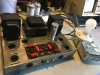
Post Refurb.JPG
 
Register to hide this ad
What does the manual say to do?
LOL I expected somebody to ask that. It gives assembly instructions, setting bias, general stereo vs mono principles, how to use it as a 70 watt mono amp (I thought I'd read here that couldn't be done), basic troubleshooting steps, and some voltage test points. I'd assume these numbers would be off if on a DBT, and it doesn't state if those are used with or without tubes installed. Can I test EL34 sockets without a 5AR4 installed? Are the fThis is my first experience with tube equipment, so I'm not too sure about much of this.
Manual Snip.jpeg
 
Page 6 of the ST-70 manual under "Initial Adjustments" gives you all the information you'll need to start with. Fire her up!
 
Page 6 of the ST-70 manual under "Initial Adjustments" gives you all the information you'll need to start with. Fire her up!
Oddly enough, that's not in my manual. Perhaps I've got a different one; I def need to get one that has that section.
 
You're getting good advice. Literally, there were tens of thousands (if not more of these made over the years, I'm sure you're up for this. There's an excellent thread on these.
https://www.audiokarma.org/forums/index.php?threads/dynaco-st-70-base-line-testing.578485/
Definitely worth a read.
One point made in thread is that modern line voltage is usually around 122vac. Because most tube gear was built in an era that line tended to be around 117vac, all the voltages in your amp will be somewhat higher (not through the DBT)
Short term it's fine. For long term reliability you should make yourself a bucking transformer. If you set bias plugged into wall, you'll need to rebias after you install bucking transformer.
 
When I restored my own ST-70 back in 2001, as detailed on my restoration page, I was perhaps a bit careless in not using a variac or dim-bulb tester, neither of which I had at the time. My four steps after the restoration were the following:

1. Pull tubes, connect speakers, power amp on with hand on plug, look for smoke
2. Power down, Install all tubes except 5AR4 rectifier, power back up with hand on plug, make sure their filaments glow
3. Power down, install 5AR4, power back up with hand on plug, watch for smoke and glowing things that shouldn't be glowing
4. Apply audio signal, listen for hum or distortion

Thankfully, nothing went wrong during power-up, and I didn't experience any issues with the amp until last year. Once I attempt repairs, I will likely use my metered variac when initially powering it on, but I don't think it'd be entirely necessary. As long as you shut it down within a few seconds if something goes badly wrong, the amplifier should be fine.
-Adam
 
When I restored my own ST-70 back in 2001, as detailed on my restoration page, I was perhaps a bit careless in not using a variac or dim-bulb tester, neither of which I had at the time. My four steps were the following:

1. Pull tubes, connect speakers, power amp on with hand on plug, look for smoke
2. Power down, Install all tubes except 5AR4 rectifier, power back up with hand on plug, make sure their filaments glow
3. Power down, install 5AR4, power back up with hand on plug, watch for smoke and glowing things that shouldn't be glowing
4. Apply audio signal, listen for hum or distortion

Thankfully, nothing went wrong during power-up, and I didn't experience any issues with the amp until last year. Once I attempt repairs, I will likely use my metered variac when initially powering it on, but I don't think it'd be entirely necessary. As long as you shut it down within a few seconds if something goes badly wrong, the amplifier should be fine.
-Adam
That's the plan. I didn't have my test speakers at home last night, and I didn't want to use a good pair initially. I'll power it on on the DBT first just in case something goes boom or poof! If nothing bad happens, I'll go from there. First, I'll give it a good visual check to make sure there are no obvious issues. It worked really well before I got to it, so anything wrong with it now is on me! ;)
Thanks.
 
That's the plan. I didn't have my test speakers at home last night, and I didn't want to use a good pair initially. I'll power it on on the DBT first just in case something goes boom or poof! If nothing bad happens, I'll go from there. First, I'll give it a good visual check to make sure there are no obvious issues. It worked really well before I got to it, so anything wrong with it now is on me! ;)
Thanks.
Unlike a solid-state amplifier, an average tube amplifier is extremely unlikely to damage the speakers connected to it if something goes wrong. The output transformers see to that quite well, blocking any DC from reaching the secondary. If you're really concerned, you could use a pair of 8 ohm non-inductive power resistors across the speaker outputs as dummy loads, but I wouldn't bother personally. I do keep some pairs of sacrificial speakers around for testing purposes, but that's mostly for when dealing with solid-state gear.
-Adam
 
Unlike a solid-state amplifier, an average tube amplifier is extremely unlikely to damage the speakers connected to it if something goes wrong. The output transformers see to that quite well, blocking any DC from reaching the secondary. If you're really concerned, you could use a pair of 8 ohm non-inductive power resistors across the speaker outputs as dummy loads, but I wouldn't bother personally. I do keep some pairs of sacrificial speakers around for testing purposes, but that's mostly for when dealing with solid-state gear.
-Adam
I guess I was thinking more of noise being amplified and damaging the speakers. When I first got it, I'd occasionally get a loud pop from the speakers. Removing and reinstalling the tubes a couple times in their same sockets seemed to resolve it, so I put that down to dirty pins or sockets. I used DeOxit on a small brush to clean the contacts since then, so hopefully it's all good now. I have an old pair of 5.25" car speakers with a rattle that I think I'll use as initial speakers; they are definitely OK as sacrificials. If I don't hear any weird sounds, I'll go for my test speakers. This is my first time with tube equipment, other than back in the 70's with an old Zenith TV and stereo... of course, they really weren't all that old then!
 
Well, it didn't pop, spark, or smoke. In fact, it sounds ok on test speakers... at least on the left channel; I have nothing on the right. These are new tubes, so I'll let them cool a bit and switch them side to side to see if that makes a difference.
 
Switching tubes did nothing. I turned the amp off for a minute to switch sources. When I switched it back on, there was a small pop and a flash from the rectifier tube. I shut it down, obviously. I have an original, but I'd like to not damage that one, if possible. Also, the 3A slo-blo fuse is blown. Any ideas as to what would cause the flash and pop from the 5AR4 would be appreciated.
 
Last edited:
Switching tubes did nothing. I turned the amp off for a minute to switch sources. When I switched it back on, there was a small pop and a flash from the rectifier tube. I shut it down, obviously. I have an original, but I'd like to not damage that one, if possible. Also, the 3A slo-blo fuse is blown. Any ideas as to what would cause the flash and pop from the 5AR4 would be appreciated.
You might have not waited long enough for the filter capacitors to drain. Shutting these amps down and turning them back on too soon can cause the rectifier tube to arc as you saw. The arced-over 5AR4 might be okay once you replace the fuse, but it's hard to say for sure. Best way to prevent that sort of thing from happening again would be to wait a few minutes after shutting the amp off before turning it back on again.
-Adam
 
You should put in the diode upgrade for the 5AR4 rectifier tube. Frank Van Alstine would be the guy to get in touch with on this.
 
You might have not waited long enough for the filter capacitors to drain. Shutting these amps down and turning them back on too soon can cause the rectifier tube to arc as you saw. The arced-over 5AR4 might be okay once you replace the fuse, but it's hard to say for sure. Best way to prevent that sort of thing from happening again would be to wait a few minutes after shutting the amp off before turning it back on again.
-Adam
That's quite possible. I waited a bit, but maybe not long enough. It's a bit scary to think that a momentary power interruption will damage tubes like this. There should definitely be something to prevent this. Is there a risk to trying the current 5AR4?

You should put in the diode upgrade for the 5AR4 rectifier tube. Frank Van Alstine would be the guy to get in touch with on this.
I'm definitely curious about that and will have to check into it.

Next, up... to figure out why I have no audio output on the right channel.
 
Interested in what you’ve discovered, any resolution to the right channel issue?

Was the rectifier ok?


Good luck,
Andy
 
Back
Top Bottom