• Please note that Audiokarma will be offline briefly for updates early on Monday morning, September 28th.

Static problems with all my turntables

I'm thinking there could be something wrong with the grounding in my house?!

Improving your house ground is never a bad idea, but I'm thinking it's the tables.

As I stated the two I'm currently using have this issue, my Kenwood KD-500 utilizing the same mat, in the same location, etc as my Kenwood KD-770D and had no static problems.

Again, it's only an annoyance when removing the record, I just give it a swipe with the carbon brush and put it away, they're still static free when removed to be played again.

I can see where this could really be more of a nuisance if your mat is lightweight and lifts off with the record.

Again, I find it way more of an issue with newer vinyl, my old records seem immune.
 
Improving your house ground is never a bad idea, but I'm thinking it's the tables.

As I stated the two I'm currently using have this issue, my Kenwood KD-500 utilizing the same mat, in the same location, etc as my Kenwood KD-770D and had no static problems.

Again, it's only an annoyance when removing the record, I just give it a swipe with the carbon brush and put it away, they're still static free when removed to be played again.

I can see where this could really be more of a nuisance if your mat is lightweight and lifts off with the record.

Again, I find it way more of an issue with newer vinyl, my old records seem immune.
That's true, I have a few older records that don't seem to attract as much static.

I just don't like the thought of cleaning my records for nothing... even if you brush them afterwards it won't get rid of the micro-dust in the grooves that'll just build over time.
 
It does seem that a carbon fibre mat does something though. The one I have is rubbish but when I use it I can brush the record just fine. I have another one in the mail that shouldn't shed. Perhaps a conductive mat is the way to go?
 
Do you have an AC outlet tester?

That will only tell if you have a ground or not, not much else.

Guaranteed 90% of the members here if they pulled their devices and checked they have some sort of loose connection at more than one of the devices in their house.

Added to this, I would be willing to bet most have only one ground rod and if an old home it's possibly corroded off, and likely have the improper ground rod clamp also.

Don't worry, the ground rods only protect your house and equipment if there's a large surge like a lightning strike.

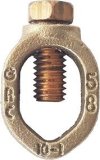
Right
Acorn ground clamp
download (6).jpeg

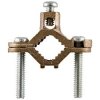
Wrong
Water pipe bonding clamp
download (5).jpeg
 
Last edited:
That will only tell if you have a ground or not, not much else.

Guaranteed 90% of the members here if they pulled their devices and checked they have some sort of loose connection at more than one of the devices in their house.

Added to this, I would be willing to bet most have only one ground rod and if an old home it's possibly corroded off, and likely have the improper ground rod clamp also.

Don't worry, the ground rods only protect your house and equipment if there's a large surge like a lightning strike.
Well, his did ask whether there was a problem with the grounding in his house. :idea: ;)

Is there is, he'll prolly need an electrician to sort it out. :thumbsup:
 
I wouldn't be placing meter probes into outlets. AC outlet testers are not that expensive. You need to buy one made for your voltages and types of outlet.

Something like this, but for your 220VAC and outlet style plug.

https://www.amazon.com/Southwire-Eq...28713&sprefix=ac+outlet+tester,aps,156&sr=8-7

That only tells you if the wiring isn't backwards and all the conductors are connected. That's if you know how to read it and with a rudimentary knowledge of house wiring. Not saying they aren't useful I've used one for more than 40yrs, in my line of work it's very useful.

Really if the OP thinks his house ground and wiring could be the culprit it's time to call an electrician. Have a panel service performed and possibly at least have the devices on the same circuit as the turntable pulled and checked.

While he's there I would suggest having a second ground rod driven, more could be needed to meet the letter of the code but most consider two on a standard size home sufficient. They need to be driven a minimum of 6' apart to be effective.
 
That only tells you if the wiring isn't backwards and all the conductors are connected. That's if you know how to read it and with a rudimentary knowledge of house wiring. Not saying they aren't useful I've used one for more than 40yrs, in my line of work it's very useful.

Really if the OP thinks his house ground and wiring could be the culprit it's time to call an electrician. Have a panel service performed and possibly at least have the devices on the same circuit as the turntable pulled and checked.

While he's there I would suggest having a second ground rod driven, more could be needed to meet the letter of the code but most consider two on a standard size home sufficient. They need to be driven a minimum of 6' apart to be effective.
Yeah. Electrician is prolly best answer.

Don't put voltmeter probes into outlets!
 
Yeah. Electrician is prolly best answer.

Don't put voltmeter probes into outlets!
This might actually be a sound idea.
I've done some cassette portastudio recordings at home as well and now that you mention it, they are also affected by static! Irregular clicking etc. Maybe my grounding is busted?

Then again, wouldn't this cause hum in my system?
 
This might actually be a sound idea.
I've done some cassette portastudio recordings at home as well and now that you mention it, they are also affected by static! Irregular clicking etc. Maybe my grounding is busted?

Then again, wouldn't this cause hum in my system?

No, your equipment uses the grounded conductor and why so many older pieces were able to utilize 2 prong plugs, the grounding conductor is there for safety reasons.
 
Last edited:
Major dumb breakthrough here!!
It turns out I in fact DON'T have safety grounds in my outlets. I don't know how I missed it, I just grounded my gear to the ground pin of my power strip that in turn was connected to an ungrounded outlet!

Maybe this is the solution?
 
Major dumb breakthrough here!!
It turns out I in fact DON'T have safety grounds in my outlets. I don't know how I missed it, I just grounded my gear to the ground pin of my power strip that in turn was connected to an ungrounded outlet!

Maybe this is the solution?
Try a grounded outlet. May need an extension cord.

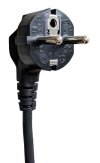
Your country runs 240VAC, Type F outlets. Correct? Be sure those Earth clips on the plug contact correctly.

AC plug 240VAC electricity-type-EF-plug-2 Sweden Schuko type.jpg
 
Last edited:
Updating this thread here.
Connecting the bearing ground to an actual ground point didn't solve anything.
However, as the result om many experiments I've come to the conclusion that friction between the LP and an insulated material causes the static build up, mainly when removing it from the platter.
When I brush the record in my hand, no static. Same when holding it with a Knosti clamp.
I've gotten some good results with using a conductive carbon mat, although the one I've been using shed like crazy.

I'm curious, maybe I should try cutting my own mat from a conductive material?
Do you think conductive rubber could work? The material used in ESD-mats.
I've also thought about copper fabric and meshed carbon fibre.
 
Updating this thread here.
Connecting the bearing ground to an actual ground point didn't solve anything.
However, as the result om many experiments I've come to the conclusion that friction between the LP and an insulated material causes the static build up, mainly when removing it from the platter.
When I brush the record in my hand, no static. Same when holding it with a Knosti clamp.
I've gotten some good results with using a conductive carbon mat, although the one I've been using shed like crazy.

I'm curious, maybe I should try cutting my own mat from a conductive material?
Do you think conductive rubber could work? The material used in ESD-mats.
I've also thought about copper fabric and meshed carbon fibre.

Exactly why I said it's not worth worrying about, I just brush the record before putting it back in it's sleeve. Even if you use the antistatic carbon brush right before removing the record it still has the charge when removing from the platter.
 
Back
Top Bottom