
• The move to the new server is done. There are some software and database maintenance updates in process. This has us passing the hat around to help out. We appreciate any donations. Seriously, even a dollar helps. The payment page may be found here - https://www.audiokarma.org/support.html

Straight Tonearm vs. S-Shaped Tonearm

Physics .. it's all about resonance control

The straight arms displaced the S-shape due to lower moving mass and simpler, tighter bearings ..
Less vibration in the tonearm results in less extraneous noise transmitted to or from the stylus ...

The S-shaped arms were ubiquitous for a long time tho ..
 
Last edited:
What I saw was an evolution from high mass arms and low compliance styli to low mass arms and high compliance style ..
IMHO... The S-arms were an intermediate step ..
FWIW
 
So I tried Audacity last night with a snippet of "run in" sampled during a holiday music "ripping" session last winter :)
I found the spectum, but the lowest frequency in the plot was 43 Hz.
Wouldn't a Fourier transform of the frequency spectrum be a more useful way to look for the resonance?
 
So I tried Audacity last night with a snippet of "run in" sampled during a holiday music "ripping" session last winter :)
I found the spectum, but the lowest frequency in the plot was 43 Hz.
Wouldn't a Fourier transform of the frequency spectrum be a more useful way to look for the resonance?
Select "Analyze" from the menu bar (or whatever it's called) and select "Plot Spectrum" from the drop-down menu. In the Algorithm box, select ""Spectrum". When I do that the frequency range is from 1Hz to 20kHz. There's probably a way to select the range you want, though I can't investigate that right now. Anyway, the resonance should be clearly visible and measuring it yourself is always preferable to relying on what it "should" be, based on specs of unknown accuracy.
 
Select "Analyze" from the menu bar (or whatever it's called) and select "Plot Spectrum" from the drop-down menu. In the Algorithm box, select ""Spectrum". When I do that the frequency range is from 1Hz to 20kHz. There's probably a way to select the range you want, though I can't investigate that right now. Anyway, the resonance should be clearly visible and measuring it yourself is always preferable to relying on what it "should" be, based on specs of unknown accuracy.
I couldn't find a way to change the frequency axis (other than logarithmic or linear) -- not that you need to provide tech support for Audacity. ;) Now my interest is piqued, though -- thanks!
 
I couldn't find a way to change the frequency axis (other than logarithmic or linear) -- not that you need to provide tech support for Audacity. ;) Now my interest is piqued, though -- thanks!
When you view the graph (or plot, as they call it) you will see four boxes, one of which is labelled "Size". Selecting a bigger size allows lower frequencies to be displayed.
 
When you view the graph (or plot, as they call it) you will see four boxes, one of which is labelled "Size". Selecting a bigger size allows lower frequencies to be displayed.
:) Thanks!!!
Yes -- of course :confused: -- after I responded to your previous post, I RTFM (past tense of the imperative "RTFM!" ;))... and found it.
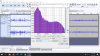
upload_2020-9-22_14-17-54.png

Looks like the ol' AT arm/DL-103 is right roundabout 8 Hz.
This is an epic tool that I had no idea I had access to; thanks again!

(N.B. the lead-in sample I just used is scratchy as all get-out)
 
Last edited:
I have owned straight arms curved arms and linear arms. Take cartridge x and it will track better and less susceptibility to warped records compared to pivot arms. Its just that simple. Wether curved or straight its about the execution of the design. A poor built arm is still poorly built now matter the shape or how it works. I owned all of SME early arms and some of their later arms. They were the only dependable arms being built at the time. Wouldn't want one today however. The straight arms are much better. I would love to have a big Bergmann table with vacuum hold down to keep records flat and to have a vacuum supported linear arm. But you can buy a new car for less.
 
I was able to use Audacity as described to measure the resonance of my Pioneer PL-518 S-shaped arm running a Shure 97xE with Jico SAS. It came out at 7 Hz. Just a tad low, but a great sounding combination.
 
Physics .. it's all about resonance control

The straight arms displaced the S-shape due to lower moving mass and simpler, tighter bearings ..
Less vibration in the tonearm results in less extraneous noise transmitted to or from the stylus ...

The S-shaped arms were ubiquitous for a long time tho ..
Fact the sl1200g has bearing clearance of 1 micro and friction of 7mg, few arms at any price compete with this. Also the S shaped rejects resanonce peaks, your physics is flawed.
And lower effective mass is not a positive, the weight of the arm and performance is directly related to the compliance of thr cart and many good carts today are demanding medium or higher effective mass.
Chris
Chris
 
Last edited:
However, lower compliance cartridges and higher mass arms are inferior as they demand higher pressures against the groove walls. That was the whole point of moving toward higher compliance cartridges and lower mass arms in the first place.

Doug
 
However, lower compliance cartridges and higher mass arms are inferior as they demand higher pressures against the groove walls. That was the whole point of moving toward higher compliance cartridges and lower mass arms in the first place.
I do not believe that is true. Records can be played without excessive wear at many VTFs as long as the stylus is tracking correctly. The fashion has shifted over time for both cartridges and tonearms and most that I've seen lately are solidly medium. Using test records I can easily demonstrate that my SL-1600 (medium compliance/mass) is actually tracking better than my SL-BD20 (high compliance/low mass).
 
You cannot deny physics. Higher pressures against the groove walls equals more wear. Many studies were done back in vinyl's heyday. Assuming styli remain in contact with the walls, the lighter tracking one will wear the vinyl less than the heavier-tracking one.

Doug
 
I don't disagree with that, but these two are at the same VTF. The better tracking one, and therefore the less damaging one, is the higher mass/lower compliance combination.
 
Back
Top Bottom