• The move to the new server is done. There are some software and database maintenance updates in process. This has us passing the hat around to help out. We appreciate any donations. Seriously, even a dollar helps. The payment page may be found here - https://www.audiokarma.org/support.html

Strange output transistor setup on JVC 4VN-880

Sergimm

Active Member
I am attempting to clean an extra-dirty JVC 4VN-880 (was used in a bar for 30 years). When I looked at how would I remove the output transistors, I found something I’m not familiar with:
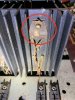
IMG_9899.JPG

On the opposite heatsink side that the transistor is, there is a strange connector composed by two flexible layers, and there is a blob of grease on the layer that is in contact with the sink. It doesn’t look like thermal grease, and it is certainly not applied as such.
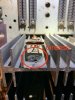
IMG_9901.JPG


Opposite side (with the transistor in it)
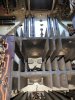
IMG_9900.JPG

What is this? And what is the grease for? Can I clean it and replace it?
 
Register to hide this ad
probably a diode clamped to the heat sink to tweak bias as things heat up. Its probably wired into the output transistor base circuit. Someone can probably explain that a lot better than I can, but basically as transistors heat up, their turn-on voltage drops so the current flow through the device increases. If another device with similar temperature-voltage properties is clamped next to the transistor and wired into the bias supply it can help keep the output from running away with itself.
 
Could be a Thermistor, these are usually spring clamped to heat sinks. These devices increase or decrease resistance value w/temperature changes. I guess no serv. manual parts list?
 
Thanks, that's very interesting. Why does it have its own blob of grease though? Do I need that grease? I guess I do because it's there for a reason, but what's its function?
 
what's its function?
gadget73 and the others explained it well, but to expand, bipolar junction transistors (the output transistor type in this and many other amps) have a tendency toward "thermal runaway", where increasing temp causes increasing current draw - right until the output devices self-destruct, if not regulated.

So another device (often a small transistor, but sometimes a diode or thermistor) is mounted to the heatsink which "tracks" the live temperature of the output transistors, and appropriately reduces the current to them to maintain equilibrium.

It makes sense for the "tracking" device to have good thermal contact to a heatsink shared with the output device, so that the regulation is accurate and reliable - hence the grease. Also, due to thermal cycling, the legs of these components can be brittle - so be careful to minimize bending during handling.
 
thermistor, thats the name of the thing that was escaping me.

and yeah the thermal grease is to put heat into the device, not to remove heat from it. Opposite what you'd normally think it does.
 
Back
Top Bottom