• The move to the new server is done. There are some software and database maintenance updates in process. This has us passing the hat around to help out. We appreciate any donations. Seriously, even a dollar helps. The payment page may be found here - https://www.audiokarma.org/support.html

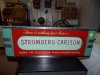
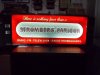
Stromburg Carlson Neon Deco Sign Late 1930,s

kcline

Tube Audio Collector
Just in a new sign for my collection Sold last night at work with other light up signs and Dbl-Bubble Pepsi clocks. Will look good with 1957 SR-406 receiverDSCN0625.JPG DSCN0626.JPGNote what it says, the key words to date are" Radio-Phonographs" Post war ads would of dropped that and most would place "Television" first.
 
Register to hide this ad
It existed, but not real common. There was a pre-war FM band here starting in 1937. TV was early 40s but they didn't really catch on until the post-war era.
 
IIRC and there is no guarantee, SC's first televisions were post world war ll, about 1947 with models with 10 inch and 12 inch screens including models such as the TV12pgm, a combination TV (12 inch screen)-radio-phonograph.
 
http://www.earlytelevision.org/stromberg.html
Several mfgrs got involved with television pre-1942, including RCA, Philco, DuMont, F. A. D. Andrea and some others. DuMont was arguably the first with a for-sale CRT based receiver in the US in 1938 with a knock-off of a British Cossor 'fishbowl' electrostat deflection set. Some mfgrs offerings (pre and post-war) were RCA rebadges or authorized RCA knock-offs.
http://www.earlytelevision.org/prewar_gallery.html

FM broadcasting began in the later 1930s by Edwin Armstrong and his Yankee Network, after RCA cut him loose from the static-free radio project and repurposed his Empire State Bldg experimental broadcasting site to concentrate on television R&D, under development for nearly a decade previous. A few mfgrs offered radio receivers for the Armstrong FM system frequency range, and later postwar, both FM broadcast ranges (notably Zenith).
 
Last edited:
A few mfgrs offered radio receivers for the Armstrong FM system frequency range, and later postwar, both FM broadcast ranges (notably Zenith) before Armstrong surrendered his frequency allocation for television channel 1, tho' never utilized.
TV channel 1 and Armstrong low-band FM radio coexisted for most of their life. In 1937, "Apex" radio (originally AM, but soon beginning FM) was allocated 41 to 44 MHz while TV channel 1 was allocated to 44 to 50 MHz. In 1940, the FCC moved FM radio to 42 to 50 MHz and TV channel 1 to 50 to 56 MHz.

In 1946, FM was reallocated to 88 to 108 MHz and TV channel 1 was moved back down to 44 to 50 MHz, but as of 1947, 25 stations were still on low band FM, in 1948 channel 1 was removed from the TV band and reallocated to other services, and in 1949 Armstrong obtained legal permission for his station to remain on the low band, which it did until shortly after his death in 1954.

Today WA2XMN has a special license from the FCC and is allowed to make periodic broadcasts from the Armstrong tower on 42.8 MHz.
 
TV channel 1 and Armstrong low-band FM radio coexisted for most of their life. In 1937, "Apex" radio (originally AM, but soon beginning FM) was allocated 41 to 44 MHz while TV channel 1 was allocated to 44 to 50 MHz. In 1940, the FCC moved FM radio to 42 to 50 MHz and TV channel 1 to 50 to 56 MHz.

In 1946, FM was reallocated to 88 to 108 MHz and TV channel 1 was moved back down to 44 to 50 MHz, but as of 1947, 25 stations were still on low band FM, in 1948 channel 1 was removed from the TV band and reallocated to other services, and in 1949 Armstrong obtained legal permission for his station to remain on the low band, which it did until shortly after his death in 1954.

Today WA2XMN has a special license from the FCC and is allowed to make periodic broadcasts from the Armstrong tower on 42.8 MHz.
Thnx!
That makes more sense than what I had understood, given the postwar production of Armstrong Yankee compatible tuner receivers.
Will lose the incorrect info.
 
Last edited:
FM no.

Taken from the link you provided:

This Stromberg Carlson model 435M was made just after the band was set to 42-50 mhz.

vwestlife posted:

In 1940, the FCC moved FM radio to 42 to 50 MHz

Which means that a Stromberg Carlson sign which features FM and TV was unlikely to be from the late 30s.
 
FM no.

Taken from the link you provided:

This Stromberg Carlson model 435M was made just after the band was set to 42-50 mhz.

vwestlife posted:

In 1940, the FCC moved FM radio to 42 to 50 MHz

Which means that a Stromberg Carlson sign which features FM and TV was unlikely to be from the late 30s.

Conceded to say that the exact dating of the sign is likely pre-1943, but promotional items could include products being readied for marketing.
Calling SCs involvement in TV and FM "pre-war" (US involvement) would be accurate, as would be likely the sign. Post-war, one could think that the newest greatest product line would be the lead.

Fwiw, Scheduled television broadcasting began in the US 1939, but was already established in Britain and Germany in 1936, when sets also became commercially available.
 
Last edited:
Back
Top Bottom