

You are using an out of date browser. It may not display this or other websites correctly.
You should upgrade or use an alternative browser.
You should upgrade or use an alternative browser.
Substitute for Speakerlab S3 Midrange Driver
- Thread starter blipco
- Start date


donbene
Member
Nice donbene! Thanks for that.
I see that you are in my old stomping grounds. I lived and worked in and around Tacoma for a long time.
Cheers,
James
edit: I haven't done much on keeping track of the different addresses that Speakerlab had, but we could probably get a date spread/limit on that document from the address.
I didn't look closely at the address. That was the location of there first store. I have some other papers from them dated 1972 so that schematic is probably 1972 also.
The bottom of the page has the schematic for the 1st gen 7s.
I lived in Seattle from 1971 to 2004.
I have been a Speakerlab fan since 1972.
The only system that I had prior to then was a R2R with a built in amp and speakers, and a Heathkit tuner.
I found a Dynaco PAT4 preamp in a pawn shop for $45. I didn't even know what a preamp was but it looked like quality gear so I bought it.
I found out that I needed a power amp so I bought a Dynaco 120 from the classifieds.
I needed speakers and there was a Speakerlab notice on the dorm bulitin board so I went to one of their sales pitches. I bought a pair of Speakerlab 1s.
Those were my main speakers for 12 years. I always lusted after the 7s but I didn't have room for them.
I bought a house in 1984 and one of the first things that I bought was a pair of 7WAs. They have been my main speakers ever since then. In all of that time I haven't felt the need to get different speakers. I now have a second setup and I have been trying other speakers.
I had some K horns for about a month. This was in 1975. I bought the pair for $350 with student loan money. They sounded great but I had to sell them. That was my first audio flip. I made $200.
A few months ago I found some 4WAs at the Goodwill outlet for $10. A week later there was a pair of 3s also $10. I loaded them in a cart but decided not to get them because my wife wasn't too happy with me bringing home the 4s. I am sorry I didn't get the 3s because the voice coil is rubbing on one of the woofers in the 4s.
It is long past time to recap the 7WAs. I plan on doing that soon.
Donbene, the only time I heard the 7 was a college dorm party in a huge room and they were cranked all night to ear bleeding level. That would have been late seventies.
I would hate to listen to them at a comfortable room level because I would probably regret not buying them but then again, they are large. You missed an opportunity not buying the 3's I think.
When I bought my new power amp I brought along my own preamp. The stereo shop hooked up JBL L100 speakers as, by my description to him, thought they would best match my S3, which he was not familiar with.
I compared back and forth for two hours on my own CD's a pair of amps.
Anyways, after deciding on the Parasound A23+ amp, on the hour and a half ride home, I was hoping that my forty year old Speakerlabs would hold up to the $4000 JBL's I was now well familiar with.
Much to my surprise, even with my then damaged crossovers and one burned out midrange, the JBL's fell short of the Speakerlab S3. And now that my S3's are on the mend, the JBL wouldn't stand a chance. In my opinion.
The S3 play loud (not like the S7) with a rich sound. I'm well chuffed.
I would hate to listen to them at a comfortable room level because I would probably regret not buying them but then again, they are large. You missed an opportunity not buying the 3's I think.
When I bought my new power amp I brought along my own preamp. The stereo shop hooked up JBL L100 speakers as, by my description to him, thought they would best match my S3, which he was not familiar with.
I compared back and forth for two hours on my own CD's a pair of amps.
Anyways, after deciding on the Parasound A23+ amp, on the hour and a half ride home, I was hoping that my forty year old Speakerlabs would hold up to the $4000 JBL's I was now well familiar with.
Much to my surprise, even with my then damaged crossovers and one burned out midrange, the JBL's fell short of the Speakerlab S3. And now that my S3's are on the mend, the JBL wouldn't stand a chance. In my opinion.
The S3 play loud (not like the S7) with a rich sound. I'm well chuffed.

tanker 200
Super Member
I have a pair of DIY Speakerlabs with the tweeter, midrange and crossover from the 3's with a 10" woofer in a utility cabinet, they sound nice but unfortunately they're in storage. I am using a pair of .1's behind the seat of my truck. I feel bad having them back there but they sound great.
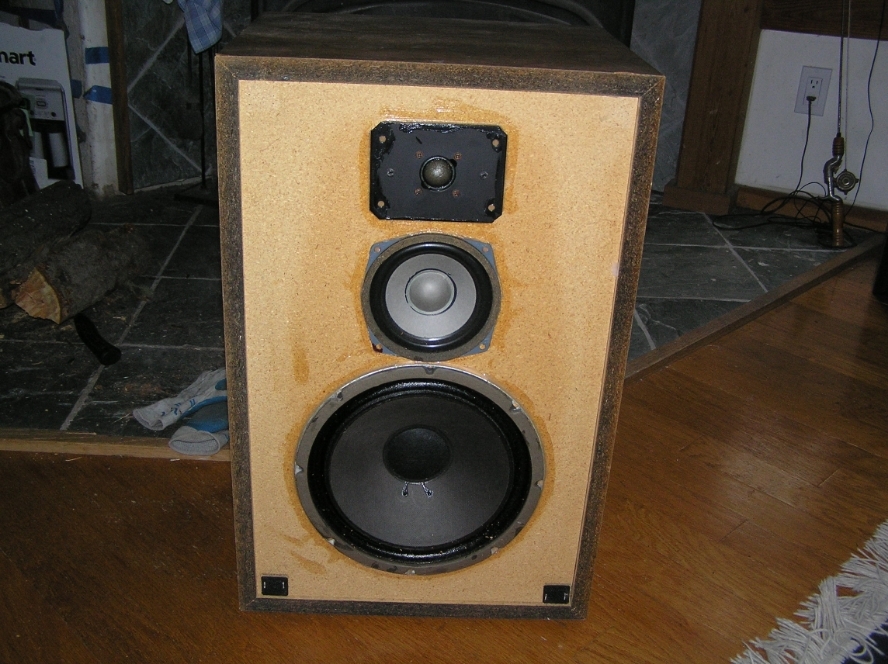
I haven't opened them up, as you can see someone got carried away with the silicone.
I haven't opened them up, as you can see someone got carried away with the silicone.
James, could you explain something for me? I just tried to research it online and my brain nearly exploded like a capacitor with too much voltage applied.
Now, as you know, I just changed my capacitors on my tweeter circuit from 4uf to 4.4uf. (I understand the caps filter frequencies).
What effect did this have on the frequencies sent to my tweeter? Did the increase in uf raise or lower the high frequencies going into the tweeter?
And where did those frequencies go? Did the midrange driver grab them?
Thanks, Mark.
Now, as you know, I just changed my capacitors on my tweeter circuit from 4uf to 4.4uf. (I understand the caps filter frequencies).
What effect did this have on the frequencies sent to my tweeter? Did the increase in uf raise or lower the high frequencies going into the tweeter?
And where did those frequencies go? Did the midrange driver grab them?
Thanks, Mark.

Hi Mark,
I'm writing from work and will have to go into detail later, but in the meantime here are a couple of toys to play with.
Go to the following link and download Xsim.
https://www.diyaudio.com/forums/software-tools/259865-xsim-free-crossover-designer.html
I'm attaching a zip file with a quick crossover simulation that I made in Xsim based on the schematic than donbene provided and the photos that you posted.
After installing Xsim you can copy the "Speakerlab S3.dxo" file into the Xsim folder and open it. The "RESULTS_S7s_W1208R_Q-Fs+Vas-T-01_01-02-2015.zma" file is an impedance sweep of the W1208R that I did a while back. Copy that to Xsim also. I'll explain later what to do with it.
With Xsim you can do detail changes to the crossover and immediately see in the frequency response window what those changes will do to the frequency response.
Cheers,
James
I'm writing from work and will have to go into detail later, but in the meantime here are a couple of toys to play with.
Go to the following link and download Xsim.
https://www.diyaudio.com/forums/software-tools/259865-xsim-free-crossover-designer.html
I'm attaching a zip file with a quick crossover simulation that I made in Xsim based on the schematic than donbene provided and the photos that you posted.
After installing Xsim you can copy the "Speakerlab S3.dxo" file into the Xsim folder and open it. The "RESULTS_S7s_W1208R_Q-Fs+Vas-T-01_01-02-2015.zma" file is an impedance sweep of the W1208R that I did a while back. Copy that to Xsim also. I'll explain later what to do with it.
With Xsim you can do detail changes to the crossover and immediately see in the frequency response window what those changes will do to the frequency response.
Cheers,
James
Attachments
Here is a screenshot of the crossover modeled in Xsim with the 2.2µF caps in the tweeter section.
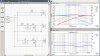
Note that since Xsim doesn't have a way to simulate an L-Pad pot I threw in a fixed L-Pad of -0.5db just for something to start with.
I just use an online calculator to find the L-Pad values that I want.
http://www.sengpielaudio.com/calculator-Lpad.htm
James
Note that since Xsim doesn't have a way to simulate an L-Pad pot I threw in a fixed L-Pad of -0.5db just for something to start with.
I just use an online calculator to find the L-Pad values that I want.
http://www.sengpielaudio.com/calculator-Lpad.htm
James
And here is the crossover with 2.2µF caps in the tweeter section.
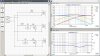
So you can see in the sim that the difference isn't large. The point where the tweeter and mid cross moved from about 4.5khz down to about 4.3khz and there is a slight response hump at about 1.8khz.
This is not exact, just a quick first try at modeling the crossover.
Cheers,
James
So you can see in the sim that the difference isn't large. The point where the tweeter and mid cross moved from about 4.5khz down to about 4.3khz and there is a slight response hump at about 1.8khz.
This is not exact, just a quick first try at modeling the crossover.
Cheers,
James
 James, so the tweeter starts picking up slightly lower frequencies?
 It doesn't seem like much but I can assure you when comparing the left and right speakers after repairing just the right speaker, the sound difference was like night and day.
Now that both left and right are the same I can tone down the sound with the l-pads (which I'm going to clean with Deoxit D5 once I get my flexibility back. LOL.
On the other hand, maybe the 4uf cap in the left speaker, though working, was compromised. And replacing it with 4.4uf got them back to original, more or less. Its just that it was so long ago.
I had replaced Pioneer speakers (a 4 way system with those beautiful wooden grills) with the S3 and I remember the sound between the two were quite different. At the time I had called Speakerlab about it and he told me that the Pioneer speakers were designed to perform more at a frequency where it was easier for your ears to hear, as opposed to the S3, which was reproducing the sound more accurately, you could feel it more than hear it.
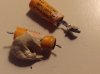
I have a picture of the left speaker 4uf cap. There is a bulge to one end as if it was ready to blow. Perhaps it was no longer doing its job.
Thanks so much, Mark.
Very happy to try to help Mark,
Yes, the change in capacitance is allowing a bit lower frequencies to reach the tweeter. Possibly enough to notice if you had changed from a new 4µF to a new 4.4µF if you were really in tune with the way your speakers sound, but I think that most people would probably not notice. And there will be a small peak where the tweeter is now playing at the same frequencies as the mid, but again a pretty small change.
The major difference in sound that you are hearing is undoubtedly because of replacing the 35+ year old very tired caps with new ones. It would be interesting to measure the old cap that isn't (quite) blown. It has probably drifted in capacitance, usually to a higher value in my experience, and easily to value that is actually more of a change from nominal than what happened when you put in the new 4.4µF. But what is worse is that the ESR of the old caps will easily have risen by several ohms.
I don't have any new NPE radial lead elcos on hand smaller than 18µF but I just measured one of those and got an ESR of 0.14 ohms. Smaller caps tend to have somewhat higher ESR so a 4µF might be closer to 0.5 ohm or a bit more. A MKP film cap will measure under 0.01 ohms usually. I would be surprised if that old cap is less than 3 ohms ESR.
One of the cool things about Xsim is that you can easily and quickly see what that change in resistance in a cap will do to your frequency response. You can hover the cursor over a cap in the schematic, right-click and select Tune in the pop-up menu. Click on the ESR entry and then simply use the scroll wheel to rapidly sweep through a range of resistances and the frequency window will show the curve change in real-time.
I just changed our prototype crossover to show a single 4µF cap with 3 ohms ESR. It drops the tweeter response by about 2db. Going to 4 ohms drops it by 3db.
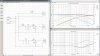
What is also bad and can't be simulated is that those old caps will be leaking electrically internally, creating a lot of noise.
So it is not at all a surprise that you are getting much better sound. Going to a single 4µF MKP film cap for the tweeter will sound even better, but not as much of a difference as you just realized.
Just think what is going to happen when you replace the midrange caps.

Cheers,
James
Yes, the change in capacitance is allowing a bit lower frequencies to reach the tweeter. Possibly enough to notice if you had changed from a new 4µF to a new 4.4µF if you were really in tune with the way your speakers sound, but I think that most people would probably not notice. And there will be a small peak where the tweeter is now playing at the same frequencies as the mid, but again a pretty small change.
The major difference in sound that you are hearing is undoubtedly because of replacing the 35+ year old very tired caps with new ones. It would be interesting to measure the old cap that isn't (quite) blown. It has probably drifted in capacitance, usually to a higher value in my experience, and easily to value that is actually more of a change from nominal than what happened when you put in the new 4.4µF. But what is worse is that the ESR of the old caps will easily have risen by several ohms.
I don't have any new NPE radial lead elcos on hand smaller than 18µF but I just measured one of those and got an ESR of 0.14 ohms. Smaller caps tend to have somewhat higher ESR so a 4µF might be closer to 0.5 ohm or a bit more. A MKP film cap will measure under 0.01 ohms usually. I would be surprised if that old cap is less than 3 ohms ESR.
One of the cool things about Xsim is that you can easily and quickly see what that change in resistance in a cap will do to your frequency response. You can hover the cursor over a cap in the schematic, right-click and select Tune in the pop-up menu. Click on the ESR entry and then simply use the scroll wheel to rapidly sweep through a range of resistances and the frequency window will show the curve change in real-time.
I just changed our prototype crossover to show a single 4µF cap with 3 ohms ESR. It drops the tweeter response by about 2db. Going to 4 ohms drops it by 3db.
What is also bad and can't be simulated is that those old caps will be leaking electrically internally, creating a lot of noise.
So it is not at all a surprise that you are getting much better sound. Going to a single 4µF MKP film cap for the tweeter will sound even better, but not as much of a difference as you just realized.
Just think what is going to happen when you replace the midrange caps.
Cheers,
James
Btw, I hope that your back is doing better.
James
James
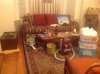 My left speaker is buttoned up. I added this polyfil to the enclosure which I know isn't the best. A local fabric store claimed they had bamboo fill in stock but when I got there, they did not. So I bought this stuff. This polyfil at least doesn't shed fibers into the air, which is good.
I did a left/right comparo before I do the right speaker.
There is a slight difference when you listen for it. The sound now seems like it's less coming from the speaker, if that makes sense. There's still prodigious bass but a tad tighter. It is a slight but good improvement. Better stuffing would have been better, maybe.
View attachment 2176709 My left speaker is buttoned up. I added this polyfil to the enclosure which I know isn't the best. A local fabric store claimed they had bamboo fill in stock but when I got there, they did not. So I bought this stuff. This polyfil at least doesn't shed fibers into the air, which is good.
I did a left/right comparo before I do the right speaker.
There is a slight difference when you listen for it. The sound now seems like it's less coming from the speaker, if that makes sense. There's still prodigious bass but a tad tighter. It is a slight but good improvement. Better stuffing would have been better, maybe.
Cool! That sort of thing is one of those incremental improvements that while not night-and-day still adds a bit to the enjoyment. Using fiberglass rather than polyfill is one of those even smaller things and is most likely not worth the time to do over. You are on the right path.
Cheers,
James

Hi blipco,
Years ago I had S6's which also used the W1208R woofer. If you put the T/S parameters into some box sim software it becomes apparent that Speakerlab designed the system with a very high Q of well over 1. This can make for a boomy and ill defined bass. At one point I built new boxes with approximately twice the volume. The bass sounded much cleaner and seemed to go lower at the same time. This shows up in a sim. More stuffing can get some of this but not nearly as much as having the larger volume. The downside will be larger cone excursion at low frequencies and consequently a reduced max power handling in the low bass. For me it was a great trade. I think SL had mainly rock music fans in mind so went for higher power handling and more punch/boom.
John
Years ago I had S6's which also used the W1208R woofer. If you put the T/S parameters into some box sim software it becomes apparent that Speakerlab designed the system with a very high Q of well over 1. This can make for a boomy and ill defined bass. At one point I built new boxes with approximately twice the volume. The bass sounded much cleaner and seemed to go lower at the same time. This shows up in a sim. More stuffing can get some of this but not nearly as much as having the larger volume. The downside will be larger cone excursion at low frequencies and consequently a reduced max power handling in the low bass. For me it was a great trade. I think SL had mainly rock music fans in mind so went for higher power handling and more punch/boom.
John
Last edited:
And now I wish I'd replaced the midrange caps. I gave them a good inspection and there's no sign of bulging but they are old.
I'll order them and have them ready. The speakers do sound fantastic tho.
They need it. They are ready to retire and go to some sunny recycling center. You will be glad that you did it after you change those caps.
Cheers,
James
Now days you can also get the performance of a lower Q sealed box alignment using a Linkwitz Transformer EQ. I have done this with subs and a miniDSP box. Works just as advertised. Again there are tradeoffs. Now you would be using more power to achieve the desired response at low frequencies. However, now you can change the EQ almost instantly for sound that goes with your music choice.
Yes James, they are old. I should just change them now so I only have to unseal one speaker. My motorcycle project is nearing its end so, it's time.
Nerdorama, my Adcom GFP1 pre-amp has tone controls so I can roll off some bass. In fact, that's how I used to run it with the GFA1 power amp. I always felt the bass response on the S3 was strong. And just guessing, judging by the pictures of the original Speakerlab crew, I'd have to say their speakers were designed with the Greatful Dead in mind. LOL. Trying to replicate the Wall Of Sound.
https://m.facebook.com/hifi/videos/...technology-of-live-music-the/218617439591159/
Nerdorama, my Adcom GFP1 pre-amp has tone controls so I can roll off some bass. In fact, that's how I used to run it with the GFA1 power amp. I always felt the bass response on the S3 was strong. And just guessing, judging by the pictures of the original Speakerlab crew, I'd have to say their speakers were designed with the Greatful Dead in mind. LOL. Trying to replicate the Wall Of Sound.
https://m.facebook.com/hifi/videos/...technology-of-live-music-the/218617439591159/