• The move to the new server is done. There are some software and database maintenance updates in process. This has us passing the hat around to help out. We appreciate any donations. Seriously, even a dollar helps. The payment page may be found here - https://www.audiokarma.org/support.html

Sudden oscilloscope grounding issue

Chris __R

Well-Known Member
Hi all,
I have been trying to diagnose a Marantz 2230 distortion problem (different thread) and after using my DMM to measure DC and AC in various places and replacing transistors and caps on the P400 preamp board, I purchased a hand held 2 channel oscilloscope to see if I can be more focused in finding the problem. This is the first time I have used one of these, so my knowledge is fairly limited, but after reviewing some threads and online videos, it seems straightforward enough for what I'm doing.

I spent the last few days running a 1kHz signal through AUX to try to detect where the distortion might originate on the signal path. The probe grounds have been connected to the chassis when using the probes and I have been getting clean sinewaves so far. The Marantz is plugged into a 3 pronged heavy duty extension cord.

I went to continue measuring today, and I am picking up significant interference when connecting to the chassis when the Marantz is plugged in - even when not powered on. So much so that the scope does not register any kind of recognizable wave when powered on and signal present. And if I connect the probe to the same grounding location, the interference is not eliminated. When I unplug the receiver the scope goes flat.

I haven't changed anything with regards to how the scope is set up.
I plugged the unit into a different cord (same house circuit) and the problem persists.
I haven't removed or made any component changes since beginning to use the scope, so I haven't created any kind of issue I am aware of.

Is there anything obvious I should be looking at?

Thanks!
 
Register to hide this ad
Can you reverse the plug of the receiver in the socket or is it polarized, either 3-wire or wide blade? IMO, the whole idea of handheld floating test equipment is that you can be immune to noise and ground problems. What kind of unit did you get?
 
Might be a long shot but are you using the ground clips from both probes at the same time? If so you might be introducing a ground loop. it's also possible one of your scopes ground connections doesn't have continuity to the scope - easy to tests with your DMM. LED lights can introduce lots of interference, but I've generally found it affects FM reception, not AUX/Tape/Phono . . .
 
Last edited:
Can you reverse the plug of the receiver in the socket or is it polarized, either 3-wire or wide blade? IMO, the whole idea of handheld floating test equipment is that you can be immune to noise and ground problems. What kind of unit did you get?
Aha! Yes - by reversing the plug in the extension cord the issue appears to have gone away. Learn something new every day......
Thanks!
 
Might be a long shot but are you using the ground clips from both probes at the same time? If so you might be introducing a ground loop. it's also possible one of your scopes ground connections doesn't have continuity to the scope - easy to tests with your DMM. LED lights can introduce lots of interference, but I've generally found it affects FM reception, not AUX/Tape/Phone . . .
Thanks for responding Richard but I think the problem/solution was just too simple.
 
Because of "death caps" and normal AC bypassing, like many receivers, you seem to have a plug position that puts high AC voltage on the chassis. And one that doesn't. Some of that is normal but I'd be doing a very careful assessment of all the AC wiring and AC bypass caps. A short there could prove hazardous. I have also seen power switches short internally, usually from some trapped piece of wire. Bone up on class X and class Y capacitors and where to use what. Then replace what's in there.
 
Because of "death caps" and normal AC bypassing, like many receivers, you seem to have a plug position that puts high AC voltage on the chassis. And one that doesn't. Some of that is normal but I'd be doing a very careful assessment of all the AC wiring and AC bypass caps. A short there could prove hazardous. I have also seen power switches short internally, usually from some trapped piece of wire. Bone up on class X and class Y capacitors and where to use what. Then replace what's in there.
Great recommendation Conrad. I’ll definitely take a closer look. Thanks!
 
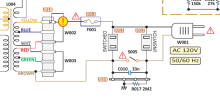
The 2230 did not have a 3 prong AC cord, so whomever added that didn't do it correctly. R017, the 2.2M resistor from one AC line to the chassis should be removed. The Ground pin in the AC cord should go to the chassis. This way, even if the house wiring is wrong and the Hot and Neutral are swapped, they would both be isolated from the chassis and the chassis would be grounded and safe.
1790134518492.png
 
The 2230 did not have a 3 prong AC cord, so whomever added that didn't do it correctly. R017, the 2.2M resistor from one AC line to the chassis should be removed. The Ground pin in the AC cord should go to the chassis. This way, even if the house wiring is wrong and the Hot and Neutral are swapped, they would both be isolated from the chassis and the chassis would be grounded and safe.
View attachment 3842086
Thanks Dr Audio - the 2230 I’m working on has the original 2 prong cord. I just had to reverse it in the plug to make the grounding issue go away.
 
The easy way to test for a leaking ground current is to rub the back of your hand against the case or smooth part of the chassis.

If you get a Burrr or vibration feeling that is "Leakage Current".

I've blown peoples minds a hundred times simply touching an appliance with the back of my hand then proclaiming...

Leakage or no leakage then confirming it with measurements.

Works!

Dryers, Toasters, Lathes, Amps, Preamps doesn't make a difference what it is, You body is
VERY sensitive to AC leakage current.

There was a whole FAD about testing your gear then marking the Non-Polarized plug for lowest leakage current.

That's why you will see Non-polarized plugs with some White paint on the plug denoting polarity.

It was someone like Vandersteen or Roger Mojeski that wrote an article about it, But of course I cannot find it as it's been lost in the deluge of internet slop...

You normally test voltage between chassis of the electronics and the wall outlet ground contact.

Found this old post on testing.

Testing Mains Leakage current

The most common problem for our customers are "Ground Loops" when adding a Sub woofer, Yikes.

Many times you need to install "Ground Cheaters" then file the wide blade to reverse polarity and get rid of Hum Loops.

Cheater_plug_edited.jpg
 
Last edited:
Turns out I was wrong that reversing the plug eliminated the problem. Reversing the plug removes the ground interference only when the unit is not plugged in. When powered on it’s still there. Was running out to see Luna last night so didn’t complete my examination….

If I put a DMM on the chassis when turned on I get 1.2VAC. If the plug is the other orientation I get 5.6VAC.
 
I’m thinking the main issue may have been with the scope. After trying a couple things it’s working fine now no matter how the unit is plugged in.
 
Back
Top Bottom