

You are using an out of date browser. It may not display this or other websites correctly.
You should upgrade or use an alternative browser.
You should upgrade or use an alternative browser.
Super Heresy v2 Project
- Thread starter Quadaptor!
- Start date

@Quadaptor!, did you purchase the TF1225's?

Quadaptor!
Well-Known Member
Not yet. I did buy the SMHALs and they should be here on Monday. I'm going to do this one step at a time and not rush into a "all at once" approach. I figure doing it that way will force me into spending some quality time and critical listening into the results of each step and make notes on what I hear. The second step would be for me to install the TF1225s along with building a new back boards with bass vents. Which I'll likely do after recovering from the current Christmas season. Thanks again for your recommendation. I appreciate it!@Quadaptor!, did you purchase the TF1225's?
Quadaptor!
Well-Known Member
I picked up my SMAHLs at the PO after lunch today and have been listening to them for about a half an hour now. It's about 4:10. The installation was straight forward. Remove the original tweeters and screw the new ones in. I had to do a little dressing to one of the mortises to make one tweeter fit. All it took was a few strokes of a file and all was well. One thing I would say here is to find the tweeter that best fits the cabinet you start with. That was the one that needed a little filing on the wood. However, the second tweeter popped right in (I'll interject a strong Homer Simpson "DOHT" right here as it appears I should have started with that one). After the tweeters have been installed just hook red to red and black to black and put everything else back together. Per the instructions, it's supposed to take a few hours of playing for the tweeters to break in. But for now, and using hyperbole rarely employed in describing hifi gear, I'd say the top end has "a bit more meat hanging on the bones." With more listening, I'm shooting for improved psychoacoustics/imaging/holographic performance in the SMAHLs over the stock horns at this stage in my Super Heresy "journey" for which, I think, the directional ques in our stereo set of ears have evolved to do best in the range of 1 KHZ and above.
Last edited:
Quadaptor!
Well-Known Member
It's now 7:11 PM (three hours after my last post) and I'm diggin' it with Vince Guaraldi and "A Charlie Brown Christmas"!
Quadaptor!
Well-Known Member
9:33 in the PM and spinning some Miles and Trane and still diggin' it!
Quadaptor!
Well-Known Member
7:52 in the AM on the next day, Christmas Eve, and I'm listening to Duke Pearson's 1969 release "Merry Ole Soul." I'm in!
Quadaptor!
Well-Known Member
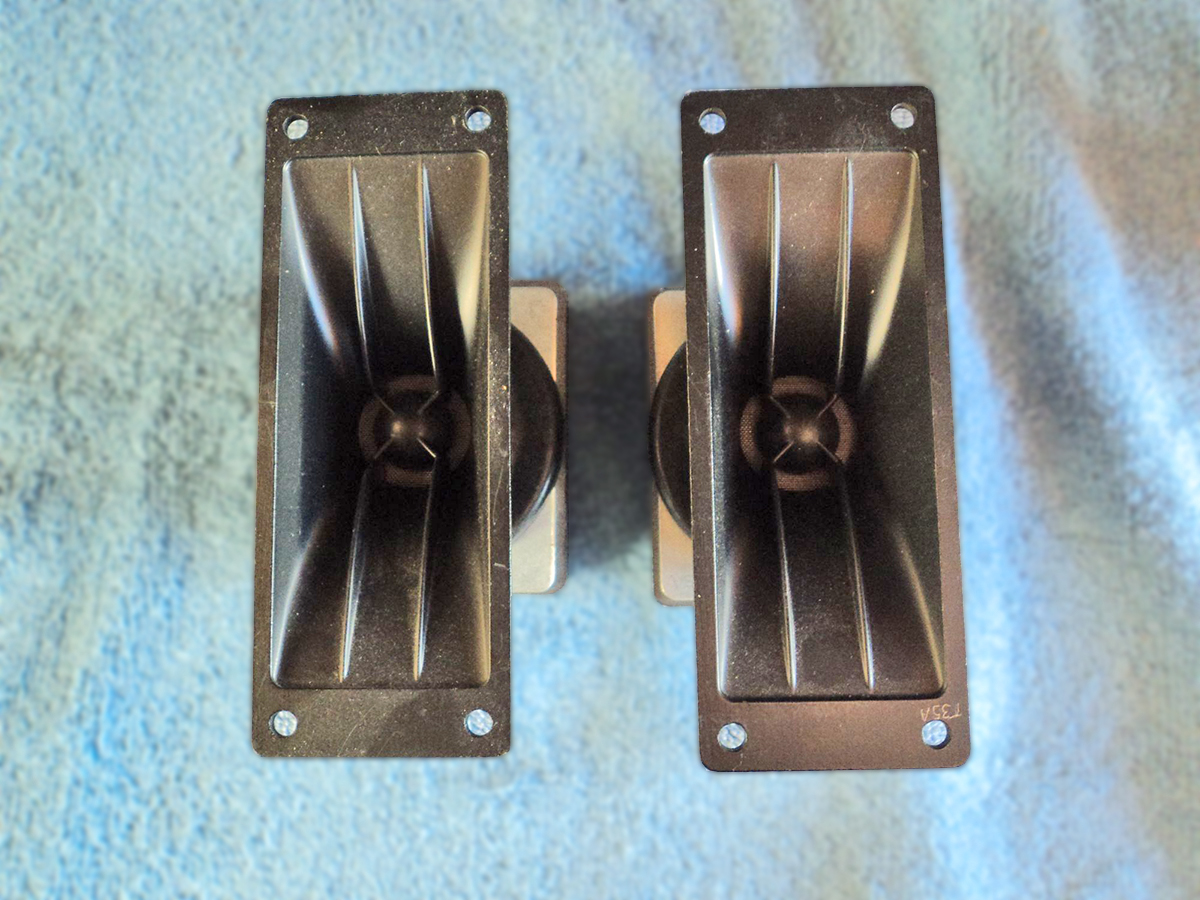
Now that I'm listening to the SMAHLs, can someone explain what the difference is between it and the stock K-77-M I just removed? I know this information is in the various posts put up on this forum, but there's a degree of prerequisite knowledge that comes with those post I do not possess. And I'd appreciate drilling down into this part of the conversion if anyone has the time. Many thanks in advance.
The K77M is a derivative of the ubiquitous Electro-Voice T-35 series of tweeters. The T-35 was used in many brands of loudspeakers and kits. It uses a phenolic diaphragm and AlNiCo (Aluminum, Nickel & Cobalt) magnet. The special horn design has a built-in phase plug to help smooth out its frequency response which extends (with luck) to 15kHz. The K77/T-35 is only rated for 5 Watts power handling with the proper crossover so they are somewhat fragile. Gazillions of them were sold and enjoyed by manufacturers and consumers. A lot of people loved them, some hated them.
The SMAHL uses a modern horn flare with better horizontal and vertical coverage patterns. The B&C driver uses a polyester diaphragm (i.e. - Mylar) which is much lighter than phenolic and it has a smoother response as well. The B&C also uses a rare-earth neodymium magnet. The B&C driver also benefits from computer modeling which was not available in the mid 50's, so everything in the DE120 design is optimized. This new generation of polyester compression drivers are the best sounding yet compared to previous generations. They sound like soft dome tweeters, but with the high efficiency that only a compression driver/horn can give you.
Some history on the T-35:
 audioxpress.com
The SMAHL uses a modern horn flare with better horizontal and vertical coverage patterns. The B&C driver uses a polyester diaphragm (i.e. - Mylar) which is much lighter than phenolic and it has a smoother response as well. The B&C also uses a rare-earth neodymium magnet. The B&C driver also benefits from computer modeling which was not available in the mid 50's, so everything in the DE120 design is optimized. This new generation of polyester compression drivers are the best sounding yet compared to previous generations. They sound like soft dome tweeters, but with the high efficiency that only a compression driver/horn can give you.
Some history on the T-35:
Remembering the Electro-Voice T35 Super Tweeter
Do you remember the Electro-Voice T35 Super Tweeter? This was a high-performance horn tweeter that even today has state-of-the-art wideband response, high sensitivity, and a history that spans over six decades! This trip down memory lane relates the story of the T35, with a look at not just the...
Last edited:
Quadaptor!
Well-Known Member
Thank you. I appreciate you taking the time today to explain this to me!The K77M is a derivative of the ubiquitous Electro-Voice T-35 series of tweeters. The T-35 was used in many brands of loudspeakers and kits. It uses a phenolic diaphragm and AlNiCo (Aluminum, Nickel & Cobalt) magnet. The special horn design has a built-in phase plug to help smooth out its frequency response which extends (with luck) to 15kHz. The K77/T-35 is only rated for 5 Watts power handling with the proper crossover so they are somewhat fragile. Gazillions of them were sold and enjoyed by manufacturers and consumers. A lot of people loved them, some hated them.
The SMAHL uses a modern horn flare with better horizontal and vertical coverage patterns. The B&C driver uses a polyester diaphragm (i.e. - Mylar) which is much lighter than phenolic and it has a smoother response as well. The B&C also uses a rare-earth neodymium magnet. The B&C driver also benefits from computer modeling which was not available in the mid 50's, so everything in the DE120 design is optimized. This new generation of polyester compression drivers are the best sounding yet compared to previous generations. They sound like soft dome tweeters, but with the high efficiency that only a compression driver/horn can give you.
Some history on the T-35:
Remembering the Electro-Voice T35 Super Tweeter
Do you remember the Electro-Voice T35 Super Tweeter? This was a high-performance horn tweeter that even today has state-of-the-art wideband response, high sensitivity, and a history that spans over six decades! This trip down memory lane relates the story of the T35, with a look at not just the...
Quadaptor!
Well-Known Member
Right now Jimmy Smith is warming my Heresys' up with his 1964 release, "Christmas Cookin'"
Last edited:

Dave MacKay
Active Member
I was going through the "Super Heresy recipe" (attached) and wanted to check about the port.
The notes call for a 4" diameter x 4" long port to be installed in the rear panel of each Heresy. However, I also included a note that "If desired (and as preferred by @ClaudeJ1) one could install two mirror-imaged ports in the bottom back corners". Regrettably, I did not include a reference for that statement; @ClaudeJ1 , if it's not correct please let me know and I'll remove it from the document.
Since the recommended 4" diameter by 4" length port is quite a substantial size and -- depending on woofer choice -- can be tricky to place, I thought it might be useful to provide information about using 2 ports (especially if they're smaller).
Would anyone care to clarify what would be needed for a two port configuration?
Attachments

Sure, and I'd like to suggest another minor tweak to your Excellent PDF of my old work. You're in the high 99's. I try to get back in a few days with the answer. Great question, which allow for all calculators to agree, like when I did my first Super Heresy (using 3)!I was going through the "Super Heresy recipe" (attached) and wanted to check about the port.
The notes call for a 4" diameter x 4" long port to be installed in the rear panel of each Heresy. However, I also included a note that "If desired (and as preferred by @ClaudeJ1) one could install two mirror-imaged ports in the bottom back corners". Regrettably, I did not include a reference for that statement; @ClaudeJ1 , if it's not correct please let me know and I'll remove it from the document.
Since the recommended 4" diameter by 4" length port is quite a substantial size and -- depending on woofer choice -- can be tricky to place, I thought it might be useful to provide information about using 2 ports (especially if they're smaller).
Would anyone care to clarify what would be needed for a two port configuration?
It's better so have more brains and fingers to average out. It's lik the inputs. So if 5 to participate we' need 4 or 5 numbers to agree, like taking 3 microphone positions at 1 meter to average out peaks and trough "wiggles" in a speaker driver.
Last edited:
You’ll need a 4”x4” port in each speaker back.The notes call for a 4" diameter x 4" long port to be installed in the rear panel of each Heresy. However, I also included a note that "If desired (and as preferred by @ClaudeJ1) one could install two mirror-imaged ports in the bottom back corners". Regrettably, I did not include a reference for that statement; @ClaudeJ1 , if it's not correct please let me know and I'll remove it from the document.
Since the recommended 4" diameter by 4" length port is quite a substantial size and -- depending on woofer choice -- can be tricky to place, I thought it might be useful to provide information about using 2 ports (especially if they're smaller).
Would anyone care to clarify what would be needed for a two port configuration?
That statement referred to placing them in the opposite lower back corner on each speaker
Quadaptor!
Well-Known Member
So is it sufficient to say the ports should be located in the back right corner of the right speaker and the back left corner of the left speaker. And that they should be located in an area close to that shown in the picture from the Heresy Recipe? Or is there a more precise measurement for situating the port location?You’ll need a 4”x4” port in each speaker back.
That statement referred to placing them in the opposite lower back corner on each speaker
My understanding is that @ClaudeJ1 only offset the port in the original to allow better breathing room around the huge magnet on the k42/delta pro 12a.
Mine are ported about that high but dead center. Plenty of clearance for the tf1225
I’m not aware of any need for precision measurements for the location..
Mine are ported about that high but dead center. Plenty of clearance for the tf1225
I’m not aware of any need for precision measurements for the location..
Quadaptor!
Well-Known Member
ThanksMy understanding is that @ClaudeJ1 only offset the port in the original to allow better breathing room around the huge magnet on the k42/delta pro 12a.
Mine are ported about that high but dead center. Plenty of clearance for the tf1225
I’m not aware of any need for precision measurements for the location..
Quadaptor!
Well-Known Member
I
I'm reviving this thread to ask one more question. I have decided to take the dive into replacing the woofers with set of Celestion TF1225s'. However, I see that Part's Express carries two versions of these woofers; one rated at 150-watts and the other at 250. I figure 150-watts would be more than sufficient for my needs however, outside of the watt rating, is there any reason to pick one woofer over the other in converting my Heresies? ThanksThanks