• The move to the new server is done. There are some software and database maintenance updates in process. This has us passing the hat around to help out. We appreciate any donations. Seriously, even a dollar helps. The payment page may be found here - https://www.audiokarma.org/support.html

SX-650: Upgrade heatsinks on Amp2 D313?

bzenic

Active Member
Although everything works on my SX-650 I noticed that two D313 on Amp2 board are running very hot.
I'm curious if anybody tried to replace their original with bigger or better heat sinks?
Additional problem is that there is no too much space around for expansion.
It would be nice to make those two cooler.
 
Register to hide this ad
33342254-DA19-4537-AFF1-18BF89A238F6.jpeg

Agree, they run hot on mine too so staying tuned for ideas

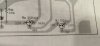
These are the two you’re talking about, right?
Always wondered why one heatsink is smaller than the other. There was room to cut the dividing metal sheet a little bigger so the heat sinks could of at least been the same.
 
Last edited:
Here’s the schematic with the transistor voltages. Maybe that’ll help with heat dissipation calculations and potential solutions. Thanks.

4D86CC0B-A09D-4479-8DFB-D4C48E90BDEA.jpeg
 
those are power supply regulators, they inherently get HOT.

yes, larger heat sinks would be advantageous.

insulate the transistors electrically from the heat sinks.

be creative in mounting and connecting them.
 
Thanks @markthefixer

Assuming a physical fit, how do you pick a heatsink that performs better than the ones that are there without knowing the existing heatsink power dissipation factors?

For example, here’s one that is fairly compact and dissipates 8.0 watts at 70C with a thermal resistance of 8.7 C/W.

3827712D-602E-4C3C-B641-FF9BF1BBD868.jpeg
 
I think a calculation (ohms law) could be made using the voltages on those transistors. It probably would provide how many watts of power in heat is given off. I just don’t know how.
 
Assuming a physical fit, how do you pick a heatsink that performs better than the ones that are there without knowing the existing heatsink power dissipation factors?

For example, here’s one that is fairly compact and dissipates 8.0 watts at 70C with a thermal resistance of 8.7 C/W.

View attachment 2604423
that would probably work better than factory being as it has "fins " on the sides that raise "above the transistor" and would dissipate heat better instead of just rising back into the device itself. it would only work if there is enough room on the board for them to be mounted next to each other and you may have to trim a little off that separator piece next to the transistors too.

i think you've got the right idea with your choice.
 
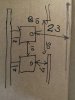
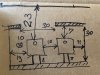
Here is my sketch. All measures are in mm, sorry but I'm terrible with inches.
Depth of the heat sink is marked with X in the circle.
Hope this helps.

The left transistor is centered at the axis of the hole in the separator.
There is also much more room on the left from the left one.
The space on the right from the right 313 is limited by a resistor on the board.
 

Attachments

  • SX-650dist313.jpg
    SX-650dist313.jpg
    111 KB · Views: 9
Here is my sketch. All measures are in mm, sorry but I'm terrible with inches.
Depth of the heat sink is marked with X in the circle.
Hope this helps.

The left transistor is centered at the axis of the hole in the separator.
There is also much more room on the left from the left one.
The space on the right from the right 313 is limited by a resistor on the board.
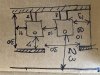
the distance here might help him too :)

InkedSX-650dist313_LI.jpg
 
Thanks guys! I'll peruse the heat sinks and try to come up with something that works.

If you figure out something please post
 
Just wondering:

No matter what heat sink is used the same absolute amount of heat will be emitted. It's just that the device itself will be cooler, correct?

With the factory heat sinks these transistors have been cooking for 46 years. Have there been many (or any) threads where they've burnt up?
 
Back
Top Bottom