
• The move to the new server is done. There are some software and database maintenance updates in process. This has us passing the hat around to help out. We appreciate any donations. Seriously, even a dollar helps. The payment page may be found here - https://www.audiokarma.org/support.html

Tandberg TR 2075 Speaker Pop

Robergé

Active Member
Good morning everyone! Thanks in advance for any info you guys can provide, this site is awesome. I recently had a full professional recap done on my Tandberg TR 2075. Not the MK II, the original 2075. The speaker pops when I turn it on, and DC voltage spikes to about 500mv for a very brief period. "Resting" DC offset is perfect.

Is this normal on this receiver? I can avoid the pop by having the speaker selector set to "off" and then engaging "Speaker A" a couple of seconds after the relay click. If it's an issue I can take it back to my tech, but if it's normal I'd like to know for piece of mind. And for those wondering, it sounds absolutely incredible! I'm tagging @jdurbin1 because of all the Tandberg expertise he has shared on this site, but anyone is welcome to answer of course. And the stacked receivers thing is temporary, I just wanted to get it above toddler reaching height (CR-2020 doesn't have a bunch of cool lights that would attract my son).
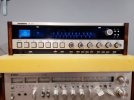
20231017_101037~2.jpg
 
Register to hide this ad
Not normal, that's what the relay should be preventing. So either timing is off on that, or transistors are dying, or both.
Tech should have tested and known that.
 
How long between turn-on and the relay clicking? Normally its a second or so, but its not impossible the timing circuit isn't working right, or someone had the brilliant idea of jumping out the relay. For unknown reasons that was a "thing" at one point, and sometimes units turn up with jumpers across the relay contacts.

also not completely impossible it suffered a failure in the past and the relay welded itself together. I'd hope a restoration would have verified it worked properly though.
 
Thanks guys, I appreciate it! I noticed that the relay wasn't replaced and has a very soft click. I'll take it back in for repair later this week.
 
usually don't have to replace the relay unless its damaged. I worked on a 2080 and don't remember the relay being especially loud so that alone may not mean much.
 
Thanks guys, I appreciate it! I noticed that the relay wasn't replaced and has a very soft click. I'll take it back in for repair later this week.
Just to clarify, if you're hearing the relay click and not having any issues with signal drop-outs, there is not an issue with the relay. The proper operation of the relay on power-on is to delay closing the contacts until after any DC surges at the outputs have settled. That is normally controlled by an RC delay circuit that is part of the relay control. If the capacitor or resistor values change over time, the turn-on time could be shorter, which could close the relay contacts too soon. Does your relay click/close sooner than a few seconds? If so, you should have the relay delay circuit checked.
 
Depending on the caps used for the recap, some cap could have been replaced by a more large capacitance, offsetting normal power up behavior and then resulting in a longer settling time needed.
 
Additionally, you may be able to reduce the amount of DC transient by unplugging and thoroughly deoxidizing the twisted pair signal cable connectors that run from preamp to rear panel I/O board, and from there back to the power amp board. This was a known weak area for the original 2075 (and 2055) and it's usually the ground side of the original (somewhat flimsy) connectors that starts to get flaky, which can let some DC get into the path.

John
 
Back
Top Bottom