• The move to the new server is done. There are some software and database maintenance updates in process. This has us passing the hat around to help out. We appreciate any donations. Seriously, even a dollar helps. The payment page may be found here - https://www.audiokarma.org/support.html

TD-124 Idler Wheel Adjustment?

Florizel

New Member
I would appreciate suggestions on how to adjust the motion of the idler wheel and improve its contact with the stepped speed adjustment pulley.

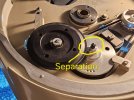
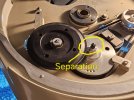
I was wrapping up maintenance on my recent TD-124 purchase and looking forward to installing it in its restored plinth. During testing, I noticed that the idler wheel did not contact the 16 rpm pulley at all. I'm likely ever to play a 16 rpm record, but if it's not contacting the 16 rpm pulley it's probably not doing what it had ought to be doing with the other speeds.

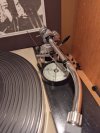
This is the view from above:
20240202_134532.jpg

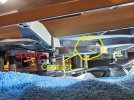
Moving the idler wheel by hand, I could feel that the arm carrying the idler wheel was contacting the chassis:
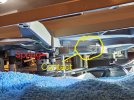
20240202_134306.jpg

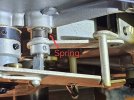
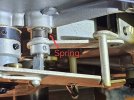
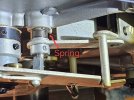
It occurs to me that issue might be with the spring regulating the motion of the arm:
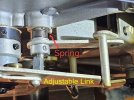
20240202_132947 copy.jpg

I surely don't want it to be with Adjustable Link. That wouldn't have changed since assembly. It also seems impossible to move - I tried to loosen the screws and the heads started to deform - they don't want to come out!

Can an expert please enlighten me on what I need to do to make this right? What do I need to do to relieve the contact between arm and chassis and connect the idler wheel with the 16 rpm step on the pulley? Thank you so much!

Bob C
 

Attachments

  • 20240202_134532.jpg
    20240202_134532.jpg
    132.2 KB · Views: 8
  • 20240202_132947.jpg
    20240202_132947.jpg
    148.8 KB · Views: 6
  • 20240202_132947.jpg
    20240202_132947.jpg
    148.8 KB · Views: 5
  • 20240202_132947.jpg
    20240202_132947.jpg
    148.8 KB · Views: 6
  • 20240202_134306 (1).jpg
    20240202_134306 (1).jpg
    131.8 KB · Views: 6
Register to hide this ad
The idler wheel probably won't contact the 16 RPM pulley with the platter off, it needs the platter on to work properly. The idler wheel needs to get pinched between the platter and stepped pulley.

The only thing you should need to adjust is the idler wheel height-and I'd leave that alone until you fully understand the mechanism.

Take a break and look at it with fresh eyes.
The thing about the TD-124 is that it makes sense if you look at it long enough. If you get stumped, take a break.
 
Last edited:
Yep, you’ll mess things up without understanding the function….Does the table adjust to correct 33/45 after warm up? If so then there’s little need to adjust anything, assuming it’s been cleaned and lubed.

Good information in the previous posts,

Andy
 
Thank you for your replies. The key note was heyraz's that the platter needed to be in place. I've been following the more credible online resources and did not see that [rather obvious in retrospect] instruction. Fortunately I did see that the platter needed time to sink into place into its new oil (filled to the top of the bottom bronze bushing).
The turntable gets up to correct speed within a minute or so - it does run a smidgen slow and then a smidgen fast but can then be adjusted to correct speed without playing with the eddy brake. 16 rpm works now (don't really care the actual speed). The clutch works. Everything functions. Is it dead silent? Nope. Is it WAY better than I received it? Absolutely. I've ordered new motor grommets and mushrooms from Audiosilente.
I have the Pritchard wood arm and ADC cartridge. I'll play with it for awhile and compare it to my as-new TD-126. There is plenty of time for improvements.
Thanks again!
 
I would appreciate suggestions on how to adjust the motion of the idler wheel and improve its contact with the stepped speed adjustment pulley.
The idler wheel height is pretty much fixed, and is controlled by several factory installed washers. You don't normally adjust that. The idler wheel contact relationship with the stepped pulley is controlled by raising and lowering the stepped pulley. This is achieved by releasing the lock nut at the bottom of the stepped pulley well, and screwing the height controlling screw in/out. It raises/lowers the stepped pulley thrust plate, and therefore, its height. The relationship of the idler and stepped pulley is fixed, with, or without the platter, and it can be inspected without it - and remain that way. Proper inspection of the functioning of the drive system, should however, be carried out with the platter fully in place.

EDIT: Adjusting the stepped pulley height, will normally also require adjusting of the motor pulley height, so the belt ride is aligned and centered between the two.
 
Last edited:
Thank you for your replies. The key note was heyraz's that the platter needed to be in place. I've been following the more credible online resources and did not see that [rather obvious in retrospect] instruction. Fortunately I did see that the platter needed time to sink into place into its new oil (filled to the top of the bottom bronze bushing).
The turntable gets up to correct speed within a minute or so - it does run a smidgen slow and then a smidgen fast but can then be adjusted to correct speed without playing with the eddy brake. 16 rpm works now (don't really care the actual speed). The clutch works. Everything functions. Is it dead silent? Nope. Is it WAY better than I received it? Absolutely. I've ordered new motor grommets and mushrooms from Audiosilente.
I have the Pritchard wood arm and ADC cartridge. I'll play with it for awhile and compare it to my as-new TD-126. There is plenty of time for improvements.
Thanks again!
I have some td-135s, 3 td-124s, three td-125s, 1.5 td-126s, two td-160s - Always loved Thorens tables but didn't have one.

During covid managed to find a few “projects” Thorens tables. The common theme for each and every one was - each table is a system of components. Aside from the sophisticated electronic control framework on the 126 and the electronic speed control board of the 125, troubleshooting is always about “the system”. There’s lots of information out there and some of it is even useful.

All of the classic Thorens idler drive tables (121,125,135,184?) use the same motor and idler system and i found it rare to have to do significant adjustments. The only specific example was when i tried to mix parts between td-124 mk1 and mk2 since the idler assembly changed somewhere between those two models - took me a while to understand that the use of additional fiber washers/spacers under the idler wheel and/or mechanism required true adjustment to get right if you intermingle parts across those mk1-2 variants.

Quiet is all about vibration reduction or isolation of same. The most beneficial changes i found for quiet 124s is using springs on the motor mounts versus the rubber mounts. Second, was a massy plinth. Third was trying to decouple the arm board from the main chassis with just a touch of small thin rubber washers between the chassis and the arm boards. Lastly lubrication - the right kind in the right place. Main bearing can make quite a bit of sneaky residual noise so a cleaned lubed main bearing (well and the actual bearing) and possible replacing of the delrin type disc that the main bearing spindle rests on when fully inserted.

In fact, the tables are not at all complicated, excluding the quirky 125/126 electronic systems, so if you have an issue, understand the system components that are implicated and start from there.

Good luck- its worth the journey
 
Another trick to reduce noise:
Apply talcum powder to the belt.

Talc acts as a dry lubricant and reduces how much the belt sticks to either pulley.
Put a small amount of talcum powder in a small plastic bag with the belt and shake it up till the powder coats the belt.
Not Baby Powder- The baby powder you see in stores is cornstarch. You can find plain and pure talc on Amazon.

I also use talc with my road bike. I apply it to each tube when changing the tubes and tires. Talc keeps the tubes from sticking to the tires during inflation.
 
Used the Audiosilente gummy motor mounts instead of the springs, also their idler, well cap kit and it’s in a very heavy constrained layered plinth. Plus the shaft well bearings are Delrin rather than bronze….

It’s considerably quieter than it was in stock form, in fact there’s no audible noise from the table or through the Altecs.

Lots of improvements over a stock 124…..

Andy
 
@taskerc said:
decouple the arm board from the main chassis with just a touch of small thin rubber washers between the chassis and the arm boards.

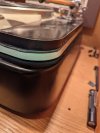
Exactly what I did. I cut a layer from a sheet of EPDM rubber and placed it between the armboard and the frame:
20180103_010652.jpg

PXL_20240203_034901605.jpg

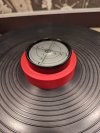
Hidden benefit of using a compressible layer between the armboard and frame is the armboard can be easily leveled to the platter by adjusting the 3 armboard screws.

At one time the armboard on my table was not level with the platter and I was hearing distortion during playback (duh-of course the cartridge can't track properly if the tonearm isn't level with the platter because the pillar isn't perpendicular to the platter). Once I leveled the armboard to the platter the magic of vinyl was back.

If that didn't make sense take a minute to think about it. If you look at the TD124 long enough it always seems to make sense.
PXL_20240203_041041848.jpg
PXL_20230126_151005246.jpg
I love it!
 
Last edited:
Back
Top Bottom