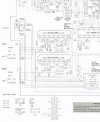
Your test (removing C409/C410 fixes volume/noise) confirms the issue is in the feedback loop of IC402—those caps are essential for stability, but if they're faulty or if the IC/transistors around it are degrading, it destabilizes the amp.
Why Oscillation (and Power Supply Sag)?
- High-Pitched Noise = Oscillation: The phono stage is a high-gain (~40-60dB) circuit for weak cartridge signals (2.5mV input sensitivity). Without proper phase compensation, it can oscillate at ultrasonic/high frequencies (10-50kHz, sounding like a faint "whine" or "squeal"). At low volume, it's subtle; at high volume, the amp drives harder, amplifying the oscillation into audible buzz/distortion. Removing C409/C410 breaks the feedback loop partially, stopping oscillation (but also messing up RIAA EQ response, hence why you need them back in).
- Low Volume: Oscillation injects noise that masks the signal and loads the output, reducing effective gain.
- Loud Buzz + Bulbs Dim at High Volume:
- Oscillation draws excess current from the power supply, causing rail sag (voltage drops from ~±15V to lower under load).
- Bulbs dim because the main AC transformer is overloaded momentarily—the receiver pulls ~300W max, but phono oscillation can spike current draw in the preamp.
- Not "Something Else":
- Bad input coupling caps (e.g., C811/C821 electrolytics): Would cause DC offset or hum, not high-pitched noise.
- Ground loop: Would be 60Hz hum, not high-pitch.
- Bad IC402: Possible, but oscillation often precedes full failure.
- Cartridge/stylus issue: Unlikely, as removing caps fixes it (and other inputs work fine).
- Common in Vintage Technics: Electrolytic caps in the supply dry out, increasing ripple/ESR (equivalent series resistance), which destabilizes high-gain ICs like this. Transistors (e.g., in the regulator) can also leak with age.
Troubleshooting Steps
Don't electrocute yourself.
- Visual Inspection:
- Check for bulging/leaky electrolytics around IC402 (C404, C406, C408, C410) and supply (C44, C45).
- Look for cracked solder joints on IC402 pins or R46/R48.
- Ensure no cold solder on phono input jacks.
- DC Voltage Checks (Power On, No Signal, Volume Low):
- Probe IC402 power pins (likely pin 4 = -Vee, pin 8 = +Vcc; confirm with full schematic if possible).
- Expect ~+12-18V on + rail, -12-18V on - rail (relative to GND).
- If sagging or noisy, supply issue.
- Output pins (2/5): Should be ~0V DC with no signal (offset <50mV).
- If offset >100mV, bad feedback caps or IC.
- Capacitor Testing:
- You said C409/C410 "tested fine," but ESR matters for ceramics/discs—use an ESR meter if you have one (or swap with known-good 0.1µF 50V ceramics).
- Test electrolytics: C404/C406/C408 (10-47µF, 25V) in the amp—high ESR causes instability.
- Supply caps: C44/C45 (large electrolytics, 1000µF+ 25V)—these often fail first.
- Oscillation Detection:
- Hook up a turntable (or test signal generator at 1kHz, 2.5mV).
- Use an oscilloscope on IC402 output pins: Look for sine-wave oscillation (high freq, small amplitude at low vol; grows with vol).
- No scope? Listen with headphones on REC OUT (tape monitor)—faint whine confirms.
- High volume test: Monitor supply voltage at IC402 pins—if drops >2V, confirm sag.
- Grounding Check:
- Verify phono GND lug is soldered securely to chassis. Clean jacks.
Replace C409 & C410 with fresh 0.1µF ceramic (50V, low ESR like NP0 type). Solder in temporarily—test volume/noise.
~$1 each. If fixes but RIAA curve off (boomy highs), values are correct per schematic.
Phono Amp Electrolytics
Replace C404, C406, C408 (all channels, 10-22µF 25V audio-grade).
Use Nichicon or Panasonic FC series for low noise.
Power Supply Stabilizers
filter caps C44/C45 (2200µF 25V). Check diodes D701/D702 for shorts.
Bulb dimming = sag; new caps fix ripple.
If Oscillation Persists
Add small compensation: 10-47pF ceramic across R46/R48 (feedback). Or bypass IC402 with socket—test/replace if dead (~$10 on eBay, AN7129 equiv).
Oscillation from layout—keep leads short.