• The move to the new server is done. There are some software and database maintenance updates in process. This has us passing the hat around to help out. We appreciate any donations. Seriously, even a dollar helps. The payment page may be found here - https://www.audiokarma.org/support.html

Technics SH-9010 Equalizer Recap—a few questions

was thinking of pulling the trigger on one of these(150)...doesn't seem worth the overall expense,work and sound;if the overall sound db are being decreased for the convenience of tailoring it. Thanks for the info., all.
I am also considering it but not sure if it is going to be worth the effort as you suggested.
 
I am also considering it but not sure if it is going to be worth the effort as you suggested.
What effort are you guys talking about? It is not mandatory to upgrade all 50+ caps in this EQ... as I did... it was most likely overkill.

Just today I happened to put this EQ back to work, after having used a digital software EQ (LSP-Plugins) for a few months. I am quite familiar with my speakers now, and was able to dial in (or, better said, dial out) the frequencies to make 'em sound right, yet sweet and not harsh.

Not sure if it's Jimmy Smith' smooth playing, or just me, but I do like the sound with this EQ better than the digital one.

In summary: If you need an EQ, and can find the SH-9010 in good condition, I can highly recommend it.
 
I was wondering if it is normal to replace the old caps with new higher capacitance values?
Depends on the application/function of the cap. For power supply caps I'd say maybe, keep in mind that these are typically the largest (=most expensive) so there MAY be some cost cutting going on. These caps are mostly for storage so the result is increased storage.

The older caps seem to be much closer to their stamped values versus all the new caps seem to be on the lower end of the spec.
Manufacturing techniques/precision has improved, it was posted elsewhere (by gadget73?) that Nichicon manufacture at -10% of nominated value, still within the +/-20% specs.
 
The opportunity passed and I didn't pull the trigger on the EQ. Instead, I purchased a marantz 7t preamp from the mid 60s and this thing rocks! The sound just below me away. I have it paried with a marantz 170DC running 4 large speakers.

I have accumulated a few pieces of vintage gear now. I replace the caps, transistors and regulators in the power supply section to avolid premanutre failure. In a few cases, I replaced the caps in the amp and preamp circuits and got really good results with the Pioneer receivers. However, I can not say the same about the marantz receivers! I only use the best nichicon MUSE caps, like the KZ or FG or bipolar muse caps. There is something special about the orginal marantz caps and I think it has to do with the cap value being closer to the posted value than the new caps. I have the caps that I removed and so far, I have only come across 2 that were defective in say the 60 caps that I pulled. The bad caps were in higher power receivers, like 100+ watts/channel. I did not find any problem with the lower power parts that I pulled in the past.
 
Just got myself a 9010 which the previous owner recapped. Work looks good, and it sounds good as well (who knows if it was properly calibrated - to @DrTebi's point, the procedure is relatively demanding).

Curious if anyone reckons that replacing the original ICs with something modern could improve performance. Thanks, all!
 
Just got myself a 9010 which the previous owner recapped. Work looks good, and it sounds good as well (who knows if it was properly calibrated - to @DrTebi's point, the procedure is relatively demanding).

Curious if anyone reckons that replacing the original ICs with something modern could improve performance. Thanks, all!

I remember drooling over the brochures for that and the other units in the Technics Professional Series.

Yours is an interesting question. Do you have schematics and/or a BOM. That would help identify the parts in question and see if better, modern alternatives are available.
 
I remember drooling over the brochures for that and the other units in the Technics Professional Series.

Yours is an interesting question. Do you have schematics and/or a BOM. That would help identify the parts in question and see if better, modern alternatives are available.
Yep, all 12 of the ICs are JM4558DS. Service manual shows all are running at 13.5V, if that's relevant in terms of selecting potential subs.
 
I found this interesting post about recapping the SH-9010 while researching before doing mine and thought I should give some additional feedback.

My equalizer was put out of service a few months ago for loss of output signal. Spent a couple of hours scoping a tone around and found it was going through places, but not reaching the output. The sine wave was also distorted a lot. Finally it gave me output and I suspect the muting capacitors are to blame for a very long delay to switch on the relay which is the last thing before the output jacks. And the EQ seems to be not doing any EQing. Setting the sliders to max or min didn't have an audible effect with music and I confirmed the same with a square wave, except for the 4kHz band where moving the slider caused some worm looking traces on the scope plus a lot of noise.

I am pretty early in replacing 55 elcos and already I have found about one third or more having green stuff on the legs. Funny thing, these appear to be the capacitors that measure well in capacitance, ESR and θ.

About one third is way off specs, with some - notably two of the PS caps - measuring some nF. After these were replaced, the output relay kicks in a bit faster but still takes it's time.

The NP capacitors appear to be fine in every single measurement. As good or better than the brand new NPs I have to replace them with. But they are 47 years old so they must be retired.

This unit is one of these that really suffer from Panasonic green stuff on the capacitors. Along with the RS-Mnn cassette decks and the RS-1500 R2R decks from the same era.
 
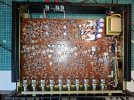
And here is a picture of the inside of the unit. The image is of the bottom side of the unit. When you remove the top cover, you are faced with the solder side of the PCB. Everything is mounted upside down inside.
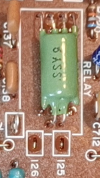
The small picture shows the muting relay. I am curious as to what kind or relay this is and why it was chosen. Looks like nothing familiar. Is that an early type of solid state relay? Low noise relay?

1743750681059.png
20250402_164929.jpg
 
The orange cans are most likely not actually electrolytic capacitors so you can leave them alone and focus on all the rest. Quality gen purpose caps will give a marked improvement to the purple/blue caps in there.
 
The orange cans are most likely not actually electrolytic capacitors so you can leave them alone and focus on all the rest. Quality gen purpose caps will give a marked improvement to the purple/blue caps in there.
There are 2 orange low leakage 'lytics in the upper left that could benefit from replacement. Either nichicon ukl or a film cap. Most likely in the signal path but im not referring to a schematic. Just assuming...
 
The two orange caps are 3,3uF ones. And two of the few that measure fine. The NP 47uF ones measure all good as well, and no leaking of green stuff in any of them. They are all going, as they are 45+ years old, but I find it interesting that the green stuff is in the positive lead of specific cap values. And then we have the 470uF in the power supply where two measure and perform fine and the other two are gone.

Plenty of electrolytics in the audio path and most of them bipolar.

I made some performance tests with square waves and each band and each potentiometer produced different kind of problems. Like:
  • the sliders have marginal contact and sliding generates noise
  • altering the Q can generate heavy ringing at the positive edge of the wave
  • increasing or decreasing the level doesn't alter the angle of the positive edge but changes the shape altogether - each band different shapes.
it was distressing to watch that and didn't take screenshots. I now regret it. But I have another 9010 and probably in similar condition so I will be back.

After replacing the caps I have at hand, and while waiting for the NP and low leakage to arrive, I am in the process of cleaning the pots. Currently in spray and pray mode, and hopefully will not need to take them out and apart.

 
The two orange caps are 3,3uF ones. And two of the few that measure fine. The NP 47uF ones measure all good as well, and no leaking of green stuff in any of them. They are all going, as they are 45+ years old, but I find it interesting that the green stuff is in the positive lead of specific cap values. And then we have the 470uF in the power supply where two measure and perform fine and the other two are gone.

Plenty of electrolytics in the audio path and most of them bipolar.

I made some performance tests with square waves and each band and each potentiometer produced different kind of problems. Like:
  • the sliders have marginal contact and sliding generates noise
  • altering the Q can generate heavy ringing at the positive edge of the wave
  • increasing or decreasing the level doesn't alter the angle of the positive edge but changes the shape altogether - each band different shapes.
it was distressing to watch that and didn't take screenshots. I now regret it. But I have another 9010 and probably in similar condition so I will be back.

After replacing the caps I have at hand, and while waiting for the NP and low leakage to arrive, I am in the process of cleaning the pots. Currently in spray and pray mode, and hopefully will not need to take them out and apart.
How’s this going?
 
I just realized I didn't give an progress feedback - that was rude of me.
Well, long story short. I took all three units I have on the bench and took the covers apart. Tested them and only one operated acceptably and only at some random frequency slots.
I had to peel off a mylar looking sticker around the pots that showed their values and also covered what appeared to be access holes. That took me a half a day for the first unit. Spraying contact cleaner on the surface of that sticker helped fight the glue. With lots of contact cleaner sprayed in the pots, the issues were resolved.

Even though these units come from the era when the purple and blue capacitors are way off, these units were not that bad with capacitors, having said that all were replaced because they leaked electrolyte - but still functioned. They were really bad in the shape the pots were. But all came to function well after a couple of thorough cleaning sessions each.
 
Back
Top Bottom