SaSi
Seriously Illogical
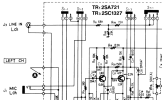
I just started working on a SH-9020 VU meter from the slimline series. This one has an issue - the right channel meter deflects to 0dB or +20dB upon power up and stays there.
While going through the circuit and capacitors complement I noticed something strange (to me) regarding the choice of capacitors.
I am copying a portion of the capacitor list that shows the thing that has me wondering.
C201, 202 are the input coupling capacitors. They are 0,47uF electrolytic, rated at 50V. They are orange ones, which probably implies low leakage. It's a rather low value to require an electrolytic. And to make a point, C209 and 210 are the same 0.47uF value, again rated at 50V but polyester.
With the general understanding that it's not a good thing to put electrolytic capacitors in the signal path, and with polyester capacitors already in the BOM of this unit, why did the designers choose to put an electrolytic as a coupling capacitor? They surely didn't do it for cost reasons or lazyness. There has to be a reason, right?
I have seen the same choice in the SH-9010 parametric equalizer. Same type of orange electrolytics at the input, just a different 3,3uF value, implying there's a "school of thought" here.
While going through the circuit and capacitors complement I noticed something strange (to me) regarding the choice of capacitors.
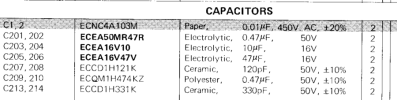
I am copying a portion of the capacitor list that shows the thing that has me wondering.
C201, 202 are the input coupling capacitors. They are 0,47uF electrolytic, rated at 50V. They are orange ones, which probably implies low leakage. It's a rather low value to require an electrolytic. And to make a point, C209 and 210 are the same 0.47uF value, again rated at 50V but polyester.
With the general understanding that it's not a good thing to put electrolytic capacitors in the signal path, and with polyester capacitors already in the BOM of this unit, why did the designers choose to put an electrolytic as a coupling capacitor? They surely didn't do it for cost reasons or lazyness. There has to be a reason, right?
I have seen the same choice in the SH-9010 parametric equalizer. Same type of orange electrolytics at the input, just a different 3,3uF value, implying there's a "school of thought" here.