Being an active ‘hi-fi’ hobby-ist/audiophile and most of all a lover of most types of music mostly all of my life I can recall when in 1972 Panasonic/Technics was still striving to find a strong foot-hold in the USA audiophile and consumer stereo market.
Living in NYC since birth, I also lived in the other boros but as a teenager I had made almost monthly trips into the big city. I went there because more than any place NYC had it all. From food, stereo, TV’s, fashions, jobs etc, if it was man-made, you’d find an example of it there in NYC.
In my many trips into the city, Technics by 1971-72 flooded practically every hi-fi store. I mean these Technics tables were everywhere. Initially, I didn’t care for them as I felt they looked too technical/mechanical whereas I felt music was better served on a table that looked inviting thru the use of wood and softer more graceful lines.
Realizing that my 1972 purchase of a AR-Xa table was not giving me what I ultimately wanted, after two years with it, I needed something better, more upscale. By 1974 I started searching those numerous NYC hi-fi stores again. With only scarce test reports on the table I was yearning for, I purchased a b rand new Tannoy/Micro-Seiki TM-55 direct drive table.
It was beautiful with it’s wood-veneer dark-reddish color that covered the entire base and plinth, it was simply lovely. Best of all it was that ‘new’ ‘direct-drive’ method I had already read so much about as the new coming technology. Brought it home, hooked it up and I was immersed in a realistic sounding wave of music like never before.
Gone was the rumble, the slow starts, the frailty and uncertainty of the absent settings of the AR-Xa table. Now I could now turn up the volume and not worry about any acoustic-feedback or fear of foot falls being heard. Not to forget, the speed accuracy was a total joy. Mid range was more articulate, highs were more crystalline, bass was effortlessly firm and confident sounding. There was no slight congestion and the separation of notes offered even more air. It all gave me a new dimensional thrill through vinyl in 1974. I was so thrilled, (and that was with a Shure M91E), that I saved up and dropped a whopping $75. on a brand new Shure Type III. I surely must've had the best sound system in at least 5 square block area, or so I thought. Through a Dynaco PAS-3X, Phase Linear PL-400 and AR-3a's my system was all I could ask for.
Fast forward to 2005 and I was setting up a new apartment and looking for something new in tables. Unfortunately my budget was limited so I searched older used tables. Through the ease of the internet, I discovered that the auction site offered many options. It was never that easy years before the interweb.
I bought a used SL-120 with its factory tonearm. Later on I bought another with a arm I had lusted for back then, a Black-Widow. The sound of it seemed so much more quicker, stable, full and overall better and more musical than my aging Micro-Seiki TM55. Itself, the TM55 was excellent in all areas but, the SL-120 edged it out of my system just the same. I found it personally amazing that the table I disliked in 1972 I was now quickly falling in love with. The music seemed to flow so much more effortlessly right to my mind, I was impressed.
Well that was 2005 and since not only have I enjoyed myself more than ever listening to music, I went out and bought 5 more SL-120’s. I’ve installed a mint S.M.E. 3009
Pre-Improved tonearm on each table. I can also recall it was sometimes offred that way in stores but, it was the '3009 Improved arm.
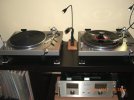
By 2016 I’ve also purchased two SL-110’s and for those I use two mint Dynavector 505 arms with heavier cartridges. I also play with other top arms and use a full complement of quality cartridges. The Lyra Delos, Kleos and AudioTechnica ART-9 in system number 1. In system number 2, I use the SL-1100’s with the 505 arms along with a Ortofon Cadenza Blue and a Benz-Micro Gull-Wing. Attached fotos of system # one. I'd show System # 2's but, the room is to full to show in public.
In closing, I can whole-heartedly say I feel the SL-120 and SL-1100 are excellent tables and can probably give a good run to some of the more costly, more modern tables out there. I’m more than satisfied with its performance and continue to enjoy both models frequently.
With over 7000+vinyl disks I always utilize ultra-sonic cleaning and have always been critically concerned of a disk's handling and playing condition.
P.S. I also enjoy the Thorens 125 turntables and find it uncannily close in many ways to the SL-120's sound. Though, the SL-120 seems faster in the retrieval and decay of note edges. Though it wasn't a qualifying test as I used two different cartridges.
FM
FM

FM
P.S, To answer the OP, as I recall though I could be wrong, the SL-120 came out as the consumer flagship model and it came out first. Any other models that came out after were lesser in materials and construction. The later introduced SL 'II's were better than the original SL-1400, 1500, 1600, & 1700, example SL-1600II. The SL-1100 was entirely different than those models and closer to the SL-120 though, it's motor is virtually identical. It's been said that Panasonic being as huge as it was/is had a huge budget in these table's research and design.
There was even another rare SL-120 but, with only half a plinth, no tonearm and built and sold to be placed in a custom plinth. To me it also gave more credence to the design quality of the standard SL-120.
When the consumer SL-120 came out, so did the TOTL SP-10 with a similar motor to the SL-120 and later with newer later iterations of itself with better motors and platters aimed at the professional market. A deep search could prove me wrong but, I think I've relayed the general information.
FM
5k


