• The move to the new server is done. There are some software and database maintenance updates in process. This has us passing the hat around to help out. We appreciate any donations. Seriously, even a dollar helps. The payment page may be found here - https://www.audiokarma.org/support.html

Technics SL-B3 tonearm help

Texas Tom

Active Member
Howdy turntable lovers. I need some help with my Technics SL-B3.


When I picked this up it the tonearm would get stuck no matter where I placed it on the record. It turned out the pivot point on one of the tonearm bearings had a big blob of green corrosion. The bearings seemed to be ok so I cleaned up the point, put a dab of oil on it and tried again with the same result.

I ordered another arm and installed it and I am having similar issues. The first question I have is: Is it possible to over tighten the two brass fittings to the tonearm shaft?

Any assistance is greatly appreciated!

Thank you,
Tom
 
Register to hide this ad
Yes. Bearings can be overtightened, and they won't work well and it isn't good for them. This is true of both the vertical and horizontal bearings, but by your mention of brass fittings, I assume you are talking about the horizontal bearing, and that it is composed of two ball races, top and bottom. Such bearings are meant to have some slop in them, and it is gravity that is what keeps them tight, not the mechanical clamping of the races - as, it appears, you have discovered.
The arm rests on the top ball race, and the bottom ball race is not really involved - it there mostly to keep the bearings tight enough that the balls don't fall out. Calmping the bearings tight will jam the balls in the bearing when the high points of the balls run into the high points of the bearing surface.
Nothing made by humans is perfect, though ball bearings can get pretty close. Unfortunately, the tighter the tolerances, the greater the cost, and by something like an exponential amount. So a bearing with absolutely zero play, if it were possible, would cost an astronomical amount. And it may be news to rabid audiophiles, but such bearings are unnecessary for our purposes - NASA and the US military may need them, and can afford them. We can't. And we don't need them - as small as the movements of the stylus we are trying to capture, and as low as the friction we want the arm to have, the tolerances are enormous compared to those in gyroscopes or metrological equipment.
The mass of the arm is quite large relative to the forces put into the arm by the groove/stylus, and it is resting on whichever of the bearings are the highest (at that point in their rotation on the bearing surface (which is almost certainly less precisely machined than the balls). The top of the balls that the uppper bearing surface rests on present a very small area, o the downward pressure is very high. You don't need clamping to help.
Ease up a bit - not a lot - on the lower bearing. Hopefully the bearing surfaces and the balls haven't been distorted (brinnelling is the term, I believe), and your arm will work just fine. If not, ease up a little more. Just don't let the balls fall out.
 
This is a full auto turntable. Have you checked the parts underneath the plinth for obstructions?
 
Thank you both for your responses. Sorry for my tardiness in thanking you.

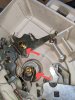
I think I did a poor job expressing my question. I hope the picture will help. In the attached picture, there are two brass fittings that are tightened to the vertical shaft of the tone arm. Can these be tightened too much.

Also, the retaining clip is not tight.

Additional guidance is greatly appreciated!

Thank you in advance,

Tom
 

Attachments

  • PXL_20210708_222944412~2.jpg
    PXL_20210708_222944412~2.jpg
    112.7 KB · Views: 32
I have installed the tonearm twice. It seems to move fine, but when I try to play a record, it doesn't move with the groove!
 
Am I correct in thinking that the lower of the two red arrows points to tonearm shaft, and the upper approw points to a part that has been taken off that shaft?
I believe I answered your question already, but seeing the picture makes me wonder if another problem may be that that part taken off wasn't aligned exactly right and was fouling something.
We aren't very good at sensing how freely something like a tonearm moves - it can seem fine and still have enough resistance not to work. Even how you dress the leads can cause problems. An arm that has good bearings should, if balanced, be free to move through it's entire range with just a puff of air.
 
Back
Top Bottom