Chris Rist
New Member
Hello everyone!
I recently rescued a Technics SL-P10 from a thrift store and managed to get it working again after addressing a few dry joints near the heatsink. While the player technically functions well, I've encountered an audible issue that I couldn't find much information about online. So, I thought I'd reach out to the community for some advice.
During playback, there's a noticeable noise floor or jitter that becomes apparent, particularly during quiet and subtle parts, especially in more dynamic music like orchestras or audio with long release/sustain (such as reverb). This noise is only present during playback, specifically when the audio circuits are switched on after the relay click. The noise is akin to artifacting, almost like the noise floor on a vinyl record. It seems to worsen the longer the player is powered on, though it's not dependent on the type of disc or the playback position (beginning or very end). The quieter the audio, the louder the noise. Importantly, the noise is not present during silent parts or between tracks.
I've taken a series of troubleshooting steps thus far, covering various components. This includes cleaning the transport and pickup/lens, reseating all connections, and meticulously inspecting solder joints on the power/audio/amp board, servo board, and digital board. Despite the original Panasonic electrolytics, all filter caps have tested well with low ESR.
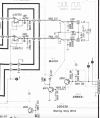
During my investigation, I identified a broken trace on the power board connecting the collector of Regulator Q852. A resistor (R853) runs in tandem with this trace leading to pin 8 of the RCH and LCH daughter boards. Additionally, I noticed some additional caps soldered on the back of the digital board, likely added during the factory assembly. I addressed these concerns by retouching the pads and cleaning the board of flux and old glue.
However, these efforts have yielded little to no improvement in the observed symptoms. I'm left with a few possible explanations.
The symptoms might be indicative of a failing transport, issues with the drop-out board, problematic transistors or regulators, faulty amplification or switching components, or a concern originating from the digital board. Alternatively, it's possible that I could be overlooking something on the power supply board. Although the caps tested good capacitance with low Vloss and ESR, should I still consider replacing them, given the symptoms persist?
I was wondering if anyone has experienced something similar or could offer advice on where to look next. Your help would be highly appreciated!
I recently rescued a Technics SL-P10 from a thrift store and managed to get it working again after addressing a few dry joints near the heatsink. While the player technically functions well, I've encountered an audible issue that I couldn't find much information about online. So, I thought I'd reach out to the community for some advice.
During playback, there's a noticeable noise floor or jitter that becomes apparent, particularly during quiet and subtle parts, especially in more dynamic music like orchestras or audio with long release/sustain (such as reverb). This noise is only present during playback, specifically when the audio circuits are switched on after the relay click. The noise is akin to artifacting, almost like the noise floor on a vinyl record. It seems to worsen the longer the player is powered on, though it's not dependent on the type of disc or the playback position (beginning or very end). The quieter the audio, the louder the noise. Importantly, the noise is not present during silent parts or between tracks.
I've taken a series of troubleshooting steps thus far, covering various components. This includes cleaning the transport and pickup/lens, reseating all connections, and meticulously inspecting solder joints on the power/audio/amp board, servo board, and digital board. Despite the original Panasonic electrolytics, all filter caps have tested well with low ESR.
During my investigation, I identified a broken trace on the power board connecting the collector of Regulator Q852. A resistor (R853) runs in tandem with this trace leading to pin 8 of the RCH and LCH daughter boards. Additionally, I noticed some additional caps soldered on the back of the digital board, likely added during the factory assembly. I addressed these concerns by retouching the pads and cleaning the board of flux and old glue.
However, these efforts have yielded little to no improvement in the observed symptoms. I'm left with a few possible explanations.
The symptoms might be indicative of a failing transport, issues with the drop-out board, problematic transistors or regulators, faulty amplification or switching components, or a concern originating from the digital board. Alternatively, it's possible that I could be overlooking something on the power supply board. Although the caps tested good capacitance with low Vloss and ESR, should I still consider replacing them, given the symptoms persist?
I was wondering if anyone has experienced something similar or could offer advice on where to look next. Your help would be highly appreciated!