
• The move to the new server is done. There are some software and database maintenance updates in process. This has us passing the hat around to help out. We appreciate any donations. Seriously, even a dollar helps. The payment page may be found here - https://www.audiokarma.org/support.html

Technics SU-7100 Project - Need your help!

twilliams

New Member
Hello everyone,

First off, I'd like to say that I love this forum. You seem to make everyone feel welcome, and the information on here is priceless.

In a few days, I will be buying a Technics SU-7100 amplifier. According to the seller, it works great, except for the fact that one channel has no sound. I have been after a project like this for some time, and I think this is a perfect introductory step for me to get into the world of tinkering with audio equipment. I have built 3 sets of speakers, and successfully separated an amp from its home in a cassette player/radio tuner, but I have never actually repaired an amplifier. I am somewhat well versed in soldering, and I know these amps commonly experience problems with the channels. I'm decent with a multimeter and there is an electrical engineering degree in my household. With the help of you guys, I think I can get this fixed!

I was wondering what my first step in diagnosing this problem should be. Should I replace the transistor for the not working channel? Should I replace power packs? Please help!

Thank you.
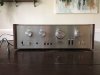
 

Attachments

  • 00m0m_7uDsUoSs2ah_1200x900.jpg
    00m0m_7uDsUoSs2ah_1200x900.jpg
    56.3 KB · Views: 50
Register to hide this ad
check for blown fuses and any circuit board cracks or bad connections before you replace anything. It uses speaker protect fuses (3.15a), and the headphone jack also switches off the speaker connections. Make sure you don't have bad connections where the headphone jack connects to the circuit board. Of course dirty switches and controls can be an issue as well
 
check for blown fuses and any circuit board cracks or bad connections before you replace anything. It uses speaker protect fuses (3.15a), and the headphone jack also switches off the speaker connections. Make sure you don't have bad connections where the headphone jack connects to the circuit board. Of course dirty switches and controls can be an issue as well

Thanks a million. If I am super lucky, it will just be a fuse. I'll also check all of my connections and switches (when I get it), and report back. Thanks!
 
The SU-7100 contains two integrated amplifier chips; STK0039 in this case. It often happens that they blow. They can be replaced, but be aware that the Internet sells a lot of fake modules that are not half as robust as they should be. Also always check the output voltage for DC carefully before wiring up speakers—if memory serves me right the 7100 has no electronic speaker protection, just the fuses mentioned. Good luck!
 
The SU-7100 contains two integrated amplifier chips; STK0039 in this case. It often happens that they blow. They can be replaced, but be aware that the Internet sells a lot of fake modules that are not half as robust as they should be. Also always check the output voltage for DC carefully before wiring up speakers—if memory serves me right the 7100 has no electronic speaker protection, just the fuses mentioned. Good luck!

I have heard about this amplifier chip, and I am aware that there is no speaker protection. My question is this: how do I properly test if they are blown or not?
 
@twilliams Welcome to AK.. me and @inductor are just trying encourage you and units with STK's can be okay.. but bi junction polar transistor (BJT) models are much more forgiving and easier to replace transistors. Other questions we ask often are: What are your soldering skills? You answered most of that. There are good amp kits you can get to build complete with parts.

Just trying to make your 'initiation' so to speak a bit easier and don't be afraid to ask before you buy and get opinions on gear.
 
Thanks everybody. I'm getting it for $20 and I'm okay with spending that on a good case. If nothing else, I'll drop a new board in.
 
If the IC is bad, usually you will be able to identify and confirm this by checking for a short between pin 2 and 3, or/or 8 and 9. Any shorts between pins 1 and 2, and or 0 and 9 are also isdicators of a failed chip. The result a short in the chip usually results in 30vdc across pins 8 and 3, or at the speaker out. do not connect speakers until you confirm there isn't any DC on the output. It should be no higher than 50mv dc.
 
Before you do anything, flip the "Tape Monitor" switch on & off several times. I got one of these off the Bay a few years ago for 50-cents because it didn't work on either channel. Wiggling the TM switch fixed it.

I did need to disassemble the switch and polish the contacts. They were actually green.
 
If the IC is bad, usually you will be able to identify and confirm this by checking for a short between pin 2 and 3, or/or 8 and 9. Any shorts between pins 1 and 2, and or 0 and 9 are also isdicators of a failed chip. The result a short in the chip usually results in 30vdc across pins 8 and 3, or at the speaker out. do not connect speakers until you confirm there isn't any DC on the output. It should be no higher than 50mv dc.
Before you do anything, flip the "Tape Monitor" switch on & off several times. I got one of these off the Bay a few years ago for 50-cents because it didn't work on either channel. Wiggling the TM switch fixed it.

I did need to disassemble the switch and polish the contacts. They were actually green.

I picked up the amp today He threw in an Onkyo TX 82 with a bad power supply for free. If anyone knows where I can get one of those, let me know.

After taking apart the amp, testing for continuity, trying to figure out where I'm losing power, I believe my problem lies within the power packs. I desoldered both and ordered two Darlingtons from the bay. I'll be doing them this weekend hopefully!
Thank you for the help everyone, sadly it wasn't a fuse or a switch but I still feel like I'm in a decent place.
 
Don't just install new ic's and power up, it;s almost certain you will have resistors and driver transistors blown as well. You will likely blow your new ic's up. Now's the time to build your dim bulb tester to aid in newly rebuilt first start ups.
 
Don't just install new ic's and power up, it;s almost certain you will have resistors and driver transistors blown as well. You will likely blow your new ic's up. Now's the time to build your dim bulb tester to aid in newly rebuilt first start ups.

If this is the case, I'm not going to be able to do anything with this amp. I'm just not smart enough to repair all of that.
 
Don't just install new ic's and power up, it;s almost certain you will have resistors and driver transistors blown as well. You will likely blow your new ic's up. Now's the time to build your dim bulb tester to aid in newly rebuilt first start ups.
I swapped power packs tonight, and I guess you're right. It sounds like I have power to the channel with the good power pack (static when connecting), but no sound in either channel. I don't know what to do. Maybe I'll just bring it to a shop (if I can find one) and see what they'd charge me for repairs. Looks like this one is over my head :(
 
At some point in time, you may want to step back and evaluate where you are with this project. Don't throw good money after bad. If you got this working perfectly, you'd still have a low power BOTL Technics integrated. These were never highly regarded amps. And that coming from someone who has one.
 
If this is the case, I'm not going to be able to do anything with this amp. I'm just not smart enough to repair all of that.
Use the amp to learn.
Download the service manual, as suggested, build a DBT, do some basic voltage measurements...
 
At some point in time, you may want to step back and evaluate where you are with this project. Don't throw good money after bad. If you got this working perfectly, you'd still have a low power BOTL Technics integrated. These were never highly regarded amps. And that coming from someone who has one.

Yeah, I see these have been going for no less than 150 bucks. If I can stay under 100 dollars all in, this might be worth it. I hate leaving stuff for dead.
 
Use the amp to learn.
Download the service manual, as suggested, build a DBT, do some basic voltage measurements...
I have the service manual, I just can't make enough sense of it to use it correctly. I'll never figure out the problem, I can't test each part individually
 
Do you have a reasonably good test meter to use? if you do the schematic should give voltages for the stk pinouts in a working system. If you are not confident working with electricity and the potential risk of shock then perhaps electronic repair is not for you. If you want to give it a go then there is lots of help and advice on here. Read through some of the old threads, there is hope.
 
Do you have a reasonably good test meter to use? if you do the schematic should give voltages for the stk pinouts in a working system. If you are not confident working with electricity and the potential risk of shock then perhaps electronic repair is not for you. If you want to give it a go then there is lots of help and advice on here. Read through some of the old threads, there is hope.

I do have two very different test meters
that both work well. I tested the STKs, but I don't know if I'll be able to test everything accurately.
 
Back
Top Bottom