

You are using an out of date browser. It may not display this or other websites correctly.
You should upgrade or use an alternative browser.
You should upgrade or use an alternative browser.
Teflon Coupling Caps In Vintage Tube Amps . . .
- Thread starter FalconEddy
- Start date

I don't make a habit of buying high-priced caps -- I thought I'd experiment here. I really share the notion that there isn't a lot of sonic difference among caps of the same species. No cap is the best sound . . .
There sometimes are differences in leakage, ESR, etc. on SOME new versus old production, so a lot of what people are "hearing" may have some quantifiable basis.
Several years ago I bought some high-priced "silver" caps from a chap in Britain. I was excited and installed them in an ST-70. They sounded like crap. They leaked like sieves. I opened one up. I have some left and can take photos if anyone is interested. I know I got ripped off -- maybe "real" silver caps are good?
Anyway, I was a huge skeptic about wires and wiring, until I did a test using different interconnect wire on a DAC. The difference was quite remarkable. OTOH, I also won a $400 AC power cable as a door prize. You'll have a hard time convincing me that it's any better than a $2.50 cord from Mouser.
There sometimes are differences in leakage, ESR, etc. on SOME new versus old production, so a lot of what people are "hearing" may have some quantifiable basis.
Several years ago I bought some high-priced "silver" caps from a chap in Britain. I was excited and installed them in an ST-70. They sounded like crap. They leaked like sieves. I opened one up. I have some left and can take photos if anyone is interested. I know I got ripped off -- maybe "real" silver caps are good?
Anyway, I was a huge skeptic about wires and wiring, until I did a test using different interconnect wire on a DAC. The difference was quite remarkable. OTOH, I also won a $400 AC power cable as a door prize. You'll have a hard time convincing me that it's any better than a $2.50 cord from Mouser.

FalconEddy
Audio Mastering Engineer
I don't make a habit of buying high-priced caps -- I thought I'd experiment here. I really share the notion that there isn't a lot of sonic difference among caps of the same species. No cap is the best sound . . .
There sometimes are differences in leakage, ESR, etc. on SOME new versus old production, so a lot of what people are "hearing" may have some quantifiable basis.
Several years ago I bought some high-priced "silver" caps from a chap in Britain. I was excited and installed them in an ST-70. They sounded like crap. They leaked like sieves. I opened one up. I have some left and can take photos if anyone is interested. I know I got ripped off -- maybe "real" silver caps are good?
Anyway, I was a huge skeptic about wires and wiring, until I did a test using different interconnect wire on a DAC. The difference was quite remarkable. OTOH, I also won a $400 AC power cable as a door prize. You'll have a hard time convincing me that it's any better than a $2.50 cord from Mouser.
THAT, is absolutely correct, primarily due to how we all hear differently to some extent.
Yes, even DAC's themselves can make a tremendous difference in digital material. People always ask me why their material sounds so much better when they get it back, and I tell the type of signal wire being used along with the mastering DAC and wordclock I'm using is correcting all the timing crap and bit errors before it goes down to the CD.
However, as far as sound differences in capacitor species. . .
If the 'species' is film and foil, the differences are actually quite pronounced and distinct to many of us.
Polyester, polyproplyene, polystyrene, paper in oil, and teflon dielectrics all sound completely different. Many of these change over time, and a few manufacturers take a very long time time for a proper break-in period, just like a Brazilian Cherry floor went it's first put down. It looked one way that first day, but after UV light hit it repeatedly over time, it changed and matured to where it was supposed to be.
. . Falcon

Now that should raise some eyebrows! But I am of the same opinion. So, if anyone wishes to hurl harpoons, I will be on the receiving end as well
Make that 3 of us. I cant tell the difference between OD's and K40's.
Larry
FalconEddy
Audio Mastering Engineer
Make that 3 of us. I cant tell the difference between OD's and K40's.
Larry
Ok, now that we have at least three of you, I can toss the harpoon!
First of all, the choices that you've made are so close sounding, most people wouldn't notice a difference anyway.
Larry, there are a lot of "OD's" out there, and I'd be a dolt to speculate on which manufacturer's and which model number, so I won't

However, I'd be willing to bet if one of you three had installed Sonicap Gen I's (far from a boutique cap) into the coupling stage of your tube amps, you wouldn't have said you couldn't have heard a difference in caps. That one generally sounds as though someone cranked the treble control up when you weren't looking.
So, I guess I'm really not tossing a harpoon after all. Just pointing out your cap selections don't give MASSIVE differences in sound characteristics. But, in reality, it's still all about the different nuances; and, of course, the subjectivity of what's being heard by the listener.
. . Falcon
FalconEddy
Audio Mastering Engineer
Will you be testing the new Psvane teflons from Grant Fidelity by chance?
Sorry, no.
Still not looking to install teflon.
. . Falcon
I had been tempted to use Teflons in my amp (modern circuit) but have ordered the new Deulund Alexandra caps instead.
I believe in caps sounding different, and how much different can depend on the circuit, some circuits will dominate the sound signature, while others will show more differences with component changes, IMO.
I'll be interested in what you do here, in this thread
I believe in caps sounding different, and how much different can depend on the circuit, some circuits will dominate the sound signature, while others will show more differences with component changes, IMO.
I'll be interested in what you do here, in this thread

The concept of "the sound that the original (vintage) tube amplifier desired" is a foolish anachronism. The design engineer usually got the sound that the accounting department wanted, and there were not a ton of choices.
This may well be the case on a given amp... but the question that arises is... how much are you willing to re-engineer the totality of the amp, to make it work well with caps that are significantly different in character than the originals?
Many of these old engineers were very good at balancing properties of components and circuit designs, to give remarkably even-handed response from these amps. Change one significant element of the balance, and you no longer have balance. You then have to go find out something that will cancel out the inadvertent response anomalies you have created... and then once you've changed other things to cancel that out, you have tertiary things you have to do, to ameliorate other problems you just created with the second step... and so on. Proverbial can of worms open, worms crawling around everywhere, in essence...
For many cases, the logical course of action, is to not upset the apple cart, if the apples are already pretty good-tasting...

Regards,
Gordon.

chinacave
Its Like a Jungle Sometimes; It makes me Wonder
One Idea I have to test in my endless list of things to build or try is a simple one tube / one capacitor pre-amp (or a power amp with small # of caps) and build in a switching scheme that would enable one to listen to several different caps in rapid succession (or at least to switch rapidly..)
This would seem to be a great way to listen for any differences and compare / contrast.
Just throwing that out there.....
This would seem to be a great way to listen for any differences and compare / contrast.
Just throwing that out there.....

audiodon
Addicted Member
Well,
I've bought some teflon caps that were on sale and put them in the outputs of my keeper Fisher 500-C.
You might ask, "Why would you use teflons in a receiver when integrateds or amps would provide a better platform for assessment"?
This 500-C is an early one without Nuvistors and it definitely sounds more like a 500-B but with more power.
That is, it has the muscle but the midrange is sweeter than any Nuvistor model I've tried.
Therefore, it can get a different kind of treatment that I'd give other 500-Cs, where I try to reinforce the midrange a bit more so it isn't overshadowed by the extension on each end.
I put all new resistors from the volume pot to the outputs also. They're Takman carbon comps or Kiwame carbon films.


This 500-C is the cleanest unit I've come across and was bone stock and functioning normally when I got it. I've made some changes, but the power supply isn't upgraded yet. The first stage filter caps, rectifier, and diodes are done though.
I think I'll change out that 7watt power resistor too. The value at the screens is off.
I think I might put some 100 ohm resistors on the output tube screens also, but I didn't have 8 matching ones for pins 4 & 8 of each output 7591.
These are .1uf teflon coupling caps. I staggered the voltage as Fishers usually do it. I tested them to find the shield and the farthest one on the right in the photos was mislabeled according to my tests, so in each case the shield is towards the phase inverter 12AX7s.
I've got about a half dozen hours on this receiver at this point since installation .
The output sounds lively and pleasant, slightly etched but very dynamic and forward. I don't know if this is a teflon characteristic or if they just need time to settle.
For anyone who's played with different flavors of 5751s, these remind me of what Sylvania black plate or gold brand triple micas do in a preamp's line stage.
That is, the sound is quite a bit more forward than Fishers usually sound, but it's not unpleasant.
I often am suspicious that the front and center instruments seem so front and center because the background is smeared a bit. I'll have to give them some time to burn-in and reassess. Ripening time.
I've bought some teflon caps that were on sale and put them in the outputs of my keeper Fisher 500-C.
You might ask, "Why would you use teflons in a receiver when integrateds or amps would provide a better platform for assessment"?
This 500-C is an early one without Nuvistors and it definitely sounds more like a 500-B but with more power.
That is, it has the muscle but the midrange is sweeter than any Nuvistor model I've tried.
Therefore, it can get a different kind of treatment that I'd give other 500-Cs, where I try to reinforce the midrange a bit more so it isn't overshadowed by the extension on each end.
I put all new resistors from the volume pot to the outputs also. They're Takman carbon comps or Kiwame carbon films.
This 500-C is the cleanest unit I've come across and was bone stock and functioning normally when I got it. I've made some changes, but the power supply isn't upgraded yet. The first stage filter caps, rectifier, and diodes are done though.
I think I'll change out that 7watt power resistor too. The value at the screens is off.
I think I might put some 100 ohm resistors on the output tube screens also, but I didn't have 8 matching ones for pins 4 & 8 of each output 7591.
These are .1uf teflon coupling caps. I staggered the voltage as Fishers usually do it. I tested them to find the shield and the farthest one on the right in the photos was mislabeled according to my tests, so in each case the shield is towards the phase inverter 12AX7s.
I've got about a half dozen hours on this receiver at this point since installation .
The output sounds lively and pleasant, slightly etched but very dynamic and forward. I don't know if this is a teflon characteristic or if they just need time to settle.
For anyone who's played with different flavors of 5751s, these remind me of what Sylvania black plate or gold brand triple micas do in a preamp's line stage.
That is, the sound is quite a bit more forward than Fishers usually sound, but it's not unpleasant.
I often am suspicious that the front and center instruments seem so front and center because the background is smeared a bit. I'll have to give them some time to burn-in and reassess. Ripening time.
Attachments

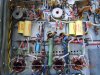
Last edited:
Falcon Eddie
Just a heads up in case you haven't seen it anywhere, the Psvane caps are not real Teflon caps.
OH! I have the Deulund Alexandra caps in my amp for a while now, and love them, very nice realistic tones, and they just seem to do everything pretty much right. They make the Mundorf silver and oils they replaced sound artificial in comparison
AudioDon, nice job! I used a few of those Kiwame resistors along with a couple of Shinkoh's to nice effect. I have heard good things about the Takman Carbons, and might even try them in place of a couple of the Kiwame's and see how the mix goes.
Just a heads up in case you haven't seen it anywhere, the Psvane caps are not real Teflon caps.
OH! I have the Deulund Alexandra caps in my amp for a while now, and love them, very nice realistic tones, and they just seem to do everything pretty much right. They make the Mundorf silver and oils they replaced sound artificial in comparison
AudioDon, nice job! I used a few of those Kiwame resistors along with a couple of Shinkoh's to nice effect. I have heard good things about the Takman Carbons, and might even try them in place of a couple of the Kiwame's and see how the mix goes.
Last edited:
Audiodon
I put these caps ( i think the same REL TFT Caps ) in my Scott 222c.
They do need a long time to burn in, in my case about a 100 h.
I replaced Russian pio's for these (coupling ) but the difference is Hugh !
Much more detail and more natural,enz. a whole other class.
Just wait and let it play, it only gets better.
Arnold
I put these caps ( i think the same REL TFT Caps ) in my Scott 222c.
They do need a long time to burn in, in my case about a 100 h.
I replaced Russian pio's for these (coupling ) but the difference is Hugh !
Much more detail and more natural,enz. a whole other class.
Just wait and let it play, it only gets better.
Arnold
FalconEddy
Audio Mastering Engineer
audiodon, You got the 500-C updated with the TFT's from Handmade... and the job looks really Excellent! They'll need break-in time, especially for the low-end to come up; but, the change in detail and clarity should be there right out of the gate. I did my 100 hour break-in over a ten day period with actual music, as opposed to a 20Hz - 20KHz sweep tone; more fun that way.
datafone, thanks. Yes, I knew about that one after researching why a particular vendor put them on sale at clearance type prices.
arnold58, Hoe is het met jou? Did you see audiodon's photo of the two different sized TFT's next to each other? That's the difference between your 400V version and my 600V version, and it's why they were so hard to fit into my LK72-A. The Fisher 500-C has plenty of room, but those Scott amps are short on having enough space inside the chassis for larger components like those.
Doe voorzichtig!
The Falcon has spoken. Do with it what you will.
datafone, thanks. Yes, I knew about that one after researching why a particular vendor put them on sale at clearance type prices.
arnold58, Hoe is het met jou? Did you see audiodon's photo of the two different sized TFT's next to each other? That's the difference between your 400V version and my 600V version, and it's why they were so hard to fit into my LK72-A. The Fisher 500-C has plenty of room, but those Scott amps are short on having enough space inside the chassis for larger components like those.
Doe voorzichtig!
The Falcon has spoken. Do with it what you will.

idadude
Super Member
Audiodon, I'm very interested in hearing what you think of the TFT caps in the 500, once they break-in. I was going to put V-Caps in my HF-81 until a friend brought over his homemade EL84 amp that blew it away. Sold it soon after that.
I have a Sherwood integrated that I like really well now, so I may go the teflon route with it somewhere down the road if they are a huge improvement. I have some Duelunds for my speaker crossover if I ever get that project finished. Maybe a mix of teflons & Duelunds would be nice.
Larry D.
I have a Sherwood integrated that I like really well now, so I may go the teflon route with it somewhere down the road if they are a huge improvement. I have some Duelunds for my speaker crossover if I ever get that project finished. Maybe a mix of teflons & Duelunds would be nice.
Larry D.
FalconEddy
Audio Mastering Engineer
Audiodon, I'm very interested in hearing what you think of the TFT caps in the 500, once they break-in. I was going to put V-Caps in my HF-81 until a friend brought over his homemade EL84 amp that blew it away. Sold it soon after that.
I have a Sherwood integrated that I like really well now, so I may go the teflon route with it somewhere down the road if they are a huge improvement. I have some Duelunds for my speaker crossover if I ever get that project finished. Maybe a mix of teflons & Duelunds would be nice.
Larry D.
Although NOT Teflon, the polystyrene RT Series are undoubtedly the closest you will get to the TFT's (at 1/10 the cost, unless you get them on sale), and, for me, the change was VERY noticeable as soon as power was put to the amp. Detailed and articulate, with a less mid bloom than the CDE WMF Series polyesters I had in there. But, I was trying to tone that down a bit anyway because of the Argos TX12's (Jensens) the LK72-A was driving. Those 8" sealed mids were just too up front, and the Jensen TF-3's don't have a 'true' mid, so they had even better clarity, but massive low end (typical of polystyrene until about 25-35 hours on them).
However, now that the amp and all the speaker caps are broken in, I still prefer the Argos TX12's with the sub up a bit to fill the mids where the TF-3's have a complete void. The caps in the TX12's had shifted so far, the majority of energy was heading out the midrange, but almost in full range fashion with extreme rolloff for lows and highs. It was pretty strange. But, now, they sound much better back in the mix; although now I wish I'd used a 108dB horn tweeter instead of just a 100dB.
. . Falcon
Last edited:
audiodon
Addicted Member
Yeah, the teflons are spendy even when on sale.
But you know the old tagline . . . enquiring minds want to know . . .
I have a quad of Psvanes also. They'll go in something else.
I know the 500-C's sound so well that I'll have a good handle on:
1. Whether the teflons are overkill
2. If they add something
3. If they subtract something.
Not enough ripening time yet to comment again on performance at this time though.
But you know the old tagline . . . enquiring minds want to know . . .
I have a quad of Psvanes also. They'll go in something else.
I know the 500-C's sound so well that I'll have a good handle on:
1. Whether the teflons are overkill
2. If they add something
3. If they subtract something.
Not enough ripening time yet to comment again on performance at this time though.
audion, why do you have on all the legs of the resistors some kind of tubing ?
It looks very nice, but whats the reason of it.
FalconEddy, ja hoor alles gaat goed.
I am glad I used the smaller 400V ones, the bigger ones should be very difficult to fit in there.
Take care !
It looks very nice, but whats the reason of it.
FalconEddy, ja hoor alles gaat goed.
I am glad I used the smaller 400V ones, the bigger ones should be very difficult to fit in there.
Take care !